

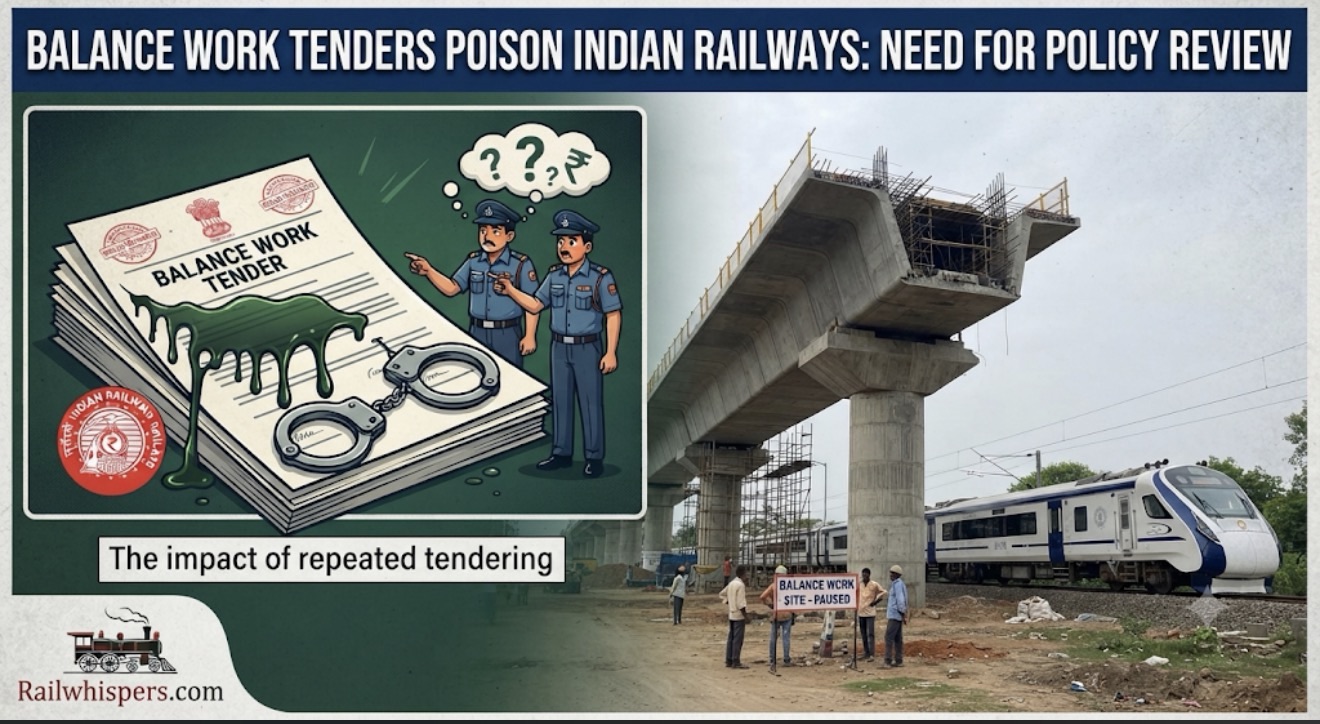
Balance Work Tenders Poison Indian Railways: Need for Policy Review
Serious questions have started arising over the practice of floating fresh “balance work tenders” for incomplete or remaining works during construction projects in Indian Railways. Experts and reviewers associated with this field believe that if the remaining work can be completed within the scope of the existing contract, the existing arrangement should be utilized instead of inviting fresh tenders. Repeatedly issuing new tenders not only causes unnecessary delays in projects but also creates a burden of increased administrative costs and disputes.
As a solution to this entire process, a three-tiered approach has been suggested. Under this, the first preference should be to explore variations of up to 50 percent within the applicable contract conditions. If, under any circumstance, it is not possible to complete the remaining work through permissible variations, a fresh tender should be floated. Additionally, in cases of urgent projects, the Railway Board should utilize its powers, subject to rules and approvals, to permit necessary variations so that the project can be completed without any unnecessary delay and dedicated to public use.
However, the implementation of this policy also raises a serious and sensitive question that requires thorough investigation. It is being questioned whether there are any commission percentages or other vested interests behind repeatedly floating balance work tenders instead of permitting allowable variations in the existing contract.
To ensure transparency in this direction, an independent vigilance review is required. Such a review should deeply investigate the reasons behind splitting unfinished works into fresh tenders, their financial implications, the decisions taken by officers, and whether undue benefit is being provided to any particular contractor through this. Instead of getting entangled in repeated tendering processes, Indian Railways must prioritize public service and public interest so that every balance work tender can be justified solely on the basis of actual necessity rather than any vested interest.