

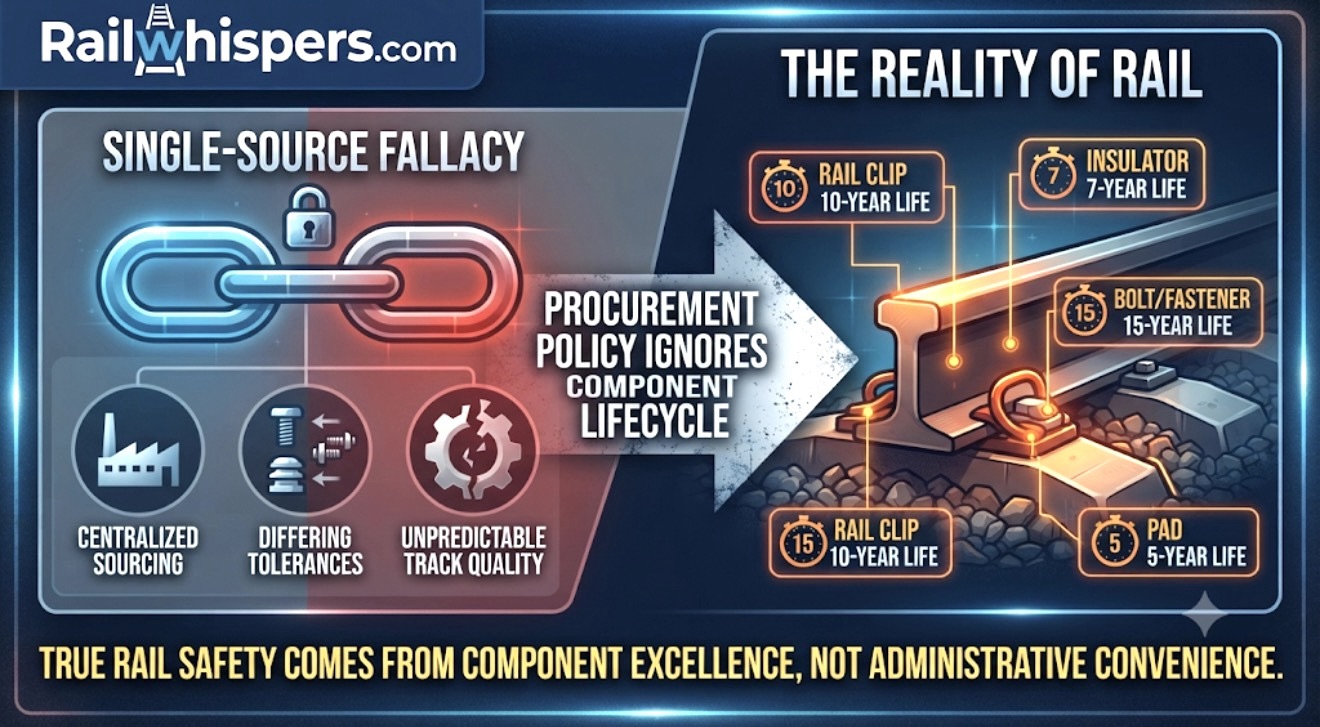
700 GMT Turnout Warranty vs. Actual Component Life: A Technical & Commercial Contradiction
Reassessing the Railway Board’s 700 GMT Turnout Warranty Policy in Light of Component Service-Life Limitations
Need to Align Component-Wise Service Life, RDSO Specifications and Warranty Obligations Under the 700 GMT Turnout Procurement Policy
Single-Source Turnout Procurement: Addressing the Technical Risks and Unfair Allocation of Replacement Liabilities
In a technical assessment, it is not realistically possible to guarantee that every individual turnout component will itself achieve 700 GMT without replacement or quality complaints under the existing RDSO designs and specifications, particularly when the Railway Board’s own policy acknowledges that several components have a substantially shorter expected service life.
The critical distinction is between:
- A complete turnout assembly remaining under warranty for 700 GMT or 15 years, whichever occurs earlier.
- Every individual component achieves a service life of 700 GMT without failure or replacement.
These are two entirely different requirements. The Railway Board’s policy—“Procurement of Complete Assembly of Turnout From a Single Source—Ref.: Policy Guidelines—dated 20.04.2026” appears to establish the first as the warranty period, while expressly recognising that individual components may require replacement much earlier.
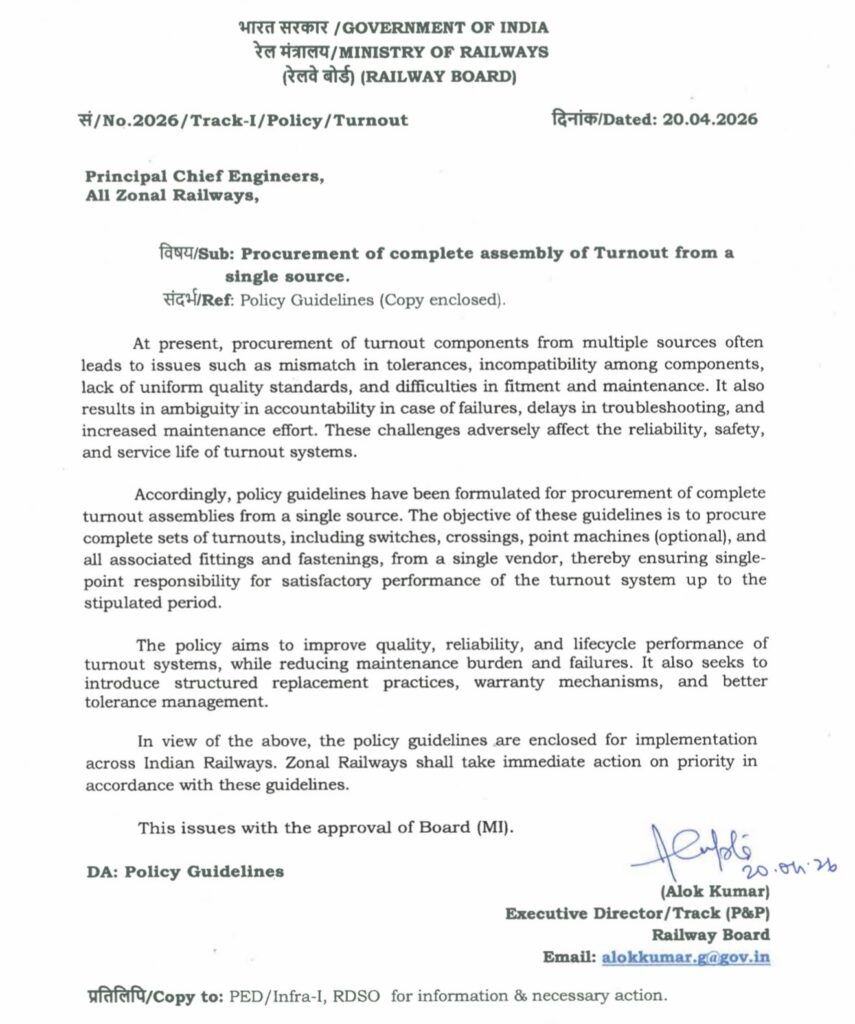
1. What the Railway Board’s own policy establishes
According to the service-life table on page 4 of the attached policy, the expected service life of various turnout components is as follows.
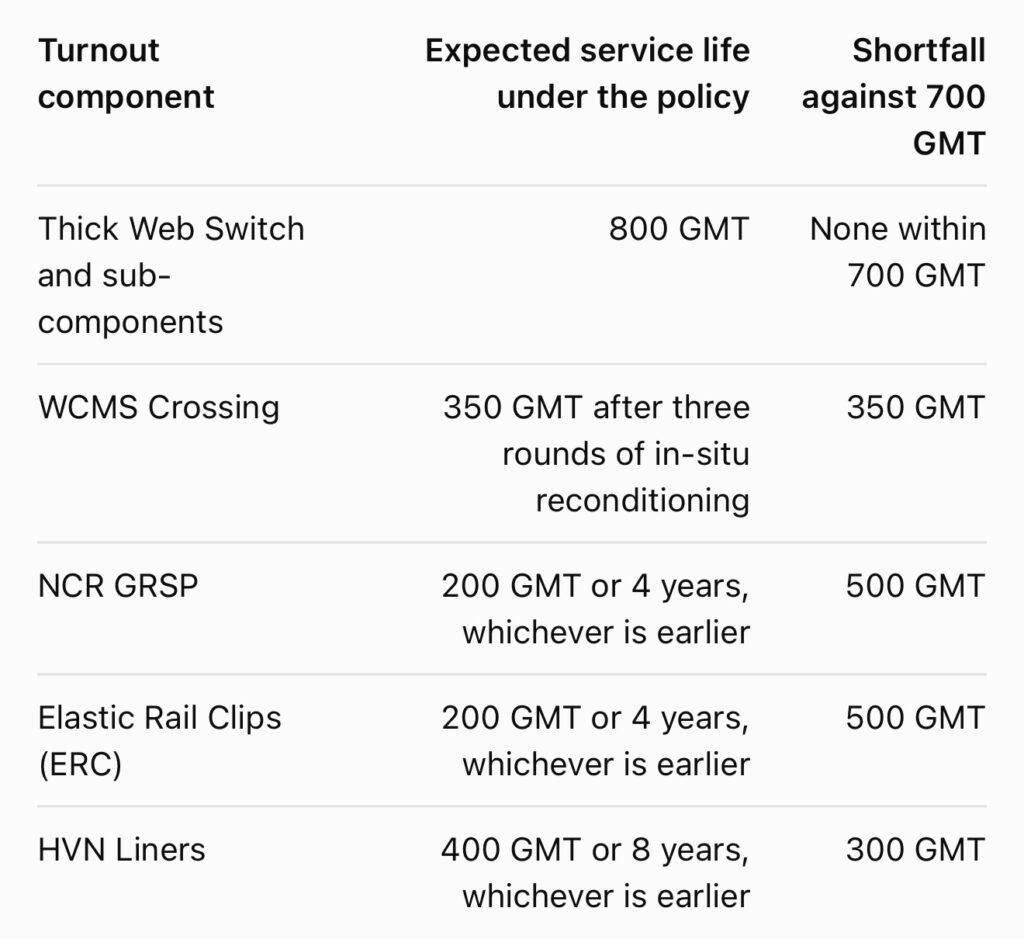
The policy itself further acknowledges that:
- The service life of NCR GRSP is not specified in the IRPWM; the policy assumes it to be equivalent to CGRSP, with the service life at special locations such as turnouts taken as 50%.
- The service life of HVN liners is not prescribed; the policy assumes 400 GMT or eight years, whichever is earlier.
- The policy expects certain components to require replacement during the warranty period because their design service life is shorter than the warranty period.
This is the central contradiction to examine: the complete turnout is covered for up to 700 GMT, but the policy’s own service-life assumptions anticipate that several components will not last for that entire period.
2. Does the policy require every component to last 700 GMT?
Not exactly. The wording of the policy needs to be read carefully.
Paragraph 4.8 on page 4 states that turnouts are being procured for service for 15 years or 700 GMT, whichever is earlier, and that the supplier must supply components required for replacement during this period. Paragraph 9.1 on page 8 specifies the warranty period for the complete turnout on the same basis.
Therefore, the policy does not expressly establish that every original component must independently last 700 GMT. Instead, it places responsibility on the complete-turnout supplier for supplying replacement components during the stipulated warranty period.
However, paragraphs 8.7 and 8.8 create a significant commercial and technical concern: they prescribe the number of payable replacement cycles for each component.
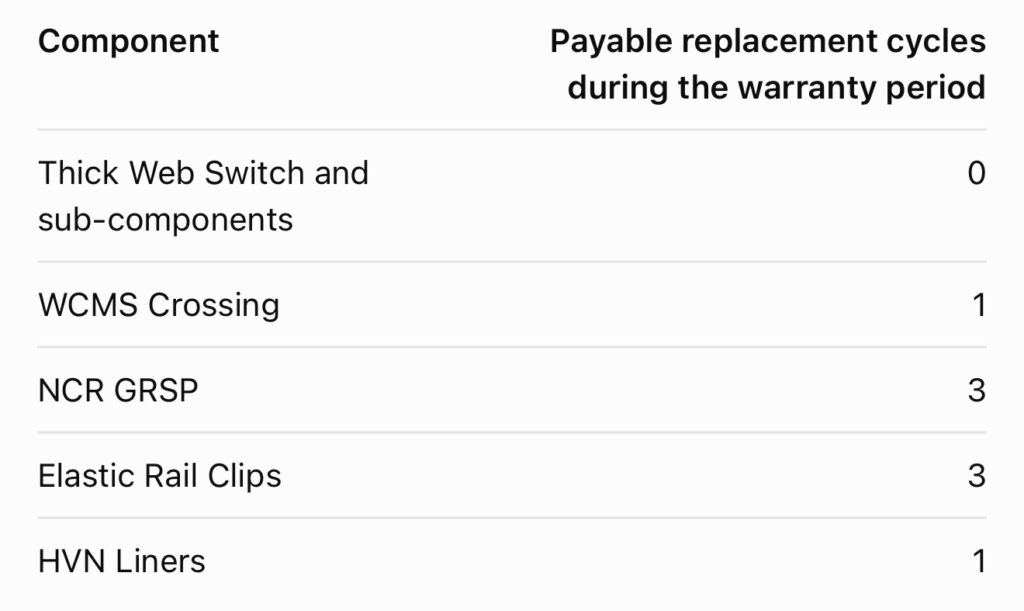
This means that the policy anticipates replacement requirements, but also limits the number of replacement cycles for which payment is admissible. Paragraph 8.7 further provides that no payment will be made for replacements exceeding the specified number of times during the warranty period. The policy also provides for recovery of replacement and installation costs in specified circumstances.
Consequently, the commercial risk for the supplier can be considerably greater than the risk associated with simply manufacturing a turnout to the existing approved specifications.
3. Can single-source procurement itself ensure 700 GMT performance?
No. Not at all. Single-source procurement, by itself, cannot extend the physical service life of a component beyond the limits of its design, material properties, operating conditions and approved specifications.
The policy’s objective is to bring the complete turnout under a single supplier’s responsibility. Nevertheless, paragraph 4.6 allows the principal supplier to submit joint undertakings with RDSO-approved or developmental manufacturers for components that it does not manufacture in-house. Paragraph 5.4 requires every component to comply with the applicable Indian Railway specifications and drawings.
This distinction is important:
- Single-source responsibility can improve coordination, compatibility, traceability and accountability.
- Improved quality control can reduce manufacturing defects and incompatibility between components.
- Longer service life requires the component to be capable of delivering that performance under the relevant operating conditions.
- A contractual warranty can allocate the financial consequences of premature replacement, but it cannot physically prevent normal wear or guarantee that no failure will occur.
For example, if an ERC is expected to have a service life of 200 GMT under the policy, merely purchasing it through a single turnout supplier does not establish that the same ERC will last 700 GMT. Achieving that result would require evidence that a revised or improved design can deliver the longer life while meeting the applicable safety and technical requirements.
Likewise, zero quality complaints cannot be guaranteed merely by changing the procurement arrangement. It is a performance objective that requires validation and effective quality assurance.
4. What would be technically and commercially necessary to make the policy achievable?
The following measures would be necessary to establish a credible basis for the proposed performance requirement:
- Component-wise service-life validation: RDSO should establish the required service life of every component against actual traffic loading, axle loads, route category, environmental conditions and maintenance practices. Any target beyond the existing service-life assumptions should be supported by testing and field-performance data.
- Review of existing designs and specifications: Where a component’s expected service life is substantially below 700 GMT, RDSO should assess whether changes in design, material, manufacturing process or technical specifications are necessary before imposing a corresponding performance obligation on the supplier.
- Realistic replacement and payment provisions: The number of replacement cycles, payment arrangements and supplier liabilities should reflect the technically established service life of each component. Unforeseeable or excessive replacement requirements should not be transferred to the supplier without an evidence-based contractual and pricing framework.
- Field trials and measurable acceptance criteria: Any proposed improved-life component should undergo suitable validation under representative railway operating conditions. The Railway should distinguish manufacturing defects, premature component failures, normal wear, installation issues and damage caused by accidents or operating conditions.
- Clear allocation of responsibility: A complete-turnout supplier can reasonably be responsible for integration, compatibility, traceability and contractual performance. However, the procurement policy should clearly distinguish these obligations from a claim that every component will inherently achieve 700 GMT without replacement.
These are technical recommendations based on the provisions of the attached policy, rather than additional requirements expressly mandated by the document.
5. The strongest argument against imposing an unconditional 700 GMT obligation
The strongest argument is not that a 700 GMT warranty for a complete turnout is inherently impossible. It is that the warranty obligation must be consistent with the expected service life, approved specifications and replacement provisions applicable to its individual components.
The policy already recognises shorter component lives and provides for replacement. Consequently, it would be inaccurate to interpret the 700 GMT warranty as a promise that every component will remain serviceable for the entire period without replacement.
At the same time, if a supplier is expected to bear the cost of all replacements beyond the prescribed payable cycles, the contract may expose that supplier to liabilities that are not proportionate to the normal service life of the approved components.
This concern is particularly relevant where the Railway continues to prescribe the component design and specifications, while placing complete-turnout performance responsibility on a single supplier.
Conclusion:
Single-source procurement can improve accountability and may improve overall turnout performance, but it cannot, by itself, establish a technically substantiated 700 GMT life for every component or ensure zero quality complaints. Before imposing such an obligation, Indian Railways should reconcile the component-wise service-life assumptions, RDSO specifications, replacement-cycle provisions and the financial liabilities imposed on the complete-turnout supplier.
That is the substantive issue to raise with the Railway Board: not simply whether the warranty period should be 700 GMT, but whether the technical standards and contractual risk allocation provide a fair and demonstrable basis for delivering it.