

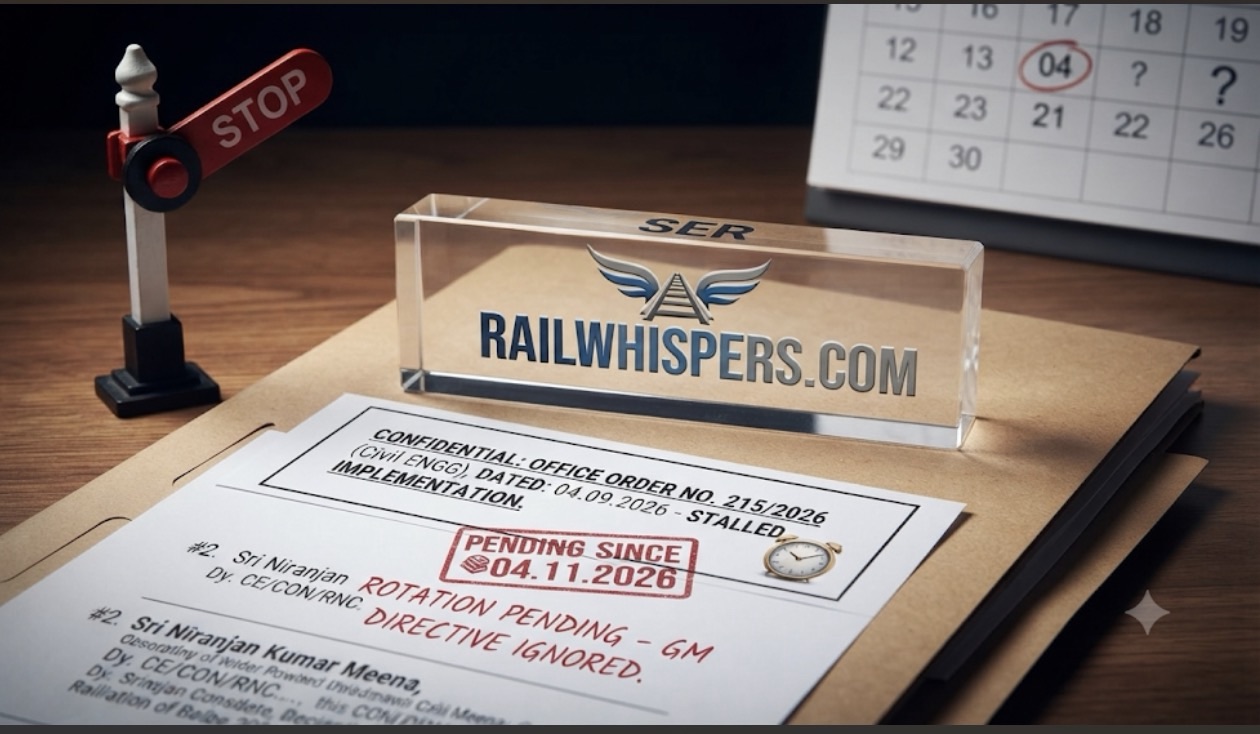
Defying Directives: Two Months On, SER Fails to Implement Transfer Order of Dy.CE/C/Ranchi
Kolkata: Nearly two months have passed since the South Eastern Railway (#SER) issued an official personnel directive—Office Order No. 215/2026 (Civil ENGG), dated 04.09.2026—yet key administrative rotations remain stalled. Among them, the transfer order concerning Niranjan Kumar Meena, Dy. CE/CON/RNC (PC: 03SE5P027), who was slated to move as Dy. CE/TM/Line/KGP, continues to face inexplicable delays and blatant non-compliance.
The ongoing impasse has raised serious questions regarding administrative accountability, governance standards, and the growing influence of extraneous considerations within railway administration.
Anatomy of the Order and the Stalled Rotation
Issued under the approval of the General Manager, SER, the September 4 order outlined routine and vital administrative rotations across divisions. Item No. 2 of the directive explicitly mandated the transfer of Niranjan Kumar Meena from his current construction assignment in Ranchi to Kharagpur.
However, unlike standard transitions where charge relinquishment and assumption reports are promptly executed, this directive has met with unyielding resistance and administrative paralysis. Critics note that when official orders can be sidelined indefinitely, it sets a dangerous precedent where accountability is subordinated to individual convenience and vested interests.
The Critical Need for Regular Rotation in Public Administration
The prolonged delay in executing routine transfers highlights a broader systemic malady: the reluctance to enforce periodic rotation policies. Regular transfer and rotation mechanisms are foundational pillars of public administration, designed to:
- Prevent Vested Interests: Long tenures in a single sensitive construction or project post often foster cozy vendor-officer nexus networks, reducing transparency and increasing vulnerability to corruption.
- Ensure Operational Dynamism: Periodic rotation infuses fresh perspectives, revitalizes project execution timelines, and brings diverse field experience to critical infrastructure roles.
- Maintain Institutional Integrity: Upholding transfer policies reassures the public and honest workforce that rules apply equally to all, regardless of an individual’s backing, reach, or leverage.
When an official directive issued with the explicit approval of the General Manager is allowed to hang in limbo for nearly two months, it makes a mockery of governance. Observers aptly question: if established administrative guidelines and transfer orders can be treated with such contempt, what message does it send about the command-and-control structure of the railway machinery?
Accountability Under the Scanner
The continued inaction despite the matter being raised across multiple forums exposes a disturbing vacuum of leadership courage. Questions are mounting across administrative circles:
- Who is shielding this defiance of a formal headquarters order?
- Why does the railway administration appear utterly helpless or compromised when faced with individual resistance to routine transfers?
- When will the competent authorities step in to fix responsibility and enforce immediate execution?
An order cannot be reduced to a negotiation or a joke simply because certain individuals choose to ignore it. To restore faith in administrative integrity and uphold the rule of law within Indian Railways, the competent authorities must intervene immediately, end this disgraceful impasse, and ensure the strict, uncompromised execution of the transfer directives in accordance with applicable rules.