

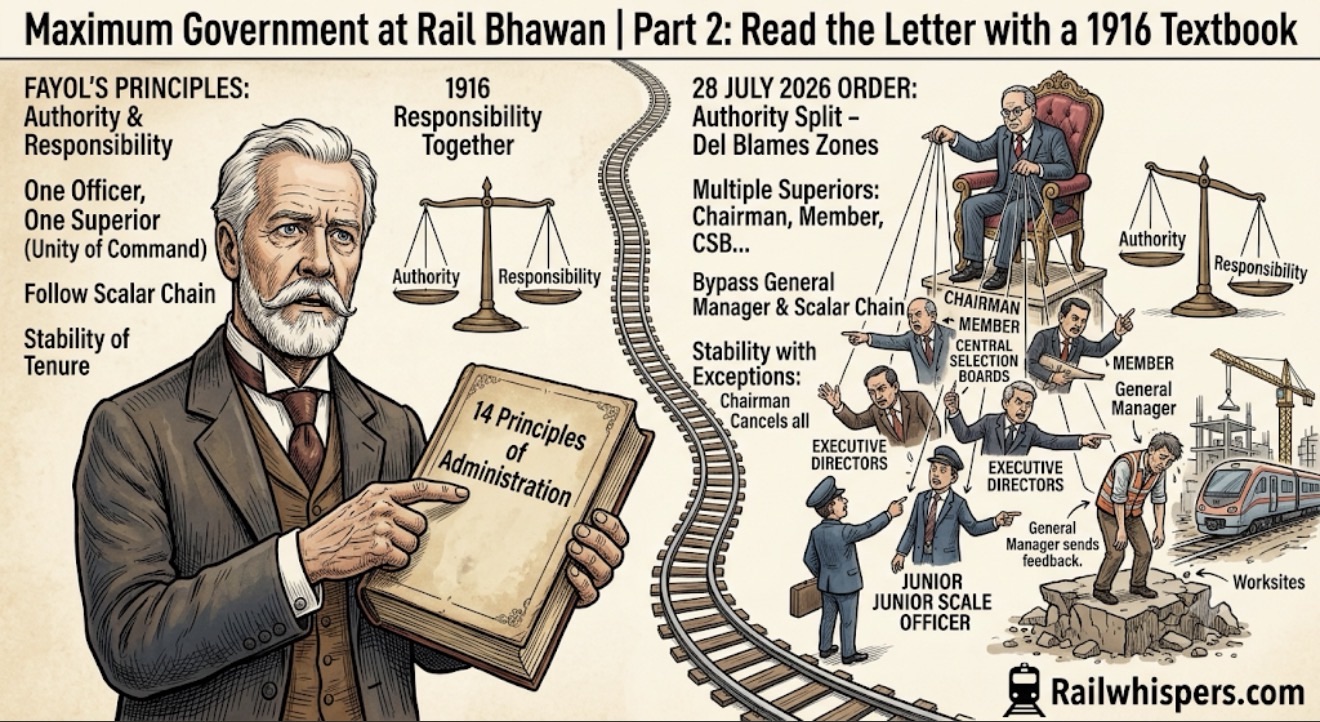
Maximum Government at Rail Bhawan | Part 2: Read the Letter with a 1916 Textbook
A French mine manager wrote the rules of administration 110 years ago. The construction posting order of 28 July 2026 breaks four of them, and cancels the one it keeps
The letter, once more
On 28 July 2026 the Railway Board sent every General Manager a new structure for the construction organisation. Central Selection Boards in Delhi will pick construction officers of every department from Junior Scale to NF-HAG, tenure runs five years extendable to seven, and transfers at the top need the Chairman. The zone sends feedback.
These pages read that letter clause by clause a month ago (11 August 2026, “Maximum Government at Rail Bhawan—Damn What the Prime Minister Said”). Ten new layers were counted between an officer and a worksite. That count stands, and this piece does not repeat it.
This piece asks a different question, which is what happens when the letter is set beside the oldest textbook of management there is, and how many of that textbook’s rules survive the reading.
Concede the problem first, as before, because officers do move too often and a bridge engineer who leaves before the girders arrive owns nothing. The Board named a real defect.
Now open the textbook.
Fayol, and why he still counts
Henri Fayol ran a French mining and steel company for thirty years and in 1916 wrote down what he had learned, as fourteen principles of administration. Every management course in the world since has taught some version of them, usually in the first fortnight and usually without the name.
They are not theory so much as the accumulated scar tissue of a man who had to keep a mine open and a payroll met, which is why they last.
Five of the fourteen bear directly on this letter. Take them in order.
One. Authority and responsibility travel together
Fayol’s first structural rule is that whoever carries the responsibility must hold the authority, and whoever holds the authority must carry the responsibility, because the moment they are split one side gets the blame while the other side gets the choice.
Now read clause 4, item v, of the letter. “ZR will provide feedback of officer for perusal of concerning Member.”
The General Manager answers for every project in the zone, for a collapsed girder, a delayed commissioning, a death on site and a question in Parliament. Under this letter the same General Manager does not choose the officer, does not retain the officer, and does not transfer the officer. Clause 5, item i, sends transfers at Junior Administrative Grade and below to the Member, and at Senior Administrative Grade and above to the Chairman.
The General Manager sends feedback.
The responsibility stays in the zone while the authority has gone to Delhi, and Fayol wrote that split down as the first thing to avoid, during a war, in 1916.
Two. One officer, one superior
Unity of command means that an officer receives orders from one superior and only one, and Fayol thought it the rule most often broken and most costly when broken, because dual command breeds hesitation and hesitation breeds evasion.
Count the superiors a construction officer now has. The controlling officer who co-signs the monthly Key Result Area. The Central Selection Board that decides retention after year five. The Member who approves transfers at JAG and below, and the Chairman who approves them above. The General Manager whose feedback the Member peruses. And clause 8, which places the Chairman above all of it in administrative interest.
That is not one superior but a committee, spread across two cities, none of whom sits at the worksite.
An officer with five masters serves the one who can hurt him most. On this letter, that master is 1,000 kilometres from the girders.
Three. The scalar chain, and who may step over it
Fayol drew the line of authority from the top of the enterprise to the bottom and called it the scalar chain, down which orders go and up which reports come. He allowed one shortcut, between two officers at the same level so long as their superiors knew, and he called it the gang plank.
What he did not allow was the top of the chain reaching past every link to place a hand on the bottom.
That is what this letter does. A Junior Scale officer, the lowest gazetted rung, is now selected for a zonal construction post by a board of Executive Directors in Delhi. The General Manager, who on every other day posts every officer up to Junior Administrative Grade inside that zone, is stepped over. So is the Principal Head of Department. So is the Chief Administrative Officer for Construction.
The chain has not been shortened. It has been bypassed, from the top, by the highest office in it, for the smallest posting in it.
Four. Centralise to the right degree, not the greatest
Fayol was no enemy of the centre, and he wrote that the question is never whether to centralise but how much, with the answer depending on where the knowledge sits. Decide where the facts are.
Where are the facts about a Junior Scale engineer? In the division that watched him hold a block and in the zone that saw him handle a contractor, not in a portal, and not in an interaction with two Executive Directors who will meet 100 candidates in a week and call it selection.
The letter centralises the one decision that Delhi is worst placed to make, and leaves in the zone the accountability for what follows. Fayol would have called that the wrong degree.
Five. Stability of tenure. The rule the letter keeps
Here the letter is right, and it deserves to be said, because Fayol held that a stable managerial cadre is the mark of a well run concern and that constant turnover is both a cause and a symptom of bad running. Five years on a project is sound doctrine, and seven is generous but defensible.
Then read clause 5, item iii. Natural transfers on promotion to Divisional Railway Manager, Principal Head of Department, General Manager and Additional Member are preserved.
Then read clause 8. The Chairman has full powers for retention and posting, notwithstanding everything above.
So the one Fayol rule the letter adopts binds the officer who is not promoted and does not bind the Chairman who might move him tomorrow, which comes to stability of tenure for the passed over and discretion at the top.
The letter kept one rule. Then it took it back.
The wall that carries the load
Now step back from the textbook and examine the building.
Indian Railways runs on one line of command. The General Manager runs the zone, the Divisional Railway Manager runs the division, and every train, every kilometre of track, every locomotive shed and every signal answers up that line and no other. The Railways Act knows one office in the zone, and it is the General Manager’s.
That is settled wisdom, and it is settled because it has been tested. These pages set it out last October (25 October 2025, “What is the role of a Division, Zone and Railway Board: Getting Basics correct, Part-I”). A division is an operating and maintenance unit whose whole attention goes to running trains safely, while capacity is built by the construction organisation, under the General Manager, and handed over. The rule that guided every generation of railway managers was to leave that architecture alone.
The same pages recorded what happened when it was not left alone. Gati Shakti Units were placed inside divisions as a branch, reporting to Delhi through the DRM, while open line construction still reported to the GM, so that one division carried two chains, and the result was recorded as a body blow to divisional working.
This letter repeats that error one level up. It takes the construction officer out of the General Manager’s hand while every commissioned asset still lands in the General Manager’s zone and the Divisional Railway Manager’s division. The wall still carries the load. The letter has removed the bricks from the side nobody was looking at.
Fayol had a name for this too, unity of direction, meaning one head and one plan for every group of activities with the same object. A zone is one such group, and a zone with its construction officers chosen in Delhi has two heads and, before long, two plans.
Who was in a position to prevent this?
Not who is to blame, but who could have stopped it.
The letter says the structure was “comprehensively reviewed and deliberated at the apex level”. Any General Manager at that table could have asked one question. Which of Fayol’s rules does this keep?
The answer was one, and clause 8 was already drafted.
Take the letter back to the table. Test it against a textbook that any Probationer at the National Academy can quote from memory. Then write it again.
IndianRailways #RailwayBoard #ConstructionOrganisation #GeneralManager #DRM #Fayol #UnityOfCommand #MaximumGovernance