

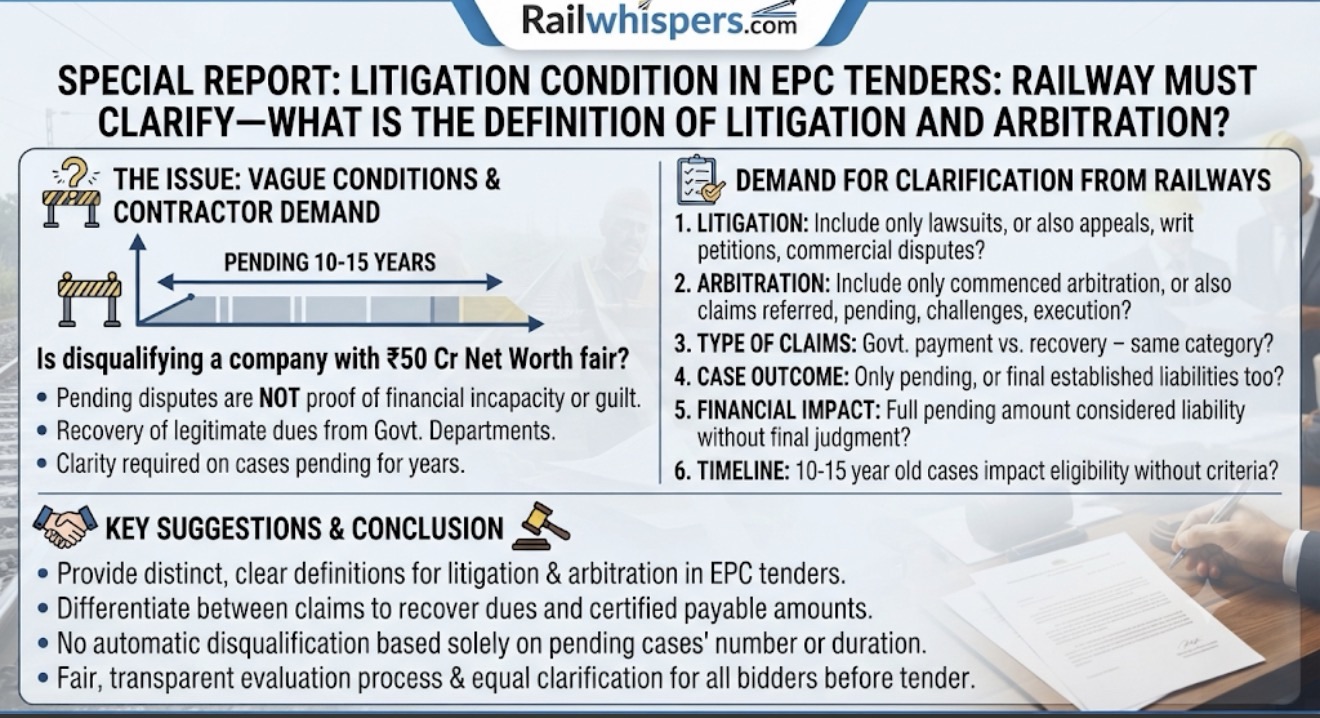
Special Report: Litigation Clause in EPC Tenders: Railway Must Clarify—What is the Definition of Litigation and Arbitration?
Questions are being raised over the provision linking pending #arbitration and #litigation cases to contractors’ eligibility in Engineering, Procurement, and Contract (#EPC) tenders. Contractors from the construction sector are demanding that before including such conditions in tenders, the Railways must clarify: What do litigation and arbitration mean? Which cases will be counted under them, and under what circumstances can a company be disqualified?
The Case of a Company with a Net Worth of ₹50 Crore
If a company has a net worth of ₹50 crore and its arbitration cases for recovering legitimate dues from Railways or other government departments have been pending for the last 10–15 years, would it be appropriate to disqualify it from EPC tenders solely on the grounds of these pending cases?
Contractors argue that pending disputes are neither proof of financial incompetence nor of any wrongdoing by a company. Disputes regarding payments, extra work, contract interpretation, and price escalation can arise with government departments, which may remain pending for years.
Railways Must Clarify First—What are Litigation and Arbitration?
Experts believe that simply writing the words “litigation” or “arbitration” in tender documents is not sufficient. The Railways must provide clear and detailed definitions so that all bidders can understand the same rule in a uniform manner.
The Railways must provide clear answers to the following questions:
- Litigation: Will this include only lawsuits pending in courts, or will appeals, writ petitions, commercial disputes, and other judicial proceedings also be included?
- Arbitration: Will this include only arbitration proceedings that have commenced, or will claims referred for arbitration, pending arbitrations, challenges against passed awards, and award execution proceedings also be included?
- Type of Claims: Will a case filed to recover one’s payment from a government department and a case initiated by a government department to recover dues from a contractor be counted in the same category?
- Outcome of the Case: Will only pending cases be counted, or will contractual violations and liabilities established in final judgments also affect eligibility?
- Financial Impact: If a company has a net worth of ₹50 crore, will the entire amount of claims pending against it be considered a liability, even if the dispute has not been finally adjudicated?
- Timeframe: Will cases 10–15 years old also be allowed to impact eligibility without any additional criteria?
Without clarity on these issues, vague conditions could lead to varying interpretations across different tenders and raise concerns of unequal treatment among bidders.
If the Government Has to Pay Money, Separate Action Should Be Taken
According to the policy proposed by contractors, if money is owed by a company to the Railways or another government department and its liability is duly established, its financial assessment should be carried out in accordance with applicable rules. Under relevant tender conditions, where necessary and permitted, such liability can be included in the evaluation of the company’s financial capacity and eligibility.
Conversely, if a company is pursuing arbitration or litigation to recover its legitimate dues from a government department, that proceeding alone should not be made an automatic basis for disqualification against it.
This distinction is particularly important because making a claim by a company, the pendency of a claim, and the final establishment of a liability are three different situations.
Rights of Officials and Contractors
Government employees can also resort to courts for promotions, pay scales, and benefits related to the 6th, 7th, and 8th Pay Commissions. Similarly, contractors should also get the opportunity to adopt available legal remedies for the protection of their contractual rights.
Fighting a legal battle does not amount to being guilty in itself. If grounds for fraud, serious contractual breach, or other disqualification exist in a case, it should be decided according to applicable rules and relevant facts.
Some Important Suggestions
- Separate, clear definitions/interpretations of litigation and arbitration should be provided in EPC tenders.
- It should be specified which judicial and arbitration proceedings are mandatory to disclose.
- A distinction should be made between claims for recovering dues from government departments and certified amounts payable to the government.
- Automatic disqualification should not occur solely based on the number or duration of pending cases.
- Clear criteria, justifiable reasons, and a fair evaluation process should be established for disqualification.
- A uniform clarification should be made available to all prospective bidders before issuing the tender.
Conclusion
The objective of the Railways should be to select competent and financially strong contractors and protect government funds. For this, clear definitions and objective criteria are required instead of vague conditions.
The Railways should clarify what litigation is, what arbitration is, which cases will be counted under them, and on what basis a company will be considered ineligible.
Rules should be framed such that genuine financial security of the government is ensured, but contractors fighting legal battles for their legitimate dues should not be forced out of competition solely for this reason.
The Railways should also clarify how cases related to debarment, blacklisting, or any other penal action pending in courts will be viewed while determining eligibility for EPC tenders. If a company has challenged a blacklisting or debarment order issued against it in court and the matter is sub judice, will the company be disqualified solely due to the pendency of that lawsuit, even if the court has stayed the order? The Railways must clarify how the status of the original order, stay orders or other interim relief granted by the court, and the final decision will be taken into account in such cases.
Similarly, departmentally, if a blacklisting or debarment proceeding against a company is currently only proposed and no final order has been passed, what will be the basis for considering it guilty? There must be a clear distinction in tender conditions—pending allegations, passed orders, court-stayed orders, and finally effective debarment are different situations. Clear, transparent, and uniformly applicable criteria must be established for all these, so that along with protecting government interests, companies also receive the right to a fair hearing and judicial remedy.