

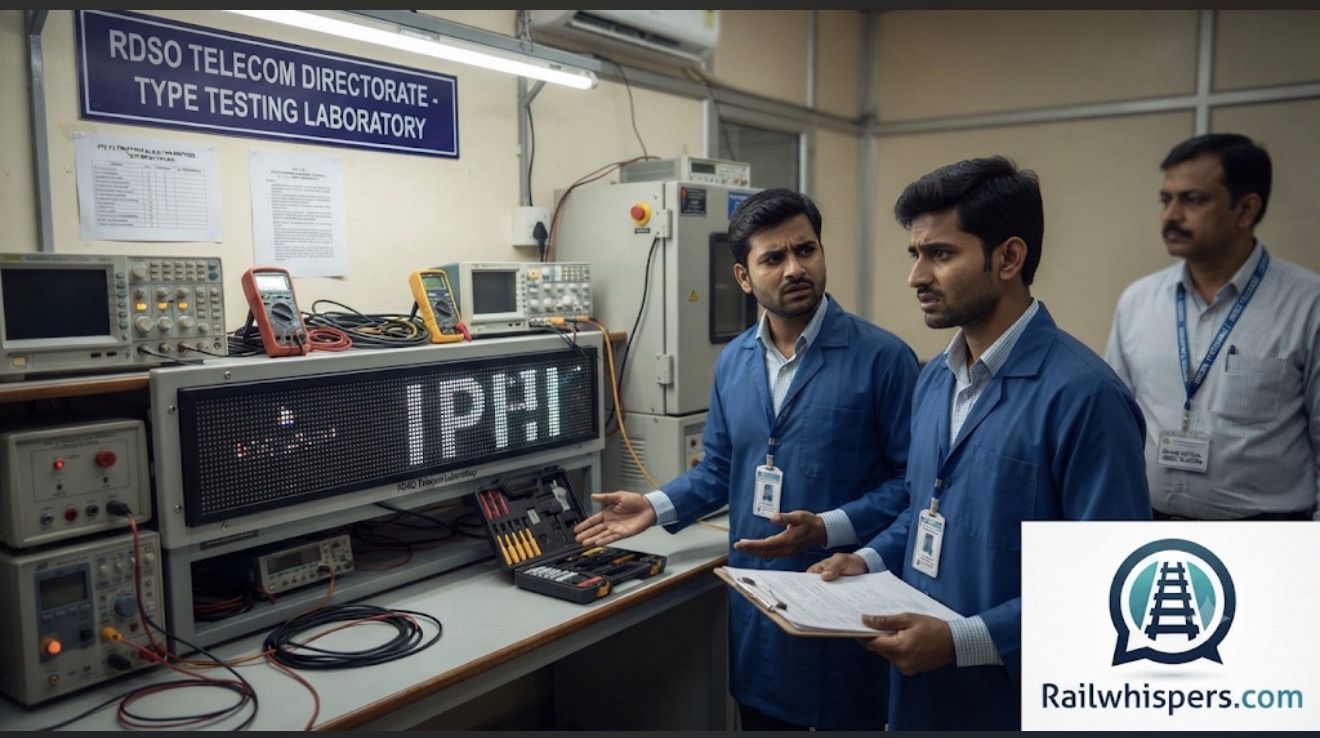
Allegations of Discrimination in IPIS Testing: A Question Mark on RDSO’s Functioning!
Procedural Disparities and Fair Treatment Concerns Surface Over Railway Testing Approvals
Controversy has emerged regarding allegations of selective procedural enforcement during equipment type testing directed specifically against ED/Tele-1/RDSO. The dispute centers on the handling of prototype evaluations for advanced integrated passenger information systems (#IPIS) by the Telecom Directorate, where stakeholders have raised serious questions concerning equitable treatment and consistency in administrative standards.
According to representations submitted to the RDSO Telecom Directorate, an eligible vendor completed compliance documentation submission, facility inspections, and the dispatch of prototype samples for advanced integrated passenger information systems. Following the delivery of these prototypes to the designated testing laboratory, officials reportedly identified a minor technical discrepancy involving a single light-emitting diode during environmental testing procedures.
However, representatives for the affected firm stated that they were only informed of this issue verbally, without receiving formal documentation detailing specific test observations or formal grounds for rejection. Furthermore, technical personnel stationed on-site to address potential laboratory contingencies were reportedly denied the opportunity to implement immediate remedial adjustments to the component in question. They also alleged that if the approved prototype of eight agencies is tested in any outside laboratory, like NABL, all will be failed.
The core of the grievance involves comparisons to established precedents within the regulatory body. Industry participants and stakeholders have noted that multiple previously approved vendors were routinely granted opportunities to rectify minor operational glitches encountered during laboratory testing phases. The denial of a corresponding remediation opportunity in this instance has prompted formal requests for a review based on principles of consistency, administrative transparency, and non-discriminatory treatment.
Observers and industry stakeholders emphasize that these requests do not seek any dilution of rigorous technical specifications, performance standards, or quality control frameworks. Rather, the appeal focuses strictly on ensuring that standard procedural practices and remedial allowances are administered uniformly across all market participants by RDSO. The ongoing situation underscores broader administrative challenges regarding standardization and fairness in technical evaluations within critical infrastructure procurement channels.