

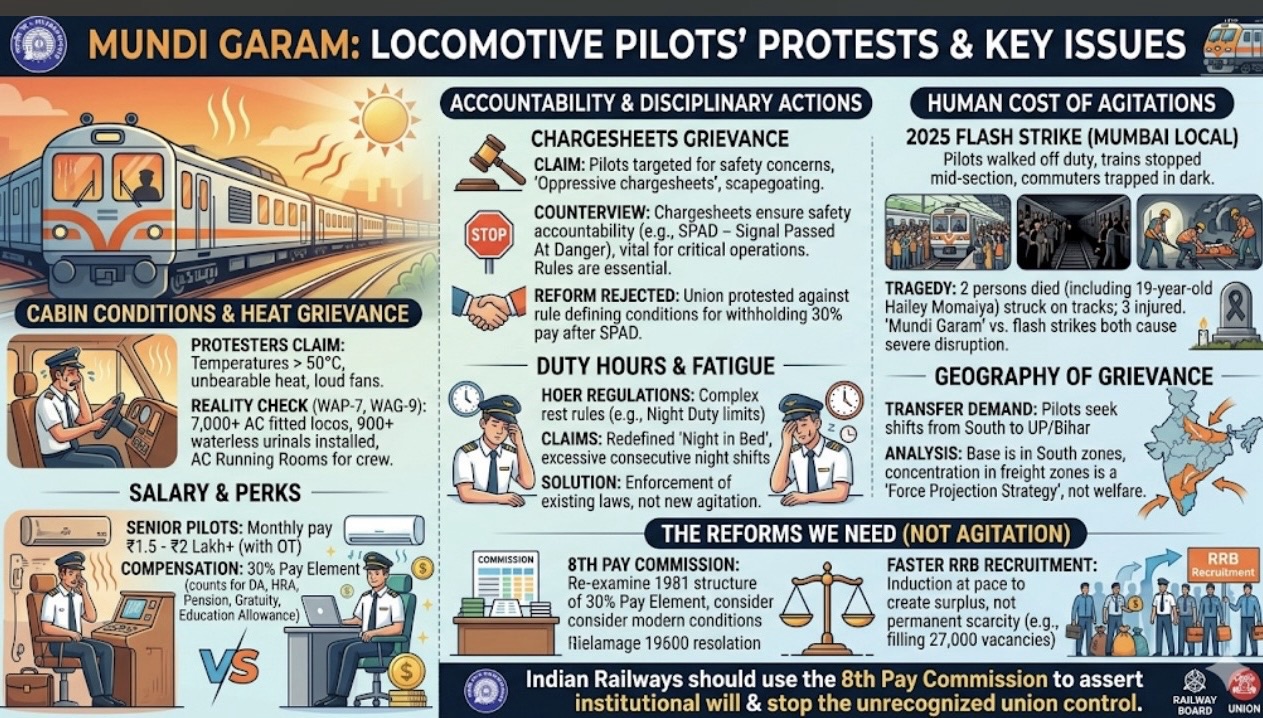
“Mundi Garam” : The Well-Fed Martyrs of the Locomotive Cabin
The union that never won recognition has perfected something better — the permanent agitation. Here is what its latest performance actually cost, and who paid
Coming on the heels of protest by Central Railway’s Guards (we reported on 15th May: “Central Railway Guards-Bell Protest—Highly Paid but the Public Interest & Accountability Zero! Part-1”, on 17th May: “Central Railway Guards-Bell Protest—Highly Paid but the Public Interest & Accountability Zero! Part-2”, on 18th May: “Central Railway Guards-Bell Protest—Highly Paid but the Public Interest & Accountability Zero! Part-3”, on 20th May: “सेंट्रल रेलवे: गार्डों का बेल विरोध—मोटा वेतन, लेकिन जनहित और जवाबदेही शून्य! भाग-4”, on 21st May: “सेंट्रल रेलवे: गार्डों का बेल विरोध—मोटा वेतन, जनहित-जवाबदेही शून्य, और अब “ईमेल-बमबारी!” भाग-5”.
We received a video by the protest by Locomotive Drivers and Assistant Drivers, who got themselves designated as Loco Pilots and Assistant Loco Pilots:
Information came from a source in Pune Division. We took opinion of a senior retired officer with rich experience of operations. Following was made with his inputs.
The Theatre Arrives at the DRM’s Gate
They called it “Mundi Garam” — heated head. Outside the Divisional Railway Manager’s office in Pune, a crowd of loco pilots (#LP) and assistant loco pilots (#ALP) gathered to “perform” outrage. The speeches were fierce. The banners were many. The grievances arrived in a neat charter: “unbearable cabin temperatures, oppressive chargesheets, manipulated rest rules, unconscionable duty hours, and — this one delivered with particular passion — no toilets in locomotive cabs.” The unrecognised union that organised the event has been staging versions of this theatre since the 1970s. The venue changes. The charter stays, more or less, the same. And the administration, more or less, folds.
Before it folds again, it is worth examining each item on the charter — not with sympathy, but with arithmetic.
The Oven That Pays ₹2 Lakh a Month
The headline grievance, the one that gave the protest its name, is heat. Cabin temperatures, protesters declared, cross 50°C in summer, turning locomotives into metal ovens. Fans are noisy and useless. Air conditioning is absent or broken. The physical toll is unbearable.
Some of this is true of older rolling stock. None of it describes the trajectory of the fleet. Modern locomotives — the WAP-7s and WAG-9s that now constitute the bulk of mainline operations — are inducted with air-conditioned cabs. Over 7,000 locomotives have been retrofitted. Waterless urinals have been installed on more than 900 engines, addressing the toilet demand for the majority of the operational fleet. Running rooms — where crews rest at outstations — are now entirely air-conditioned. Meals at running rooms cost ₹5.00 per plate.
The charter presents the worst case as the universal condition. That is not a grievance. That is a framing device. A genuinely distressed workforce presenting genuine data would distinguish between the old WAM-4 hauling a goods rake and a new Vande Bharat cab. This one does not, because the conflation is the point. And in the meantime, the senior loco pilot presenting this charter takes home gross monthly emoluments of ₹1.5 to 2 lakh — more, with overtime, than the Branch Officer above him — sustained by a 30% #pay-element that counts toward his #DA, his #HRA, his children’s #education allowance, his #pension, and his #gratuity, regardless of whether he drives a single kilometre.
Accountability, or as They Call It, Oppression
The chargesheet grievance deserves particular scrutiny. Speakers at Pune alleged that drivers who raise safety concerns are targeted with retaliatory disciplinary action, accumulating penalties of ₹4 to 5 lakh. The administration, they said, uses chargesheets to turn running staff into scapegoats.
A chargesheet is issued when there is a prima facie case of a rule violation. In a safety-critical environment — where a loco pilot passing a signal at danger can kill hundreds — the instrument of the chargesheet is not an act of oppression. It is the basic mechanism of accountability.
The demand, stripped to its core, is that running staff be insulated from disciplinary consequences for operational failures. Railway Board actually conceded part of this in 2025, when an order was issued defining conditions under which the 30% pay element could be withheld after a Signal Passed At Danger (#SPAD) incident. The #Union promptly agitated against that order too. When every enforcement of rules is recast as #victimisation, the word “victimisation” has lost its meaning.
The Sleep-Deprived ₹2 Lakh Man
The rest-rules grievance has genuine technical substance, and it is worth acknowledging that. The Hours of Employment Regulations have been contested terrain for decades. The claim that the administration redefines “Night in Bed” to cover only 12 AM to 4 AM, then resumes calls immediately after, represents — if accurate — a real violation of statutory protections. Requiring three to five consecutive night shifts where regulations specify a maximum of two is not an abstraction. Fatigue is a documented contributor to accidents.
But here is the problem. This union has been demanding an eight-hour duty cap on freight and a six-hour cap on passenger operations since before most of its current members were born. Successive pay commissions, review committees, and high-level safety panels have examined and partially addressed these concerns. The administration has repeatedly been directed to comply with #HOER. If, after fifty years of agitation, rest rules are still being violated systematically at Pune Division, the answer is enforcement of existing law — not a fresh round of theatre outside the DRM’s gate. And if the union’s actual interest were in enforcement rather than perpetual leverage, it would have filed statutory complaints through the Labour Commissioner rather than staging a street protest designed for cameras.
What the Agitation Looks Like When It Kills Someone
In November 2025, when running staff on Central Railway’s suburban section walked off their duties in a flash agitation, trains stopped mid-section across the Mumbai suburban Main Line. Commuters trapped on stationary rakes climbed onto the tracks in the dark. Hailey Momaiya, nineteen years old, was struck and killed between CSMT and Sandhurst Road. An unidentified man died beside her. Three others were injured. The Kalyan local scheduled to leave at 5.52 pm finally moved at 6.40 pm. By then there were bodies at J J Hospital.
Six months later, on the same line, #guards called a “work-to-rule” over a #safety circular asking them to ring a bell before a scheduled halt. Three evening peak services were cancelled. The administration shelved the safety circular within forty-eight hours.
The pattern is not specific to one union or one agitation. It is systemic. Running staff—loco pilots, guards, motormen—know that Mumbai’s over 80 lakh daily commuters, or a national freight corridor, cannot absorb a day’s disruption. That knowledge is the weapon. The “Mundi Garam” protest at Pune is the polished version. The November flash strike was the unpolished version. Both operate on the same premise: “that operational disruption has no cost to those who cause it, only to those who suffer it.” Hailey Momaiya’s parents would disagree. They have no union.
The Geography of Grievance
One demand from the charter that received less coverage than the cabin temperatures deserves more: the demand for transfers from southern posting zones to UP and Bihar. Framed as proximity to home, it is operationally something else entirely. This union’s organisational base lies in Kerala, Tamil Nadu, and Andhra Pradesh—the zones where it was founded and retains its deepest penetration. Concentrating that mobilised cadre in zones where freight disruption carries national implications is not a welfare measure. It is a force-projection strategy. Railway Board’s posting policy exists for operational and administrative reasons. It should stay that way.
The One Reform They Will Never Demand
Across every speech at Pune, across every press statement this union has issued in fifty years, there is one demand that has never appeared: a review of the 30 percent pay element in light of changed conditions.
That element — embedded in the pay structure since 1981 — was designed to compensate for the demands of running duty. It counts toward DA, HRA, leave salary, pass entitlements, pension, and gratuity. It survives medical de-categorisation: “a loco pilot declared unfit to drive in under fifteen years of service retains the 30 percent in his pay and carries it into his pension.”
The 8th Pay Commission will sit. Senior officers and finance ministry officials have already begun saying, in corridors if not in writing, that the 1981 structure requires re-examination. That examination should happen openly, with data on de-categorisation timelines, on the fiscal outgo of the pension tail, and on the genuine comparative compensation of loco pilots against equivalent central government technical cadres.
Faster #RRB recruitment cycles — induction at a pace that creates capacity surplus rather than permanent scarcity — would, within one commission cycle, dissolve the 27000-vacancy leverage that makes every agitation viable. That, more than any chargesheet or circular, is the structural fix.
The Mundi Garam protest is already over. The next one is already being planned. The administration that responds to it by reviewing the demand charter rather than the pay charter will be having the wrong conversation — again.
The unrecognised union runs Indian Railways because Indian Railways lets it. The 8th Pay Commission is the window to stop. Whether Railway Board chooses to use it is a question of institutional will, not institutional knowledge. They know. The question is whether, this time, knowing is enough.