

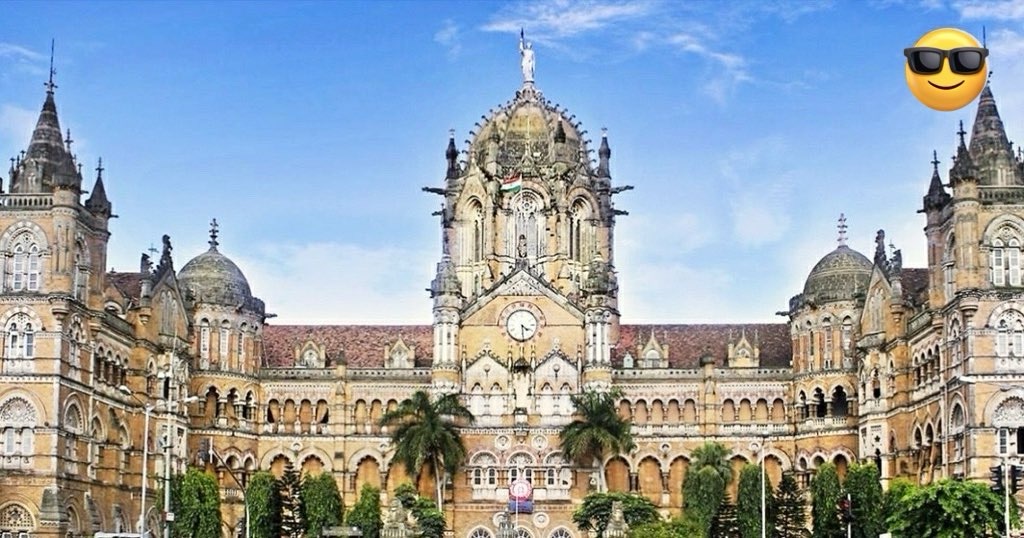
Central Railway Guards-Bell Protest—Highly Paid but the Public Interest & Accountability Zero! Part-1
How Mumbai’s Best-Paid Railwaymen Hold the City Hostage Over a Bell & Blackmail The Administration?
Hailey Momaiya was nineteen. On 6 November 2025, between CSMT and Sandhurst Road, she was killed by a Central Railway local that hit her as she walked along the tracks. She had not chosen to walk them. Her train, like dozens of others on the Main line that evening, had been stopped mid-section because the motormen at CSMT had decided, around 4.30 pm, that work was over for the night. A flash strike had been called by the Central Railway Mazdoor Sangh (#CRMS) to protest an FIR against two railway engineers in the June Mumbra accident, in which five passengers died after a freshly-replaced section of track had been left improperly welded, leaving the rails unevenly aligned. Hailey, who had nothing to do with that dispute, paid in full. An unidentified man died beside her. Three others were injured — Yafisa Chogle (62), Khusbu Momaiya (45) and Kaif Chogle (22). The Kalyan local scheduled to leave at 5.52 pm finally moved out of CSMT at 6.40 pm. By then there were bodies at J J Hospital.
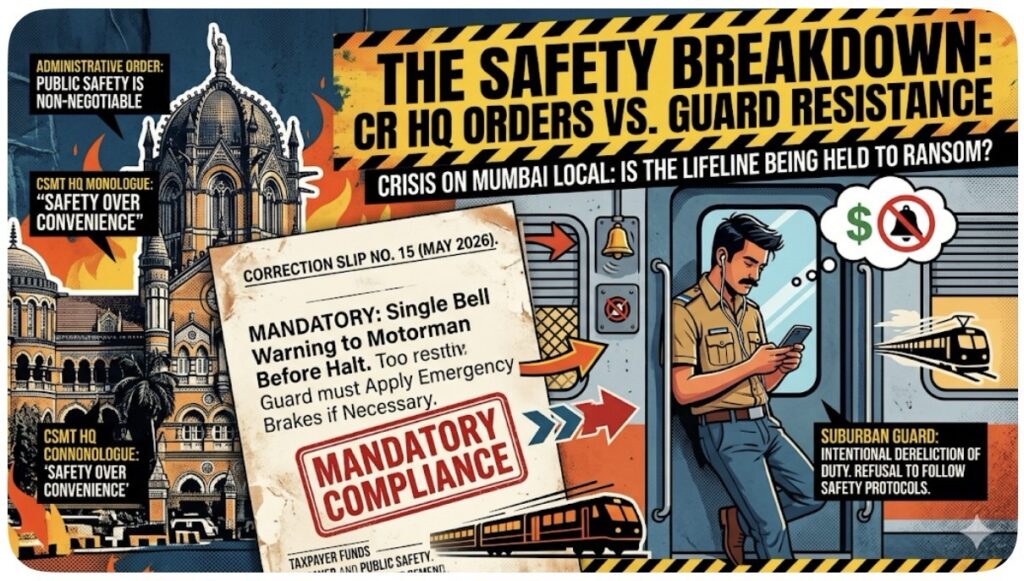
Six months on, the same union, on the same line, is at it again. This time the trigger is smaller — so much smaller it’s hard to type the sentence without flinching. On 7 May 2026, Central Railway’s headquarters issued Safety Circular No. 15. It updates Subsidiary Rule 4.51-1(B)(1) and introduces a ‘Note 4’ to the bell-code procedure between train managers — what most of us still call guards and they are still guards, not managers — and motormen. The instruction reads thus: “before the train approaches a scheduled halt, the guard, sitting in the rear cab with the timetable in front of him, will give the motorman a single bell-beat. If the train is still moving too fast to halt cleanly, the guard will apply the brakes himself.” Two pairs of eyes, two pairs of hands, to ensure a 12-coach rake carrying 4,000-odd commuters stops where it is meant to. The reform was issued because on 17 March, a Kalyan-bound AC local sailed past the Bhandup platform by two coaches. A similar overshoot happened at Vikhroli. Western Railway guards already do something close to this. None of it is exotic, expensive, or even particularly demanding.
The response has been a ‘work-to-rule’ agitation by guards at CSMT. On 13 May, services were paralysed in the evening peak. Three locals were cancelled between 5.15 and 5.45 pm. Central Railway folded the same evening: “the circular was put on hold.” The unions suspended the agitation pending a 18 May meeting, warning they will resume it if the circular is not withdrawn. A #Safety order issued in response to repeated platform overshoots has been shelved because the staff tasked with implementing it found a bell beneath their dignity.
To grasp the staggering disproportion at work here, the commuter — the citizen, the taxpayer — needs to know exactly who is doing this to her, and on what terms? India’s loco-running staff operate under one of the most generous compensation structures in the central government. A 1981 set of rules, reaffirmed by every successive Pay Commission, designates 30% of their basic pay as a ‘pay element in running allowance’. That 30% is reckoned over and above the basic for dearness allowance (#DA), house rent allowance (#HRA), leave salary, children’s education assistance, pass entitlements, and the fixation of pay if they are ever transferred to a stationary post. For pension and retirement gratuity, the reckoning rises to 55%. When natural calamities or coal shortages stop the trains, the 30% continues anyway. When de-categorised from running duty, the 30% stays. On top of all this sits the Kilometreage Allowance — a per-kilometre payment that, for a senior Mumbai motorman with night-duty allowance and overtime stacked on, comfortably pushes gross earnings past one and a half lakh, approaching two lakh at the senior end, often out-earning the Branch Officers above them. Every paisa of it is taxpayer-funded — including paisas contributed by Hailey Momaiya’s parents.
There is no quarrel with the principle that running a train through Mumbai’s suburban grid is hard work. It is. There is, however, a deepening quarrel with the politics of demanding more and refusing more, and dropping operations the moment a written order asks you to ring a bell. The unions know that Mumbai’s 80 lakh-plus daily suburban commuters cannot retaliate. There is no consumer forum for the woman who has to catch the 6.42 from Kurla to reach Sion Hospital for dialysis. There is no compensation for the daily-wager whose Thursday earnings vanish when the Kalyan line stalls. There is, however, the working memory of November. A woman named Mangala Jhingade, on her way to Byculla with her daughter’s wedding invitations that evening, watched commuters leap onto the tracks because their stranded train offered no other release. She asked, in front of a reporter, who would take responsibility if anyone got hurt. Six months on, two people have been buried, and her question is still rhetorical. And here we are again, in the same evening peak, on the same line, daring the same outcome — this time simply over a bell.
There is a name for putting lakhs of commuters at risk to score a point about workload, when that point has already been disproved by a near-identical protest that killed two people last winter, and when the workload in question is a single bell-beat per stop. That name is not ‘agitation’, not ‘dissent’, not even ‘industrial action’. It is criminal recklessness, dressed up as labour militancy, performed by the most cosseted operating cadre Indian Railways has, at the expense of the city that pays their salaries, their thirty-per-cent pay element, their kilometreage and their pension. The pity is that one has to spell this out. Mumbai is being held to ransom not by the wretched of the earth, but by the well-fed. And someone needs to say it before the next bell goes unrung, the next platform is overshot, and the next set of names appears on a J J Hospital board. Contd.