

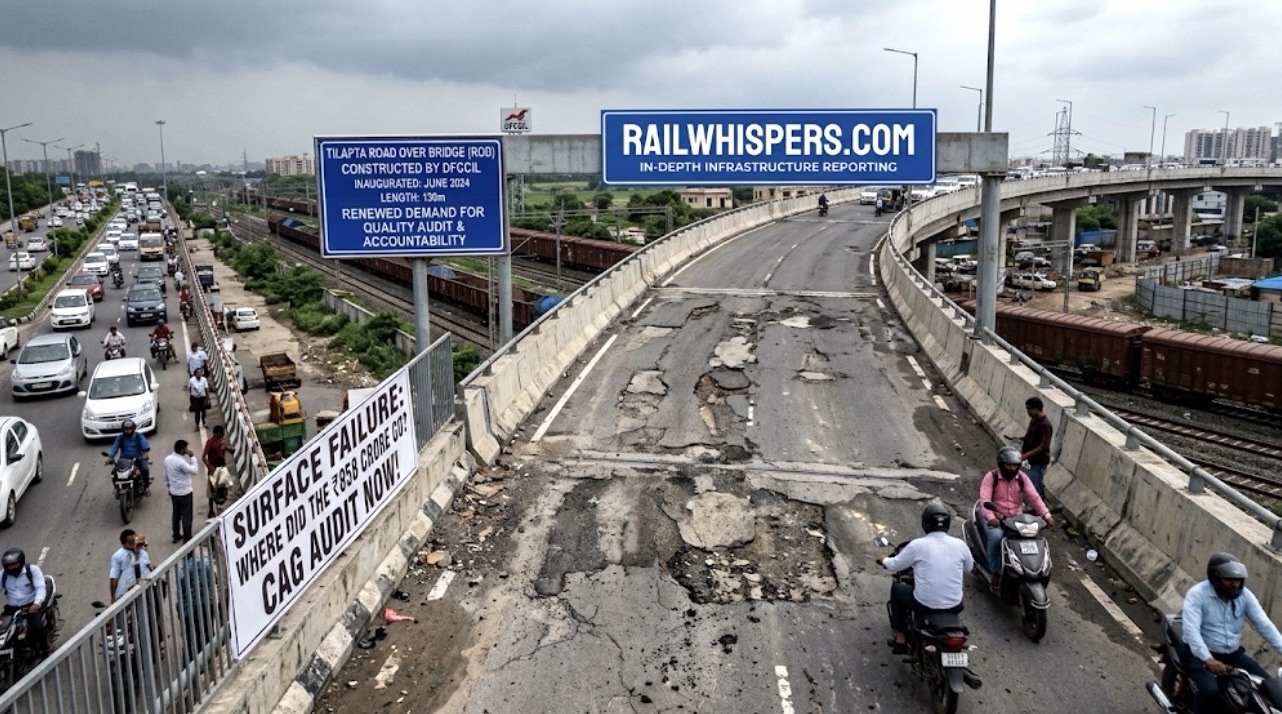
Newly Built Tilapta Overbridge Faces Quality Backlash Weeks After Inauguration
Greater Noida: The 130-meter Tilapta Road-over-Bridge (#ROB)—constructed by the Dedicated Freight Corridor Corporation of India Limited (#DFCCIL) at a cost of ₹858 crore to connect Greater Noida East and West—is facing sharp criticism after its asphalt surface began peeling off just weeks after its inauguration.
While officials attribute the damage to the season’s first monsoon rains, the timing has drawn pointed questions from commuters, residents, and local political leaders. Critics are questioning the quality of the construction materials and the execution of a project of this scale and cost.
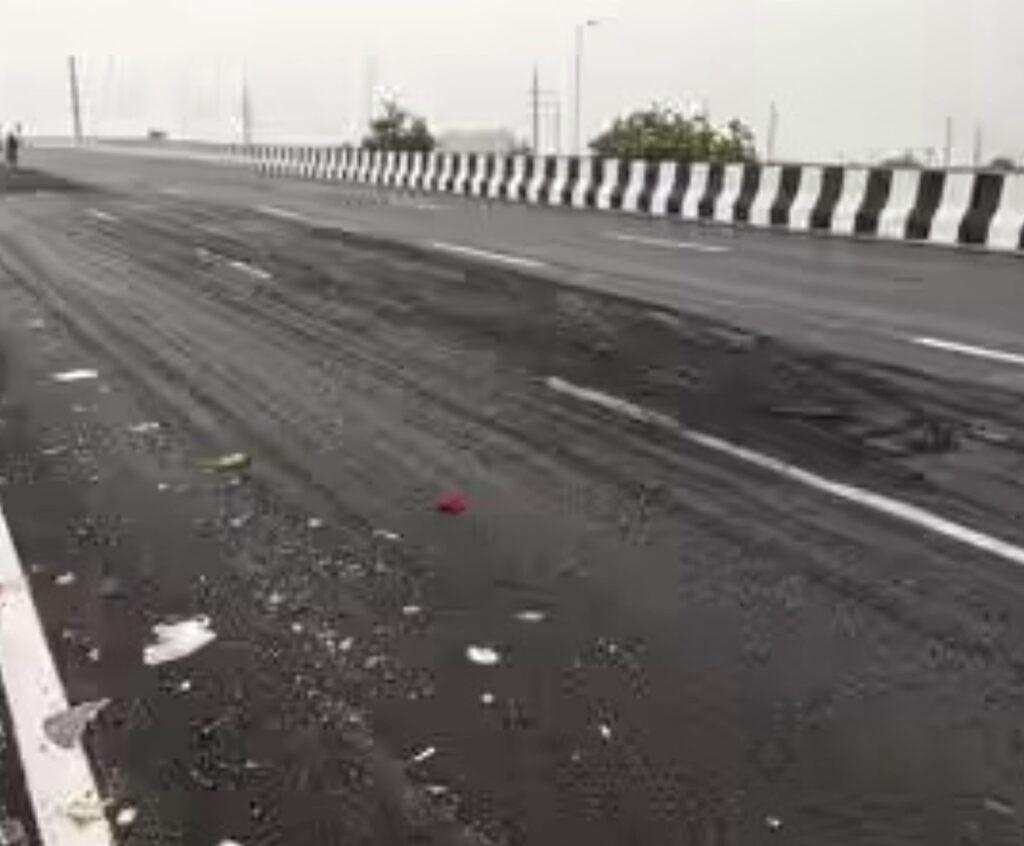
Local residents emphasize that this premature wear raises serious safety concerns on a stretch specifically designed to ease chronic traffic congestion between the two halves of Greater Noida. Consequently, the incident has renewed calls for an independent quality audit of the bridge, as well as greater public disclosure regarding contractor and material-testing records.
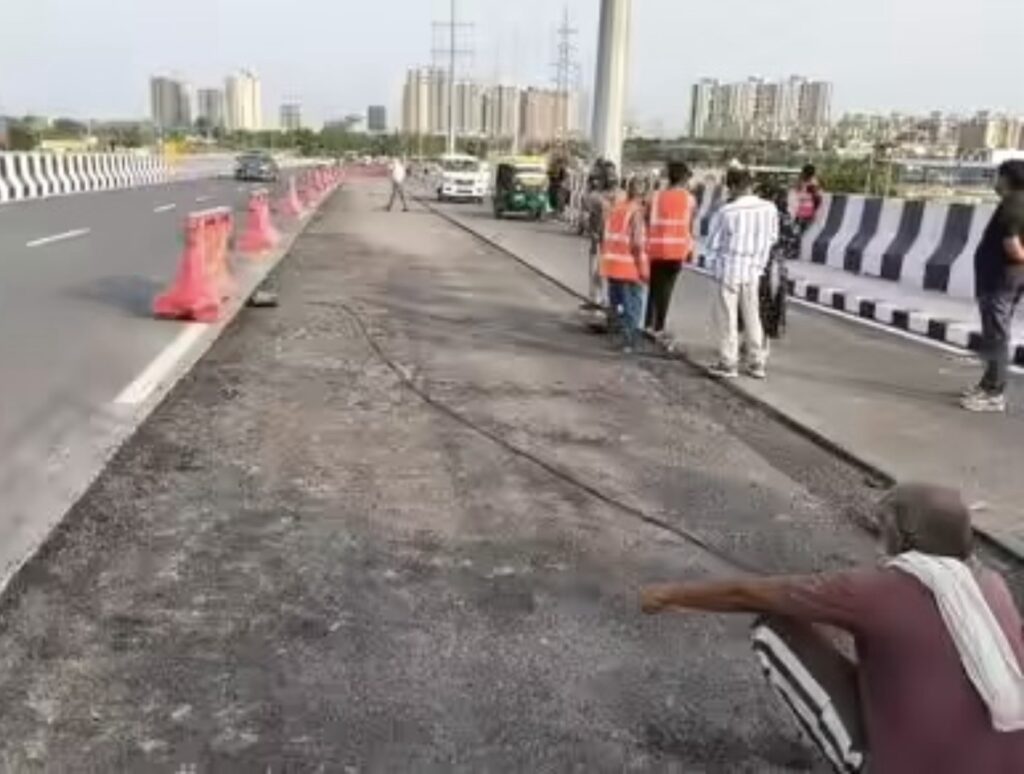
DFCCIL has not yet issued a detailed public response to explain the cause of the surface failure or to outline corrective steps. However, given the substantial public investment involved, officials note that the corporation will likely face formal demands for accountability from local authorities and elected representatives in the coming days.
Past CAG Findings Add to Scrutiny
This is not the first time DFCCIL’s project execution has drawn scrutiny from India’s top audit body. A previous Comptroller and Auditor General (CAG) report reviewing sections of the Eastern and Western Dedicated Freight Corridors—including the Rewari-Iqbalgarh, Vaitarna-JNPT, Khurja-Bhaupur, and Bhaupur-Deen Dayal Upadhyaya stretches—found that delays in land acquisition, design finalization, and utility shifting had significantly driven up costs. The CAG flagged roughly ₹2,233.81 crore in already-incurred price-escalation costs, with an additional ₹2,671.29 crore projected as future liability.
Given this track record and the fresh controversy surrounding the Tilapta ROB, civic activists and opposition leaders are renewing calls for the Central Vigilance Commission (CVC) and the CAG to formally examine DFCCIL contracts awarded over the last five years. They are demanding a thorough review of:
- Tender processes
- Material quality certifications
- Cost-escalation claims
The goal is to determine whether these recurring issues reflect systemic execution failures or point to deeper irregularities. While no official investigation has been announced at the time of this report, these demands from the public and civic leaders continue to mount.
Questions Being Raised
The recurring pattern of cost overruns and quality complaints has prompted residents, activists, and local leaders to publicly question whether DFCCIL’s contract oversight is rigorous enough for projects of this magnitude. Among the questions being raised, without any confirmed findings at this stage:
- Price escalation claims: Are cost-escalation clauses being invoked appropriately, or could they be inflated beyond what actual material and labour cost changes justify?
- Material quality checks: Were asphalt, steel, and other materials used on projects like the Tilapta ROB tested and certified to the specified standards before being approved for payment?
- Component specifications: In pipe and structural steel work on DFC projects, are thickness and grade specifications being independently verified against what contractors are billed for?
- Quantity billing: Do measured/billed quantities of materials match what was actually used on site, and are third-party quantity audits being conducted?
- Scope variations: How large have contract variations grown on DFC projects, and is there an upper limit or independent approval threshold beyond which variations are flagged for special scrutiny?
None of these are established findings — they are open questions being asked by critics in the wake of the Tilapta ROB episode and DFCCIL’s prior CAG strictures. Answering them would require a formal audit or vigilance inquiry, which has not yet been ordered.
Based on: “The Times of India” & other sources.
The Reality: Construction in Progress, Not Destruction
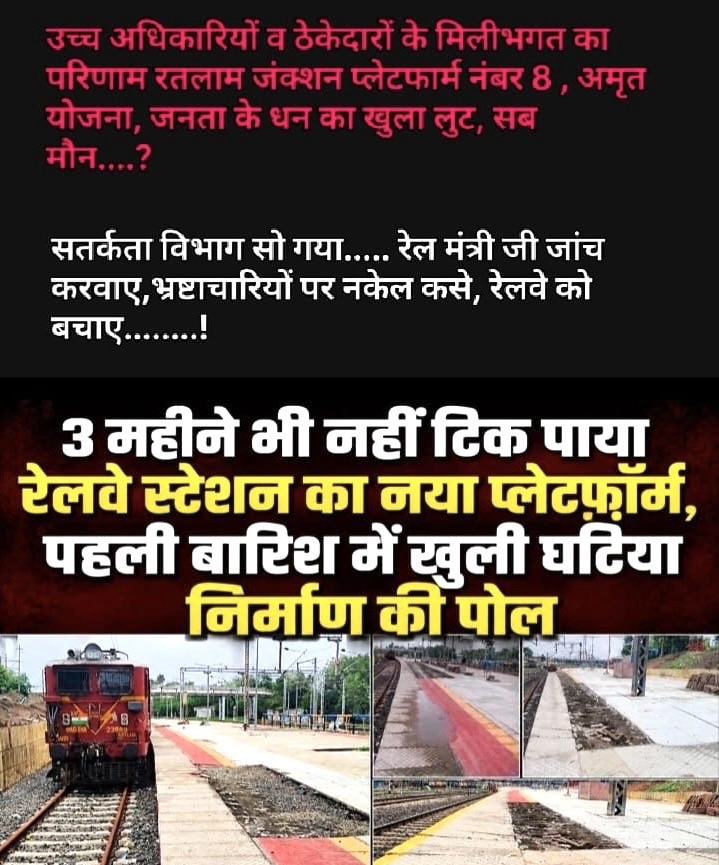
The Social Media viral post claims that a newly built platform at Ratlam Junction — Western Railway — collapsed or washed away in the first rain due to corruption. However, a close AI observation at the images reveals a completely different story:
- Work Under Construction: The platform is not broken or washed away; it is incomplete. The central portion of the platform is intentionally left unpaved with exposed soil/gravel because the final flooring tiles have not yet been laid.
- Structured Edges: Notice how neatly the platform edges (the coping stones) and the red/yellow tactile warning strips are aligned. If the platform had “collapsed” or suffered severe structural failure from rain, these edges would be displaced, cracked, or washed out. Instead, they are perfectly intact.
- The Misleading Narrative: It is common for sensationalized social media accounts to take photos of ongoing infrastructure work, wait for a rainy day to make it look messy, and frame it as a “failed project” to drive engagement and outrage.
The Verdict: The claim is false. The image depicts an ongoing railway upgrade under the redevelopment phase, where the middle section of the platform is simply awaiting its final layer of paving. It is a work-in-progress, not a structural failure.