

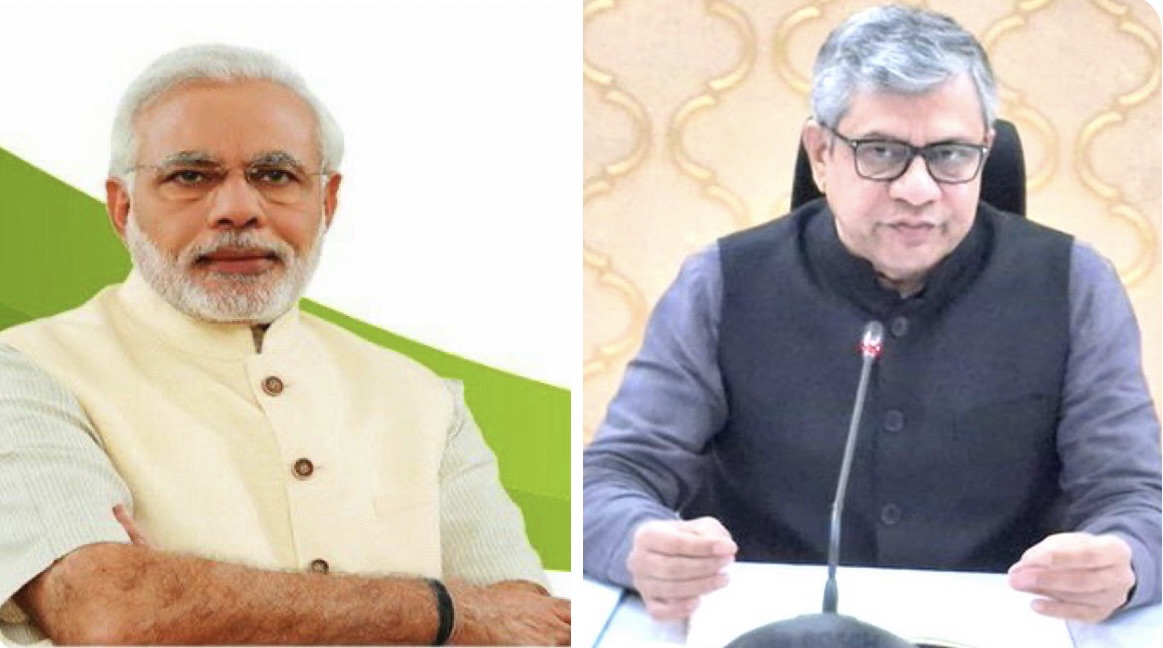
Austerity Should Start at the Station, Not at the Petrol Pump
“If the Prime Minister wants Indians to brace for hard times, his own ministries can begin by cancelling the next round of granite cladding and putting the money into a loop line”
The Prime Minister has had a rare moment of pessimism. From The Hague last week, addressing the Indian diaspora in his usual oratorical style, Hon’ble PM Mr Modi called this “a decade of disasters” and warned that another global lurch could undo decades of poverty reduction. A few days earlier, he had asked Indians, in seven neat points, to consume less fuel, less imported gold, less foreign vacation, less edible oil, less fertiliser — and to revive work-from-home. The government has since clarified, slightly defensively, that this is not austerity but “economic prudence”. Fine. Words matter less than arithmetic.
The arithmetic is unforgiving. Forex reserves have dropped by roughly $38 billion in two months. FIIs have pulled out close to ₹1.97 lakh crore from Indian markets this calendar year. Gold imports last fiscal touched $72 billion, almost double of FY 2023. We are nearly 89% import-dependent on crude, with the Strait of Hormuz looking less and less navigable by the week. Anyone who says we should sit this one out has not been reading the RBI bulletin.
The harder question — which neither government nor opposition wants to ask — is what the state itself is doing while it asks citizens to tighten belts?
Begin with the Railways—because nothing illustrates the problem better—
#IndianRailways runs its capital expenditure through “Plan Heads”, a wonderfully ‘babu’ phrase. PH-53 funds Customer Amenities — Station “Modernisation”, Beautification, Lifts, Escalators, Granite Floors, LED Facades. PH-16 funds Traffic Facilities — Yard Remodelling, Loop Lines, Signalling Improvements — the unglamorous arteries that decide whether a freight train actually moves. PH-53 gives you ribbon-cutting. PH-16 gives you throughput. Guess which one a minister prefers to inaugurate.
For several years, “Station Redevelopment” has acquired the character of a national hobby. The Adarsh Station scheme alone covered over 1,250 stations. The Major Upgradation list has added more. PH-53 outlays climbed from ₹2,345 crore in FY 2022 to ₹2,700 crore in FY 2023, and have grown considerably since. Some of this is welcome — passengers do deserve dignity. But somewhere between dignity and decoration—we crossed a line. Small divisions, small stations with modest footfall, are receiving hundreds of crores for what is essentially another round of retiling. Concourses are being widened at stations that don’t need wider concourses. Air-conditioned waiting halls are being built where the only meaningful delay is the perennial wait for a second loop line that nobody has sanctioned.
This is, in fact, a mistake even the Railway Minister now appears to recognise. Speaking after the Budget, Mr Rail Minister Ashwini Vaishnaw is reported to have asked zonal railways to stop putting in crowd-management arrangements at stations that do not need them, and concentrate them where they do. It was a quiet but important admission: “not every station deserves a stampede-control plan, and certainly not every station deserves a marble walls, pillars and lobby.”
Yet the inertia is enormous. A General Manager’s career advances by spending his budget, not saving it. A Divisional Railway Manager who returns funds is regarded, in the unforgiving lexicon of Rail Bhawan, as a poor performer. So the money flows — into mosaic flooring, into ornamental porticos, into pavilions that look terrific on Twitter and matter little to the punctuality of any superfast running through.
Meanwhile, ask any Operating officer where the real bottleneck is, and he will point to PH-16 work that has been hanging for years. A loop line of the wrong length so a goods rake cannot be received whole. A yard whose layout was last seriously redesigned in 1958 and which cannot accept today’s container traffic. A pair of signals that, if upgraded, would shave eight minutes off every train through a section, every day, for the next thirty years. These are the works that move the economy. They do not, alas, lend themselves to inauguration plaques.
Now apply Modi ji’s own logic. If citizens are to cut oil and daily needs, and imported gold and family holidays in Bali, surely the Railways can cut imported granite and cosmetic upgrades. If we are in a “decade of disasters”, capex must be triaged into what raises productivity, not what raises ribbon-cutting opportunities. Asking a salaried Indian to skip a foreign trip while sanctioning yet another waiting hall at a station with 14 trains a day and a modest footfalls is the kind of contradiction even the most loyal cadre cannot defend at a kirana shop debate.
The fix is not complicated. The Railway Board can issue a one-page instruction: “every PH-53 work, on reaching a defined level of functionality, must be paused. The released funds must be transferable, by the DRM, to PH-16 works in the same division.” DRMs who do so should be measured on it — even rewarded for it. There is no need for a new committee, a new white paper, or a new “mission”. Just the willingness to redirect.
The same logic can be pushed further down the Railways’ own value chain. Stop treating the General Manager who saves money as a delinquent; treat him as the rare officer he is. Hand over station commercial spaces — retail, parking, food courts — to private operators on revenue share, instead of having the engineering wing lay yet another row of tiles. End the unwritten convention that every Member of Parliament (MP) who shouts loud enough must be granted a station “upgrade” in his constituency. None of this asks a single citizen to give up anything. It requires the state to do what it now tells households to do.
The truth, which no one in Lutyens’ Delhi will say out loud, is this: “India’s external squeeze is real, but it is also self-inflicted.” Decade after decade, we have under-invested in domestic oil exploration along our 7,500-kilometre coast, under-built strategic petroleum reserves (60 days versus the 120-150 days a serious importer maintains), and let urban transit projects rot in environmental clearance hell. Meanwhile, we have over-invested in granite and marble tiles.
If the Prime Minister wants Indians to brace for austerity, he can begin by cancelling the next PH-53 sanction on his desk and redirecting the money to a loop line. Photo-ops on motorcycles will not save the rupee. A loop line, eventually, just might.
Author is a retired IRAS officer