

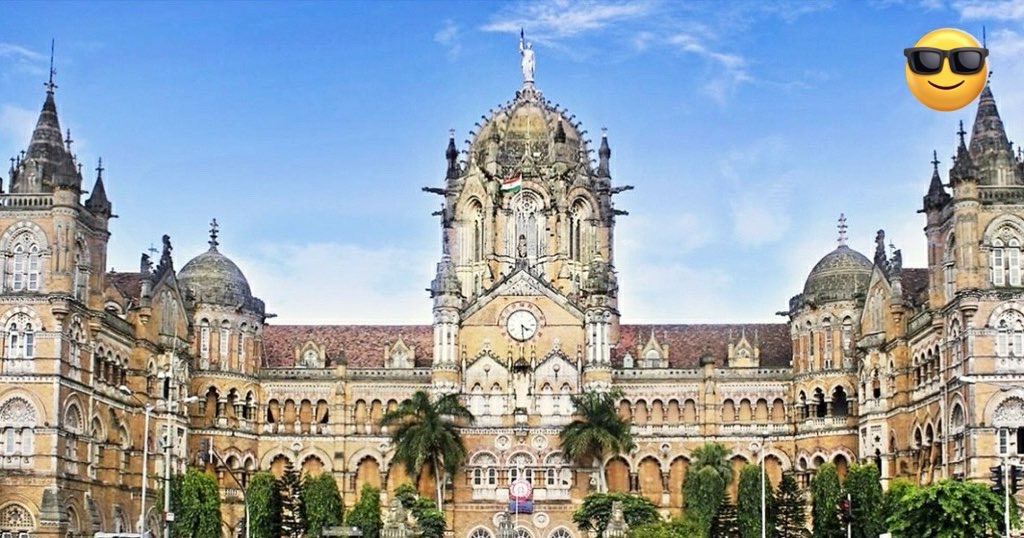
Central Railway Guards-Bell Protest—Highly Paid but the Public Interest & Accountability Zero! Part-3
The Mutiny of the Overpaid: Is Mumbai’s Lifeline Choking on Guard-Level Entitlement?
The recent “Work to Rule” agitation by Mumbai’s Suburban Guards is not just a protest—it is a calculated display of power that exposes the administration’s soft underbelly. While the city’s 4 million commuters rely on precision and safety, a cadre of staff earning executive-level salaries is weaponizing safety manuals to evade accountability.
Also Read: “Central Railway Guards-Bell Protest—Highly Paid but the Public Interest & Accountability Zero! Part-1”
Also Read: “Central Railway Guards-Bell Protest—Highly Paid but the Public Interest & Accountability Zero! Part-2”
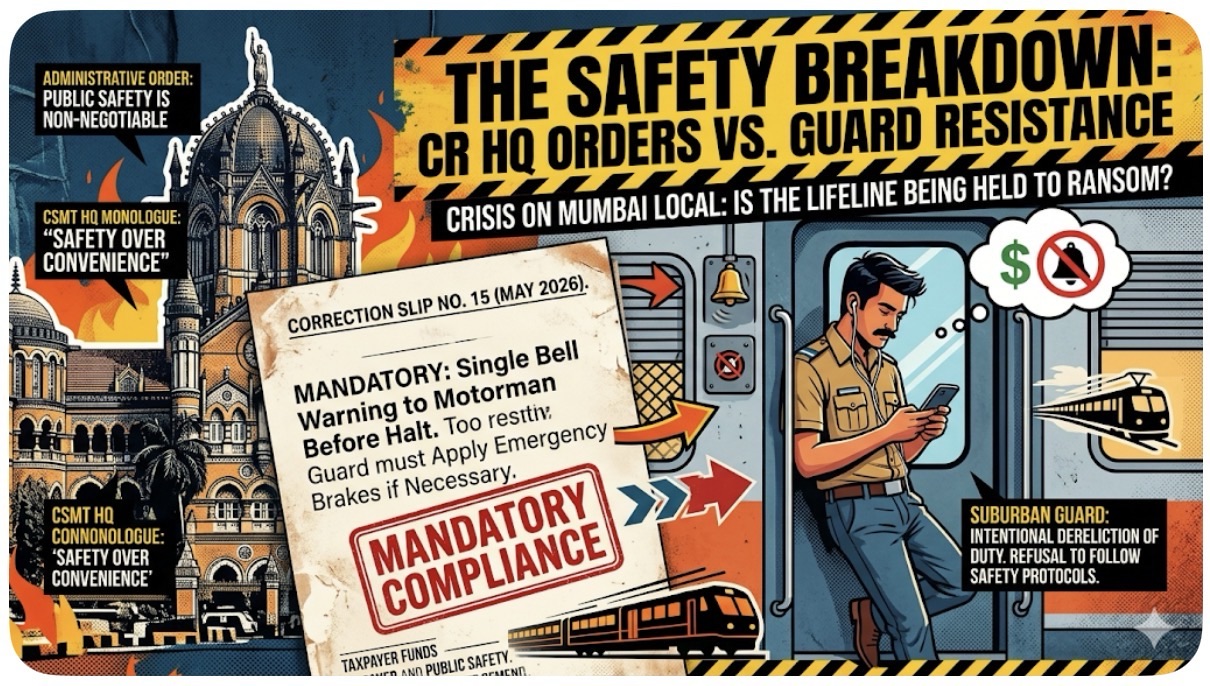
The Guardless Revolution: Why the Caboose is an Anachronism
For over two decades, the goal of “guardless” operations has been the holy grail of efficiency for Central (CR) and Western Railway (WR). In a modern suburban system, the Guard—historically necessary for visual checks and manual braking—is increasingly a vestigial organ.
- Technology vs. Tradition: Modern rakes equipped with Automatic Door Closure and CCTV surveillance (currently being trialed on CR’s new non-AC rakes) make the physical presence of a Guard redundant. In global systems (GoA 3/4), the “Train Manager” is replaced by sensors and centralized control.
- The Time-Saving Factor: Eliminating the “bell-exchange” ritual and streamlining station halts could theoretically allow for an additional 2–4 services per hour during peak times. The “human bottleneck” is currently the single largest barrier to increasing frequency from a 3-minute headway to a 90-second one.
The Union Veto: A 20-Year Stranglehold
The failure to implement guardless operations is not a technical failure; it is a political one.
- Job Protectionism: Unions have successfully framed automation as a “safety risk” to the public, whereas, in reality, it is a risk to their 1981-era compensation structure.
- The Vikhroli Incident Irony: After a local skipped its halt at Vikhroli recently, the administration tried to enforce accountability via Correction Slip 15. The Unions’ response? A “Work to Rule” protest that intentionally delayed thousands of people. By refusing to follow a safety rule designed to prevent overshooting, the Unions have effectively admitted that their “safety concerns” are only valid when they don’t involve extra effort.
The Blackmail Economy: High Pay, Zero Liability
The disproportion between the Guards’ salaries and their contribution to modern railway safety has reached a breaking point.
- The Salary Cushion: With gross earnings often hitting ₹1.5 to ₹2 Lakh, these “Train Managers” are paid more than many IT professionals or junior IAS officers. Yet, they argue that ringing a bell before a station is a “punishing” addition to their workload.
- The Ransom Tactic: The administration’s “surrender” (often staying circulars or calling for “deliberation” after a 15-minute stir) is born from a fear of a Total City Shutdown. The Unions know that even a 20-minute delay at CSMT can lead to a law-and-order crisis. They are not negotiating; they are holding the city’s economy for ransom.
Breaking the Cycle: The Path Forward
If the administration is to reclaim its authority, it must transition from “negotiation” to “disruption”:
- Strict Disciplinary Action: Use the “No Work, No Pay” (Dies-Non) principle for every minute of a “Work to Rule” delay.
- Outsourcing the Peripheral: Accelerate the conversion of all rakes to AC-standard automation. Once doors are automatic and signals are cab-based, the Guard’s role transitions from “essential” to “ornamental,” allowing for natural attrition to reduce the workforce.
- Public Accountability: The CR & WR should publish the names and designations of those causing delays during agitations, allowing the taxpayer to see exactly who is disrupting their commute and why.
Critical Analysis: The Weakness of the Administration
The administration’s weak point is its over-reliance on manual intervention. By failing to upgrade signaling to #CBTC (Communication-Based Train Control)—which is standard in the Delhi Metro—they remain dependent on the whims of the Running Staff. Until the human element is phased out through GoA 3 (Driverless) or GoA 4 (Unattended) technology, the Mumbai commuter will remain a pawn in the high-stakes game played by the Unions.
Is the “human touch” worth the ₹2 lakh price tag and the constant threat of delays, or should Mumbai follow the global path toward a fully automated, union-proof transit system?
This video report on the Mumbai Local upgrade details the introduction of automatic door systems, which is the critical first step toward reducing the Guard’s role and moving toward a fully automated, safer suburban network.