

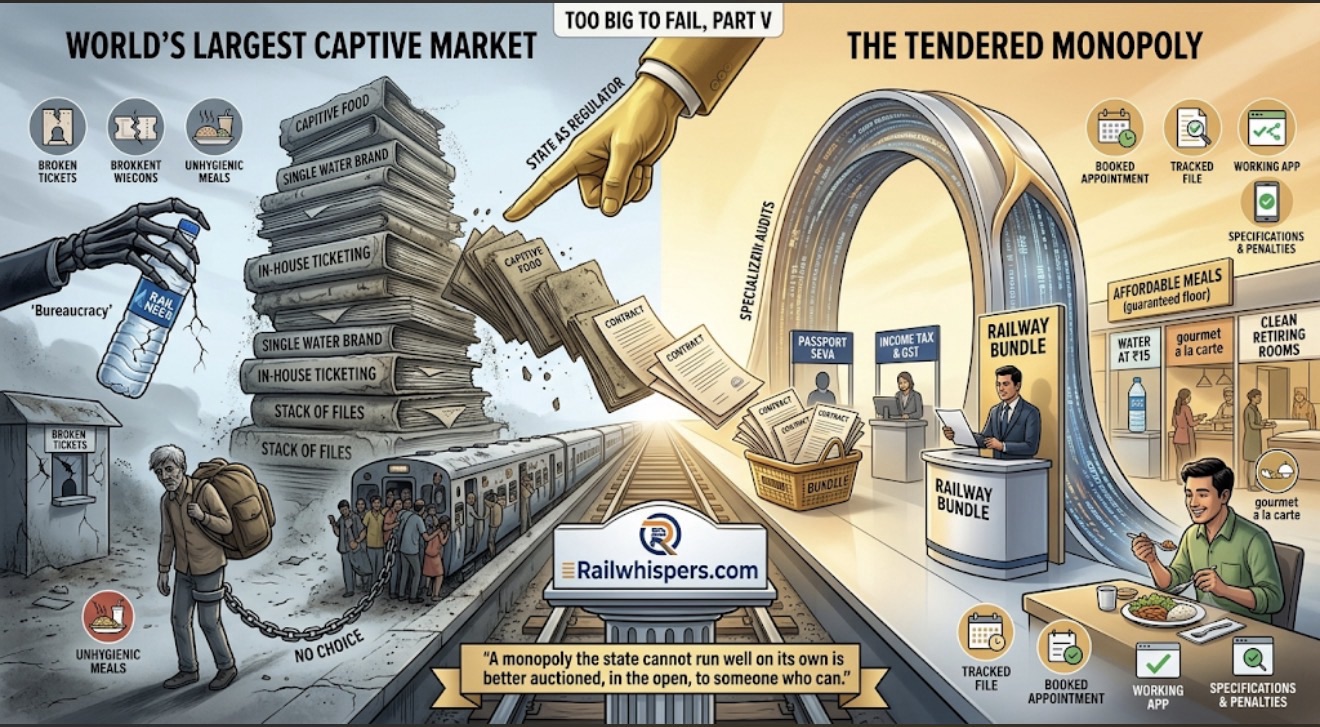
TOO BIG TO FAIL, PART V: “The World’s Largest Captive Market, Run Like a Stack of Files”
This series began with #Railwhispers’ “Too Big to Fail ???” 2 April 2026.
6 July 2026: “TOO BIG TO FAIL, Part II: The Cartel You Cannot Sack!”
7 July 2026: “TOO BIG TO FAIL, Part III: The Steel You Cannot See”
8 July 2026: “TOO BIG TO FAIL, Part IV, “Rent Without Rivals”
It Has to Be a Monopoly. It Doesn’t Have to Be Yours
Some of these services cannot help being monopolies. You cannot run two water brands, two ticket windows or two caterers on one coach. There is room for one, and one there will be. Accept that fully. It changes nothing about the argument. A service being a #monopoly does not mean a government department must own and run it forever, at the effort we now see. India has a standard answer to a monopoly that must exist. You do not fake a market. You auction the right to run it, in the open, for a fixed term, against a standard you set.
We Have Already Done This
We have done exactly this, and recently, with interfaces as monopolistic as any railway platform. One portal issues passports. One files income tax. One runs GST. Each is a single state door with no rival beside it. The government did not build and run them in-house forever. It wrote a specification, called an open tender, and a specialist firm won. Passport Seva went to a large technology house, TCS. The tax and GST systems went to another, Infosys, for sums in the hundreds and thousands of crores. It was not flawless. The new income-tax portal failed badly at launch and had to be repaired under public criticism. That is part of the lesson: a tender is only as good as the standards and penalties written into it. But the result stands. The passport, once a byword for touts and waiting, is now a booked appointment and a tracked file. A tendered monopoly was made to serve.
The One Counter They Kept, and Broke
Now take the one interface the railways kept for themselves. The #IRCTC website and app rank among the worst public services in the country. They sit near the bottom of the review sites. The complaints repeat: logged out while logging in, money taken with no ticket issued. Most reviews are unfavourable. This is not a question of national talent, because the same country built both. One interface went to specialists who are judged on their work. The other stayed in-house and was judged by nobody.
The Size of the Prize
Ticketing is the small prize. Look at the scale. More than a hundred Vande Bharat services now, and about three dozen Amrit Bharats, running beside the older Rajdhanis, Shatabdis and Rajya Ranis. Around ten thousand catering points across the stations, from a platform tea stall to a food plaza. Close to two thousand retiring rooms at some six hundred stations. A water business that made about forty six crore bottles last year, near half a billion, and still cannot keep them stocked. By any reasonable reckoning, this is the world’s largest captive hospitality market. And it is run like a stack of files.
Bundle It, Then Auction It
The design decides everything. Do not tender this as thousands of small licences, each grabbed by the best-connected operator at that station. That is roughly the present mess. Bundle it instead. Put a whole basket out together, the profitable parts tied to the unprofitable. Tie the gourmet cabin meal to the humble Jan Aahaar thali. Tie the food plaza to clean toilets and to water at fifteen rupees. Let a serious operator bid for the basket, for a fixed term, against a service floor the state writes into the contract. An affordable meal that is actually affordable. Water at fifteen rupees, not twenty. A station restaurant a family would sit in by choice. And the affordable end is no fantasy. The Akshaya Patra Foundation already cooks and serves some 2.3 million hot, nutritious meals a day from a few dozen central kitchens, as the government’s mid-day-meal partner. Feeding people cheaply and well at scale is a solved problem in this country. The contract need only ask for it. The bidder finds the efficiencies and works the cross-subsidy. The passenger is guaranteed the floor. The government leaves the kitchen and goes back to setting and enforcing the standard.
Get the Government Out of the Kitchen
Weigh what the state gives up against what it keeps. It gives up running a hospitality business it was never built for. It keeps the two things that matter: the standard and the penalty. It writes the floor, audits it, fines or removes the operator who breaches it, and re-tenders at the term’s end. That is far less work than running ten thousand stalls. It is also far more control than the state has today, when the vendor it should discipline is the vendor arranging its officers’ postings.
The Thali and the Plated Tray
The passenger is the point. He gets the one thing a departmental monopoly never bothers with, which is range. A bundled, tendered contract can carry the full spread: the twenty-rupee thali and the plated à la carte, the dormitory cot and the clean air-conditioned room, so long as the contract demands it and pays only on delivery. Choice is what competition produces and monopoly forgets.
Business as Usual Is a Choice
None of this happens if the instinct at the top is to protect the arrangement. The reflex across these five parts has been the same: keep the seat, keep the vendor, shelve the report, blame the internet. Business as usual is not neutral. It is the active choice that keeps producing the fly in the meal and the crash at the tatkal minute. Moving away from it is not a leap into the untried. India already ran this playbook for the passport and the tax return. It should run it for the railway platform, and admit the plain point: a monopoly the state cannot run well on its own is better auctioned, in the open, to someone who can. The world’s largest captive hospitality market deserves better than the effort we give it now.
The idea is not the obstacle. The obstacle is the people it threatens and the offices that keep them in place. Part VI turns to that, the political economy of why the tender never gets written and the posting never gets made.
The tender, concretely
Seven demands on the Ministry of Railways, each checkable later:
- Bundle, do not scatter. Tender station catering, food plazas, retiring rooms and Rail Neer distribution as combined multi-year franchises by station cluster or zone, not as thousands of separate licences captured one by one.
- Write the service floor into the contract. A capped and genuinely affordable Jan Aahaar meal at the bottom, water at fifteen rupees, enforceable hygiene and cleanliness standards, up to gourmet at the top, with penalties that bite when the floor is breached.
- Award on price and service to the passenger, over a fixed term, and re-tender at the close. Let IRCTC bid for the basket like any other operator, and win only on merit.
- Tender the ticketing platform the way Passport Seva, GST and income tax were tendered. A clear specification, an open bid, a specialist builder, and service-level penalties for downtime at the tatkal minute.
- Keep the state as regulator, not operator. It writes the standards, audits them, fines and re-tenders. It stops running kitchens and water plants itself.
- Publish the numbers so the bidding is real. Footfall, current unit revenues, Rail Neer demand against supply, so serious operators and the public can both see the value on the table.
- Set a date and break business as usual. Name a fixed deadline to move the first bundle to open tender, so inertia does not win the argument by simply outlasting it.