

TOO BIG TO FAIL, Part VI, “The Chair Is the Contract”
This series began with #Railwhispers’ “Too Big to Fail ???” 2 April 2026.
6 July 2026: “TOO BIG TO FAIL, Part II: The Cartel You Cannot Sack!”
7 July 2026: “TOO BIG TO FAIL, Part III: The Steel You Cannot See”
8 July 2026: “TOO BIG TO FAIL, Part IV, “Rent Without Rivals”
9 July 2026: “TOO BIG TO FAIL, PART V: The World’s Largest Captive Market, Run Like a Stack of Files”
Why Nothing Changes
Five parts of this series have shown the same reflex. Keep the #vendor. Shelve the report. Move the officer who complained. Blame the internet. The natural question is why. Why does a system full of capable people keep making the worse choice? The answer is not laziness or bad luck. The power to fix any of this sits in the very offices the vendors have learned to reach. The officer who could break a #cartel often owes his chair to it. That is the last knot, and this final part tries to untie it.
What a Bribe Was Really For
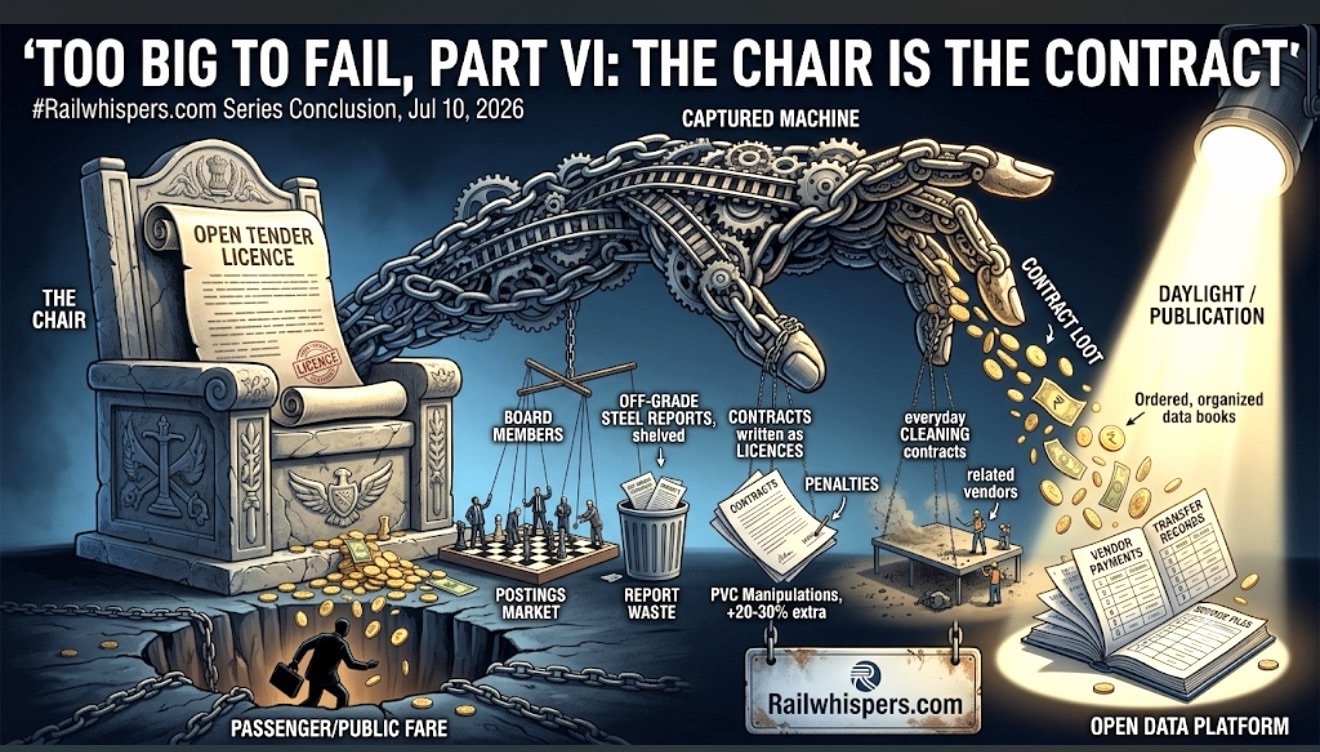
Start with the one case that reached a court and the public record. In 2013 the Central Bureau of Investigation (#CBI) seized about eighty-nine lakh rupees from the home of a railway minister’s nephew. The money, the agency said, was a bribe. It was not paid to win a contract. It was paid to place a #Member of the #RailwayBoard in a particular post, the post that dealt with more contracts. Read that slowly. The #bribe was for the chair, because the #chair is where the contracts are decided. The member had already jumped two seniors to reach the Board. The minister resigned within days. The case is a matter of public record, set out in the CBI chargesheet of July 2013 and widely reported at the time (Business Standard, 3 July 2013). It is rare only in that it was caught. It shows the machine in cross-section. Postings are bought because postings are power over money.
Postings Are the Currency
Once you see that, the rest of the series falls into place. A vendor who can shape transfers does not have to win every #Tender on merit. He needs one thing. The officer who judges his work must be the officer he wants, and the officer who crosses him must be moved on. We saw it in the earlier parts. The engineer who signed a report on off-grade steel was transferred almost at once, and the deputy who had inspected the suspect shells was shifted—as alleged in #Railwhispers, “Too Big to Fail ???”, 2 April 2026, and the whistleblower posts drawn on in Part III.
Contracts Written as Licences
The contracts finish the job. A contract can be a leash or a licence. A leash holds the vendor to his promise. A licence sets him loose with the state’s signature on it. Too many are written as licences. Long-term deals carry liberal price-variation clauses that let costs drift steadily upward. By one documented account, a division quietly widened the list of items eligible for price-variation payments without visible finance concurrence, in a system where a ten-crore contract can yield one to two crore rupees extra through the clause (#Railwhispers, “WCR’s PVC Manipulation: A Textbook Case of How Public Money Disappears”, 27 June 2026. Penalties, meanwhile, are often set below the money saved by cheating, the six-rupees-a-kilo exit clause noted in Part III. When the punishment for breaking a promise is smaller than the profit from breaking it, the promise is only paperwork.
Cleaning, the Open Loot
For the everyday version, look at cleaning. The railways have spent thousands of crores on #cleaning and #housekeeping, and the platforms show how little of it stuck. These contracts are an “open loot” (#Railwhispers, “EnHM – A Biggest Fraud in Indian Railways”, 23 February 2025. Officers are said to run them through relatives or friends, or even someone else who has supported by the back doors. Contract labour meant for stations is sent to officers’ bungalows for private work, often unpaid. Tender conditions are tailored to a chosen insider, a ninety-day laundry-setup clause here, a convenient distance rule there (same report). Cleaning is the perfect fraud because it disappears when you look for it. When the platform is empty, nobody needs it. When it is crowded, nobody can check it.
The Only Weapon Left Is Sunlight
So the honest question is not what new rule to write. A captured system administers new rules the way it administered the old ones. The one thing capture cannot survive is daylight. The demand that closes this series is therefore simple. Publish. Publish every payment to every dominant vendor, in catering, water, loco shells, signalling, tourism and cleaning, month by month, in a form anyone can search. Publish every price-variation payout against the original contract value. Publish every transfer of an inspecting or vigilance officer that follows an adverse report they filed. Publish the weekly Board agenda, and what it chose to take up and what it let slide.
Publish the people, not only the payments. When an officer is chosen for a directorship, for the Railway Board, or for a senior post at the RDSO, put his service record beside the records of those who were passed over. For every officer who has served more than one tenure in vigilance, publish the major decisions taken, and the ones avoided. There is a reason to insist on this. A system under a cloud likes to say it selects clean profiles. But in a bureaucracy a clean slate is often an empty one. The officer who delisted a powerful vendor earns adverse notes and enemies. The officer who took no decision at all earns neither, and offers the blank record as proof of integrity. It pays, in short, to do nothing. Lay the files side by side, and the public can see whether the people running the railways are the ones who acted, or the ones who were careful never to.
None of this convicts anyone. It does something better. It makes the pattern impossible to hide, and it makes the next bribe for the next chair far more dangerous to pay.
Ppl The vendors are too big to fail only while the numbers stay secret. Put the numbers in the open, and each vendor becomes exactly as big as the service it delivers, and no bigger.
What to publish, concretely
Eight demands on the Ministry of Railways, each checkable later:
- Publish every payment to dominant vendors by domain, catering, Rail Neer, loco shells, signalling, tourism and cleaning, monthly and searchable.
- Publish every price-variation-clause payout against the original contract value, so cost drift is visible to anyone.
- Publish cleaning and AMC spend per contract and per zone against measurable, independently audited outcomes.
- Publish every transfer of an inspecting or vigilance officer within twelve months of an adverse report they filed, with the stated reason.
- Publish the weekly Railway Board agenda, and which vendor-related complaints were taken up and which were let slide.
- Fix tenures for sensitive posts, and require an independent clearance before any officer who has acted against a vendor is moved.
- Publish the service record of every officer selected for a directorship, the Railway Board or a senior RDSO post, alongside the records of those passed over, with the reasons for the choice.
- Publish, for every officer who has held more than one tenure in vigilance, the major decisions they took and the ones they declined to take.