

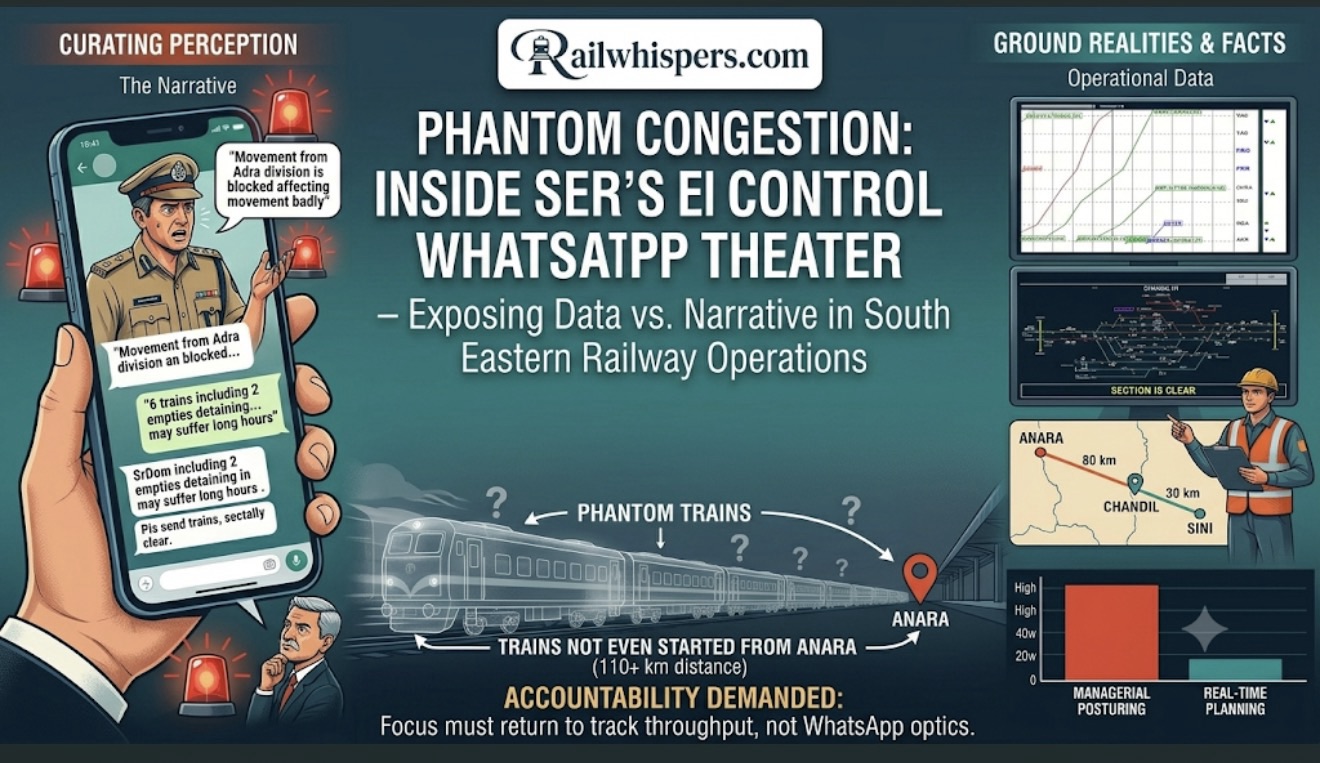
Phantom Congestion & Group Optics: Inside SER’s Emergency Control WhatsApp Theater
—Exposing Data vs. Narrative in South Eastern Railway Train Operations!
—Accountability Demanded: Focus Must Return to Track Throughput, Not WhatsApp Optics!
“Kaam ratti bhar nahi, baatein char pahar ki”—nothing captures the prevailing work culture in South Eastern Railway’s operating circles better than this old idiom.
While field operations struggle with real-time planning, top divisional and zonal railway managers appear consumed by high-stakes narrative management on official messaging channels. The priority seems less about keeping wheels turning and more about curating perception before the General Manager and Principal Heads of Departments (PHODs).
A recent string of internal exchanges accessed from the ‘SER EMERGENCY CONTROL’ group exposes how senior officers trade unverified claims, build phantom detention narratives, and shift blame—until exposed by raw operational data.
The Trigger: A Routine Engineering Block Overrun
The incident unfolded when a Track Relaying Train (TRT) and EPB maintenance block overran its scheduled window at SINI yard lines 5, 6, and 7 under the Chakradharpur (CKP) division. Permitted from 16:40 to 19:40 hrs, the work exceeded the sanctioned duration.
At 20:55 hrs, Divisional Operations Manager (DOM) CKP flagged the issue to the emergency group, highlighting that UP trains from Adra division were facing detentions.
Instead of an operational intervention to regulate flows or expedite clearance, the notification quickly escalated into a theatrical blame game.
The Panic Narrative: Sounding Alarms and Logging Off
Minutes later, at 21:04 hrs, Chief Passenger Transportation Manager (CPTM) Ashish Kumar broadcasted a sweeping remark:
“Movement from Adra division is blocked affecting movement badly.”
Having dropped this alarm bell for senior leadership to see, managerial responsibility seemingly ended there.
Taking the cue, the Senior Divisional Operations Manager (Sr. DOM) Adra escalated the crisis at 21:23 hrs:
“Sir, 6 trains including 2 empties detaining in ANR – CNI section, may suffer long hours.”
Divisional Railway Manager (DRM) Adra, Mukesh Gupta, promptly tagged his counterpart at 21:29 hrs—“Sir kindly see @DRM CKP”—cementing the narrative that CKP’s delayed engineering block had brought Adra’s traffic to a grinding halt.
Data vs. Claims: The Narrative Crumbles
The narrative fell apart once cold operational facts entered the frame.
DRM Chakradharpur Tarun took charge of the exchange, directly countering the panic from the ground:
- Empty Tracks: At 23:22 hrs, DRM CKP stated, “I’m in Control since 9 pm and CNI says there are no trains in section,” uploading visual display unit (VDU) snapshots of Chandil Junction (CNI) yard and block section monitors. The screens showed clear tracks, blank signal spans, and unoccupied lines.
- The Callout: Re-quoting Sr. DOM Adra’s alarming text about six stranded trains, DRM CKP posted bluntly: “Pls send trains, section is totally clear.”
- The Control Chart Proof: Minutes later, DRM CKP uploaded the live control chart, pointing out the glaring reality: “Only 3 trains from Adra in Up direction on chart…”
Faced with undeniable real-time charting, Sr. DOM Adra was forced to backtrack. By 23:32 hrs, the narrative shifted from trains “detaining in section and suffering long hours” to an admission that trains were not even on the tracks yet:
“Sir, Further ordering is being done from ANR. Ordering was controlled for some time.”
“7 trains TO from ANR.” (23:34 hrs)
The operational reality: Anara (ANR) sits roughly 80 km away from Chandil (CNI), which is another 30 km from Sini. Trains whose Train Orders (TO) had not even been executed from an originating yard over 100 kilometers away were falsely presented as actively stranded in the block section to manufacture an operational crisis.
Optics Over Operations
This sequence of events highlights a deeper administrative malaise inside the railway operations machinery:
- WhatsApp Bureaucracy: Rather than active monitoring on the control board, high-ranking officers rely on WhatsApp posturing. Alarming remarks are broadcast to prove vigilance to GM/PHODs, after which officials comfortably disengage while the field deals with the fallout.
- Fabricating Pre-emptive Excuses: By crying wolf about imaginary detentions 100 km out, divisions pre-emptively build alibis for their own subsequent interchange failures and late runnings.
- Disconnection from Field Reality: Senior managers routinely sign off on figures without verifying live control charts or yard VDUs, showing an alarming gap between desk optics and physical train running.
When senior decision-makers focus their energies on orchestrating control-group optics instead of regulating physical train paths, field efficiency inevitably suffers. Railway governance cannot function effectively on blanket statements and manufactured crises. If officers are more interested in cosmetic reporting than running trains, higher authorities must hold them accountable—ensuring administrative focus returns to actual track throughput rather than social media performance.