

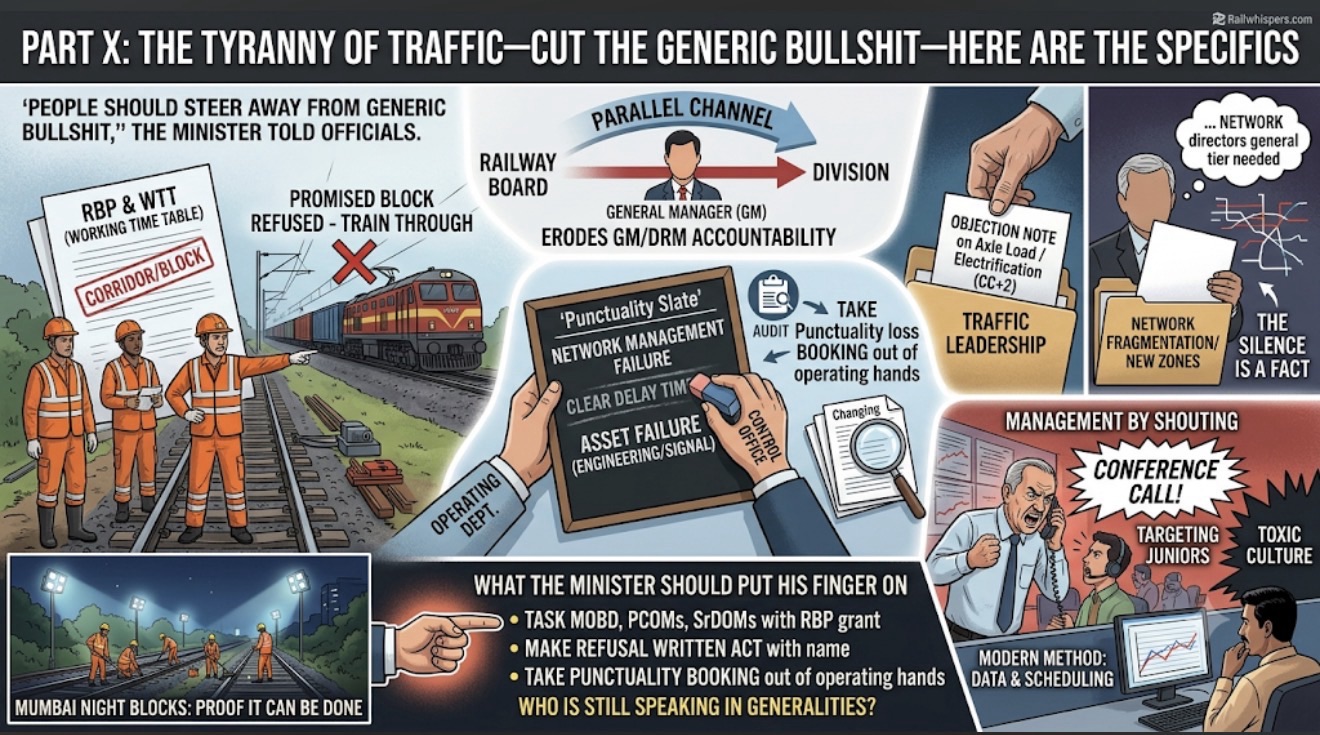
Part X: The Tyranny of Traffic—Cut the Generic Bullshit—Here Are the Specifics
At the end of the 3 September review the Minister asked for specifics and called the rest by its name. This part takes him at his word
Editor’s Note: The account of how the review of 3 September 2026 ended has started to tumble out slowly as more instructions are passed from officers who attended. The public record is the press release, and it does not carry this exchange. Everything printed as a judgement is marked as one. Rebuttal from the Railway Board is invited and will be printed.
Towards the end of the #Safety-review on 3 September 2026, the Minister asked a few Divisional Railway Managers to speak. Officers who were present say he liked some of what he heard. To others he said, in as many words, that “people should steer away from generic bullshit”.
That is the most useful sentence to come out of the meeting, and it is not in the press release (3 September 2026, “PIB release 2306359”).
Railway officers have grown used to sweeping remarks, and the stock of them is small: “safety is most critical, all out efforts, sensitisation of staff, close monitoring, and the matter is being looked into at the highest level. The Minister has heard the phrases and he has said what he thinks of them.”
So here are six specifics. None of them is generic. Each one has a document, a number or a name of a division behind it, and each one points to the same department.
One. The block promised on paper is not the block given on the field
Part IX of this series set out the arithmetic (5 September 2026, “Part IX: The Tyranny of Traffic—RBP & Corridors—The Biggest Jokes in Town”). Every asset has a maintenance cycle, the Rolling Block Programme (#RBP) collects the need weeks ahead, and the Working Time Table (#WTT) prints corridors where no train is timetabled, so the time exists on paper twice over.
Then the field takes over. In most divisions the two documents are a waste of the time it took to write them. The block is asked for, and it is promised, and then a train is put through the corridor and the engineer is told to try tomorrow. There are clear orders to give the corridors as printed. The orders are not kept. #RollingBlock #WorkingTimeTable
Two. The punctuality slate that wipes itself clean
This one is less visible and it matters more, because it decides who gets blamed for the first one.
Part V of this series asked General Managers to review punctuality honestly, because most zonal delay, read honestly, is a failure of network management and not of the machine (20 July 2026, “Part V: The Tyranny of Traffic—Take the key from the gate”). Here is why the review is never honest. When a train loses time, somebody books the loss against a department, an engineering department or a signal department or an electrical department, and that booking is done at the drop of a hat, on the day, by the control office, which is an operating department office.
When a train loses time because the network was badly run, because a crossing was mistimed, a path was given away, a section was choked, the loss is booked too. Then the days pass, people get busy with the next day’s trains, and the loss quietly gets dressed. It moves to a cause that is nobody’s, or it moves to an asset department that was in no position to argue.
By the time the month closes, the operating department’s slate is clean. The asset departments carry the punctuality losses, and then they are told they cannot have a block because punctuality is under pressure.
Ask the Board for one thing. Take the booking of #punctuality loss out of the hands of the #operating officers, and audit every booking that was changed after the day it was made. The audit will tell the Minister more than a hundred safety reviews.
Three. The bread
Part II of this series took its name from a claim, that the operating department wins the bread (16 July 2026, “Part-II: The Tyranny of Traffic—वर्चस्व की कवायद!” (The men who did not win the bread).
The claim is heard again now in a new form. Freight trains run in the maintenance corridors, the Rolling Block plans are refused, and that is how the railway earns its keep.
It is hogwash. A freight train that runs through a corridor today is a freight train that stops on a speed restriction next month, because the track it ran over was not tamped, and stops for a signal failure the month after, because the relay was not tested. The average freight train in 2024-25 ran at 23.8 kilometres an hour (19 July 2026, “Part IV: The Tyranny of Traffic—Send the bill to the gate”). That is what the bread looks like when the corridors are eaten.
Four. The note that was never written
This is the specific that goes to honesty.
A railway network cannot run at its best when it is cut into more and more pieces, because every new zone and every new division is a boundary, and a boundary is a place where a train waits, which any officer who has run a control office knows.
Compare two other decisions. When the CC+2 axle load programme was pushed, Technical Board Members wrote long notes on the record with their objections. When 100% electrification was decided, concerned Technical Board Member wrote, without hedging, that it was not a feasible decision. The Government decided both the way it wished, as was its right, but the officers and the directorates did their part, and the counter view is on file, signed and dated.
On the fragmentation of the network into new zones and divisions, no such note from the senior traffic leadership has ever come to light.
The judgement of this publication, and it is a judgement, is that the senior traffic leadership saw the chaos as useful. A network that nobody can run from the divisions is a network that needs a new tier of Directors General to run it, and that tier would be theirs. Whether that reading is right, the silence is a fact. The department that says it alone understands the network wrote nothing down when the network was being cut up. And it remains ever ready to blame the mechanical and civil engineers for what the cuts produce.
Five. Management by shouting
Every department has its problems. This series has never said otherwise, and the sister series on this site has spent a dozen parts on another department’s. But one department is singularly resistant to changing how it works.
Officers of other departments describe the daily control conference in the same terms wherever you ask. Shouting. Targeting of juniors. Bowing to whoever holds more rank in the room. Talk to junior traffic officers and station masters in private and they say the same about their own department, and they say it with some shame. #ToxicCulture
The traffic department has excellent officers. There are people in it who work with data, who know the network planning tools, who could run a section with a schedule instead of a telephone. They are sidelined, because a schedule cannot be shouted at and a data officer is no use to a boss whose method is the conference call.
In 2026, management by shouting is not tough. It is out of date.
Six. The channel that bypasses the GM
Part VIII described a chain of command that runs from the Railway Board to the division without passing through the General Manager (27 August 2026, “Part VIII: The Tyranny of Traffic—Count the Refusals”).
A General Manager and a Divisional Railway Manager are the two officers the Minister can actually hold to account. A parallel channel that bypasses them erodes the only two levers he has.
Mumbai proves it can be done
None of this is impossible, and the proof runs every night.
The Mumbai suburban system has assured night blocks. The trains stop, the gangs go in, and the trains start again in the morning, and if Mumbai division had never had those blocks the city would have come to a halt years ago. Nobody in Mumbai treats the night block as a favour granted by the controller. It is the timetable.
What Mumbai has by necessity, every division can have by order.
What the Minister should put his finger on
Hon’ble Minister sir, you asked for specifics. These are six. They point at one department, and they point at the people who are not begging for blocks, because they are the ones who decide whether to give them.
The officers you removed and the officers you warned are, for the most part, the people delivering in impossible conditions. They spend the day pleading for a block, then do the job in less time than it needs, because that is the time they got, and that is where “chalta hai” comes from. It is not an attitude. It is what a rule looks like after it has been broken every day for twenty years.
Task the operating officers, the Member Operations and Business Development (#MOBD) at the Board, the Principal Chief Operations Manager (#PCOM) in each zone and the Senior Divisional Operations Manager (#SrDOM) in each division, to take charge of the grant of blocks under the Rolling Block Programme. Every Working Time Table already has the slots. Make the refusal a written act with a name on it, and take the punctuality booking out of the hands of the operating officers.
Then ask the next review who is still speaking in generalities.
Earlier parts of this series:
Sep 5, 2026: Part IX: The Tyranny of Traffic—RBP & Corridors—The Biggest Jokes in Town
Aug 27, 2026: Part VIII: The Tyranny of Traffic—Count the Refusals
Jul 22, 2026: Part VII: The Tyranny of Traffic—The Absentee Landlord
Jul 21, 2026: Part VI: The Tyranny of Traffic—Keep the man waiting at the gate
Jul 20, 2026: Part V: The Tyranny of Traffic—Take the key from the gate
Jul 19, 2026: Part IV: The Tyranny of Traffic—Send the bill to the gate
Jul 17, 2026: Part-III: The Tyranny of Traffic—The key to the gate!
Jul 16, 2026: Part-II: The Tyranny of Traffic—वर्चस्व की कवायद! (The men who did not win the bread)
Jul 15, 2026: Tomfoolery of Prayagraj Division