

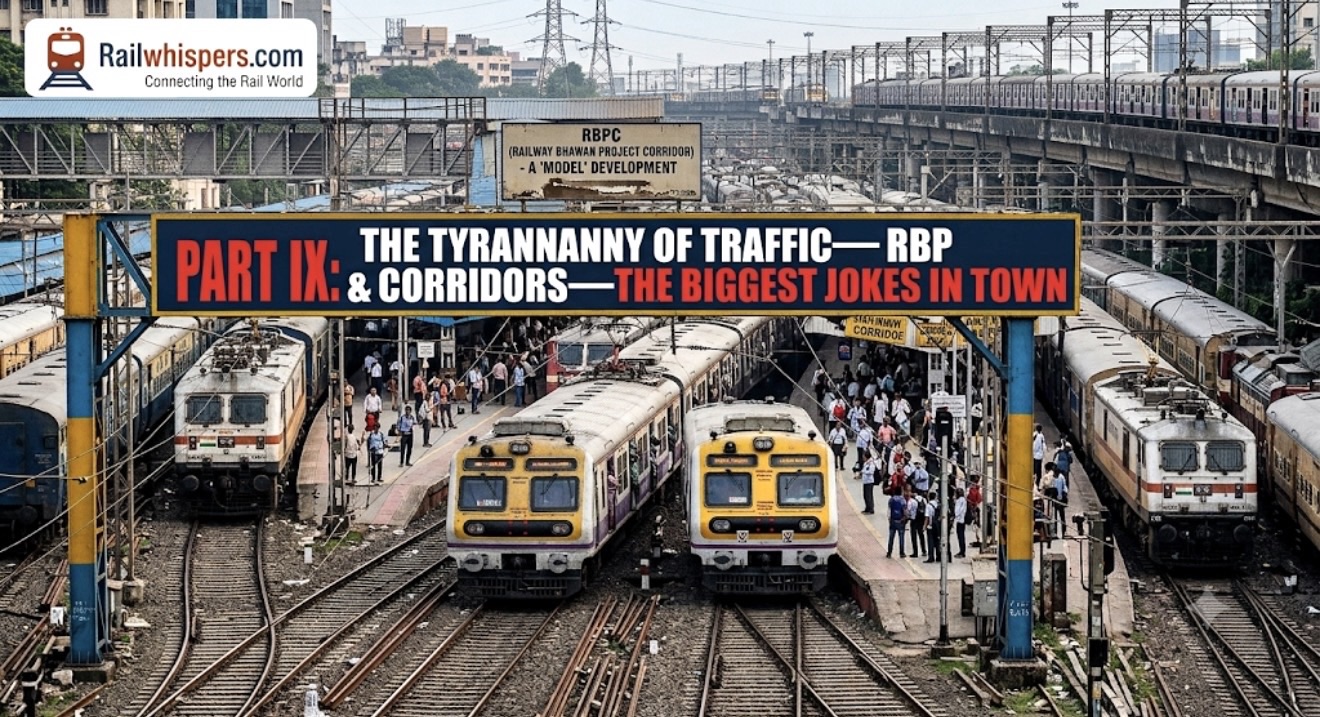
Part IX: The Tyranny of Traffic—RBP & Corridors—The Biggest Jokes in Town
The Minister wanted to know the worst divisions in maintenance. The better question is why every division is the worst at the same thing.
Editor’s Note: Part of this piece rests on accounts of the safety review of 3 September 2026, from the press release and from instructions passed by those who attended the meeting, and the text says so where that is the case. Rebuttal from the Railway Board is invited and will be printed.
On 3 September 2026 the Minister for Railways sat with the Chairman, the Board Members, every DG, every General Manager and every Divisional Railway Manager, and reviewed safety. The press release that followed lists signalling, overhead equipment, coaches, track, fastenings and suppliers (3 September 2026, “Ashwini Vaishnaw Directs Railways to Address Safety, Technical & Maintenance Deficiencies”)
It does not list blocks.
That is the word this series has been writing about since July, because the answer to the Minister’s question is not in the worst divisions but in the one thing that all the divisions do the same way.
A calendar, not a mystery
Every fixed asset on the railway has two kinds of maintenance. One is preventive, done on a fixed cycle. The other is condition based, done when an inspection finds something wrong.
The condition based kind needs judgement. The preventive kind needs a calendar.
A point and crossing has a cycle, a rail has a cycle, and a signal relay, a track circuit, a contact wire and an insulator each have a cycle written in a manual. Multiply the assets in a section by the hours each needs in a year and you have the block requirement of that section. That is arithmetic, and any traffic officer who has passed the department’s own training can do it in an afternoon with a calendar and the asset register.
So why is preventive maintenance late everywhere, on every railway, in every division, for every department that owns an asset?
Because the time was never given.
The programme nobody keeps
The Railway Board has a Rolling Block Programme. A division files its block needs weeks ahead, and the programme is supposed to turn them into granted blocks that the control office honours.
The Working Time Table goes further. It prints maintenance corridors, fixed windows on each section when no train is timetabled so that the maintenance gangs can work. The Working Time Table is the operating department’s own document (20 July 2026, “Part V: The Tyranny of Traffic—Take the key from the gate”).
Now put those two facts next to a third. In division after division, a maintenance block is treated as a favour. The engineer who owns the asset asks. The controller decides. Nothing is written down. The corridor printed in the timetable has a train in it, and the block filed in the programme was never granted, and the officer who needed it spends the day on the telephone (27 August 2026, “Part VIII: The Tyranny of Traffic—Count the Refusals”).
Those are the biggest jokes in town. A programme called Rolling Block that does not roll, and a corridor printed in a timetable that is not kept.
If the Minister wants to know why point machines were wrongly wired for three years without anyone finding it, this is where to look. The finding needs a disconnection block. The disconnection block needs a controller to say yes. #RollingBlock #WorkingTimeTable #WTT
Who owns which plan head
Here is a defence that is heard often: station development is a political demand, civil engineers drive it, and that is why the money goes to buildings and not to the line.
It is a farce, and the plan heads show why.
Plan Head 53 is passenger amenities. The commercial wing of the traffic department owns it. Commercial officers initiate the works and get them sanctioned. Plan Head 16 is traffic facilities, which means loops, yards, crossovers and the capacity of the network. The operating wing owns that one (19 July 2026, “Part IV: The Tyranny of Traffic—Send the bill to the gate”).
So the two plan heads that decide whether a station gets a lift or a section gets a loop are both inside one department.
And the average speed of a freight train in 2024-25 was 23.8 kilometres an hour (19 July 2026, “Part IV: The Tyranny of Traffic—Send the bill to the gate”). That number is the report card of Plan Head 16. #PlanHead16 #PlanHead53
The capacity claim
The second habit is a matter of honesty.
When a division states the capacity of a section, the number it gives counts the maintenance corridor as running time. The corridor is in the timetable for the gangs. It is also in the capacity sum for the trains. The same hour is sold twice.
The divisions have one honest defence, and it should be stated before the charge. Divisional operating officers do not set the interchange. The Railway Board does, and the trains keep coming whatever the division says. That is true.
But the department that carries that complaint to the Board is the same department. And it has never once used its considerable weight in Rail Bhawan to tell the political leadership a plain fact: “every new zone and every new division adds a boundary, and every boundary slows the network.”
Compare the engineers of the power grid. On 31 December 2013 they synchronised the southern grid with the rest of the country and made one nation, one grid, one frequency. They did that by removing boundaries. The operating department, over the same years, told its bosses that it could manage the network however many pieces it was cut into. It cannot, and the freight speed says so. #OneNationOneGrid
What happens when the day runs out
On 19 August 2017 the Kalinga Utkal Express derailed at Khatauli at over 100 kilometres an hour on a rail that a gang had cut for repair. Twenty three people died.
The permanent way inspector had written to the station master asking for a block of 15 minutes to mend the track. The station asked the section controller. The controller refused, because it was a busy hour and trains were on the move. The inquiry found that the controller did not block the line for the 15 to 20 minutes it needed and was not “sensitive towards the necessity”.
The work was needed, the work was known, the block was asked for in writing and refused on the telephone, and the gang worked anyway because the day was going and the arrears were not.
On 17 June 2024 a goods train ran into the Kanchanjunga Express near Rangapani. Ten people died. The automatic signals had failed since early morning. The Commissioner found that the paper authority given to the loco pilot did not say what speed to run at, and that the rules for working through a signal failure were not clear to the people who had to apply them.
The people who write those rules are operating officers.
Two accidents, seven years apart, and the same shape: the system runs trains through time that belongs to maintenance, and when the failure comes the rulebook has no page for it. #Khatauli #Kanchanjunga
Asansol, twice
In December 2025 a goods train derailed on a bridge near Telwa in the Asansol division of Eastern Railway. Nineteen wagons went off the line and into the river. Within a week the Divisional Railway Manager was moved out.
Engineers on that division say the line had not been given time to run its track maintenance machines for more than three years. That is their account, and this publication prints it as one. What is on record is who was moved.
Then on 3 September 2026, before the Minister, an account from the room says that a second Asansol case came up. A signal needed repair. The disconnection block was asked for. Twenty one days passed before it was given.
The same account says that, in presence of the Minister, the Member in charge of infrastructure spoke of overhead equipment maintenance held up because blocks are not available.
If a Member of the Railway Board has to say before the Minister that blocks are not available, what is a Divisional Railway Manager supposed to do about it? #Asansol
Nothing on paper
Ask any engineer how a block is refused and the answer is the same. It is not refused, and it is not granted, and there is no file, because the file is a phone call.
Hours of each day go in control conferences where the officer who needs the block is told to wait, then told to try tomorrow, then shouted at. In no other department does a Head of Department speak directly to the divisional supervisors and threaten them. In the operating department it is routine.
The punctuality head is changed so that the engineer who takes the block is the one who carries the delay, and the engineer who is tired enough takes the half block, or the short cut, or the work without a block. Then the accident comes and the engineer is the one who is removed.
The General Manager cannot fix this. A General Manager who cannot get the Rolling Block Programme kept on a single railway is not going to get it kept by shouting at a division. And since the chair of Member, Operations and Business Development went back to the traffic service, readers in zonal headquarters say the tone from the top has hardened, which is their account and not ours. What this publication can say is that the one order to reserve corridor blocks came from the one outsider who ever held that chair (27 August 2026, “Part VIII: The Tyranny of Traffic—Count the Refusals”).
What the Minister can do in a Day
Minister sahab, do not only remove Divisional Railway Managers. Ask each one, in confidence, one question. Can you make your operating officers work for your division?
Then give the operating department a task it cannot pass to anyone else. Once a block is filed in the Rolling Block Programme, the operating officer grants it and reports on it, not the engineer who asked. The controller who said no writes down that the answer was no, and why, and the Board reads the list every month.
If that is too much to ask, then drop the programme and take the corridors out of the timetable. A rule that is never kept is worse than no rule, because it lets everyone say the rule exists.
Who was in a position to prevent Khatauli, Kanchanjunga, Telwa and Bondamunda? Not the gang. Not the supervisor who waited 21 days.
Count the blocks. Then count the refusals. Then ask who held the key.
Earlier parts of this series
Aug 27, 2026: Part VIII: The Tyranny of Traffic—Count the Refusals
Jul 22, 2026: Part VII: The Tyranny of Traffic—The Absentee Landlord
Jul 21, 2026: Part VI: The Tyranny of Traffic—Keep the man waiting at the gate
Jul 20, 2026: Part V: The Tyranny of Traffic—Take the key from the gate
Jul 19, 2026: Part IV: The Tyranny of Traffic—Send the bill to the gate
Jul 17, 2026: Part-III: The Tyranny of Traffic—The key to the gate!
Jul 16, 2026: Part-II: The Tyranny of Traffic—वर्चस्व की कवायद! (The men who did not win the bread)
Jul 15, 2026: Tomfoolery of Prayagraj Division