

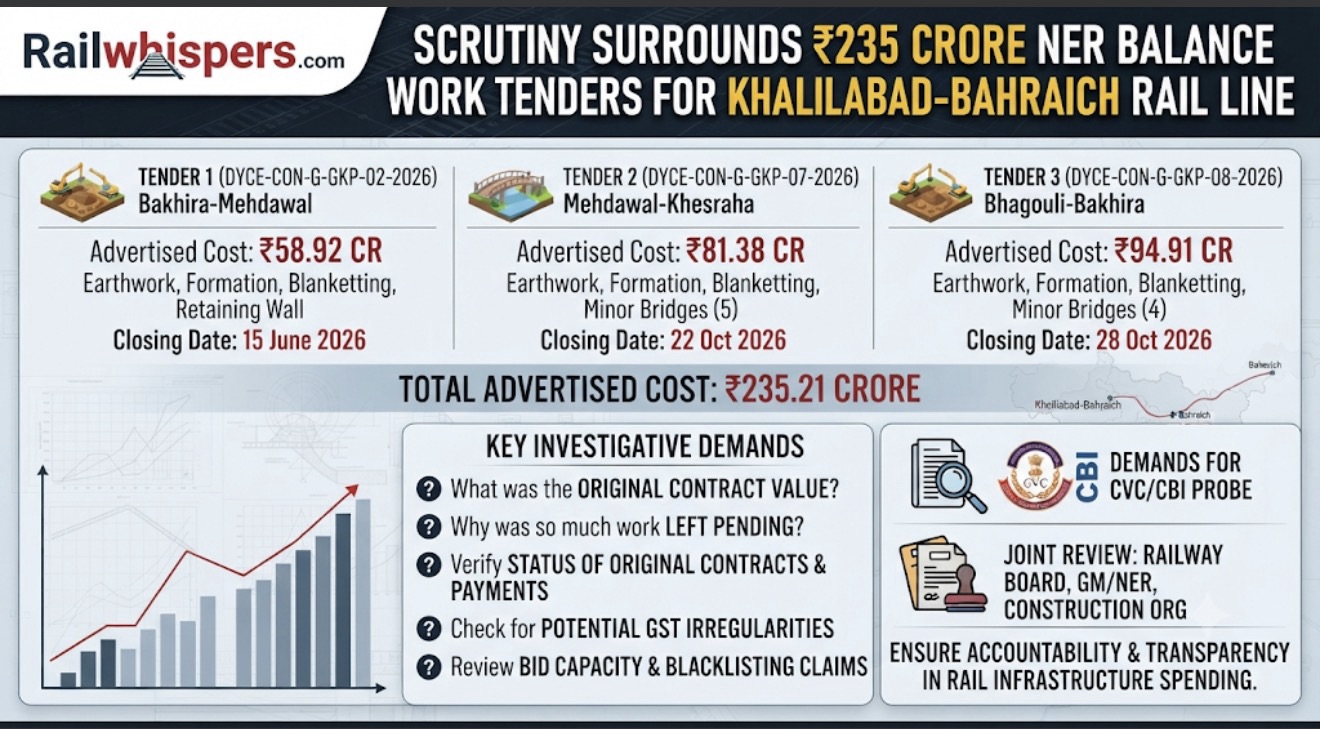
Scrutiny Surrounds ₹235 Crore NER Balance Work Tenders for New Khalilabad-Bahraich Rail Line
Over ₹235 Crore ‘Balance Work’ Tenders in North Eastern Railway Under Scrutiny; Demands Raised for Investigation into Original Contracts, GST, and Bid Capacity
Three tenders issued for the Khalilabad–Bahraich new broad gauge railway line project have raised significant questions. What were the values of the original contracts? Why was so much work left pending? And who will be held accountable?
Following the issuance of three major ‘Balance Work’ tenders for the Khalilabad–Bahraich new broad gauge railway line project by the Construction Organization of North Eastern Railway, Gorakhpur (CAO-C-NER-ENGG/GKP), several questions have been raised regarding project costs, the status of original contracts, and actual work progress. According to available tender documents, the total advertised cost of these three works is approximately ₹235.21 crore. The central question is: since these works were part of the original project, how much work was completed under the original contracts, how much was paid, and why has such high-value ‘balance work’ become necessary now?
- First Tender (No. DYCE-CON-G-GKP-02-2026): Covers balance work for earthwork, formation, blanketting, and retaining wall construction in the Bakhira–Mehdawal section. The advertised cost is ₹58,916,089.73 (approximately ₹58.92 crore). The tender closing date listed in the document is June 15, 2026.
- Second Tender (No. DYCE-CON-G-GKP-07-2026): Includes balance work for earthwork, formation, blanketting, and minor bridges (Nos. 40, 44, 46, 53, and 60) between the Mehdawal and Khesraha sections. The advertised cost is ₹81,38,02,081.72 (approximately ₹81.38 crore). The closing date is October 22, 2026.
- Third Tender (No. DYCE-CON-G-GKP-08-2026): Includes balance work for earthwork, formation, blanketting, and minor bridges (Nos. 15, 25, 35, and 37) between the Bhagouli and Bakhira sections. The advertised cost is ₹94,90,98,102.56 (approximately ₹94.91 crore). The closing date is October 28, 2026.
Thus, the total advertised cost of all three balance work tenders stands at approximately ₹235.21 crore.
The foremost question arising from these figures concerns the cost and current status of the original contracts. What was the original contract value awarded for these sections? How much has been paid to the original contractors so far? How much work was shown as completed versus left incomplete in the original agreements? Did the need for balance work arise due to changes in work volume, design, site conditions, or other technical factors, or were there execution shortcomings requiring investigation? These questions can only be answered through the original Letter of Acceptance (LOA), approved Bill of Quantities (BOQ), payment details, and section-wise progress reports.
Another critical question is whether prior approval from the competent authority was obtained before terminating the original contracts or taking other punitive actions. Was the termination process executed in accordance with prescribed contract conditions? Were contractors given proper notices, opportunities to respond, and stipulated timeframes? Related file notings, approvals, termination orders, and departmental inquiry records should be made public to clarify whether responsibility lay with the contractor, departmental decisions, or mutual circumstances.
Local discussions surrounding the construction office also hint at potential financial adjustments exceeding ₹100 crore. However, this claim lacks independent verification from available documents. Therefore, rather than apportioning blame to any individual or company based on speculation, an independent financial audit of the original contracts, payments, balance work calculations, and new tender rates should be conducted. The investigation should verify whether there was any double assessment of work volume, payment, or cost, and ensure proper technical justification exists for every item.
Demands have also been raised to investigate potential GST-related irregularities. It is alleged that changes in the quantity or classification of certain items may have granted undue GST benefits to a company. Verifying this allegation requires reconciling original and modified BOQs, tender conditions, applicable GST rates, supply and execution bills, payment records, and approvals from concerned officials. If any item was modified, its technical and financial rationale must be made public. Declaring this a GST scam based solely on allegations is unwarranted; conclusions should only be drawn after document verification.
Level books, measurement books, chainage-wise earthwork records, blanketting quantities, bridge construction measurements, site inspection reports, and payment bills are vital for verifying actual volumes and payments in railway works. Consequently, demands have been made to secure original records and conduct investigations by the Central Vigilance Commission (CVC) and the Central Bureau of Investigation (CBI) if necessary. Specifically, it must be verified that the scopes of work in different tenders are clearly demarcated and that no double measurement or payment occurred for any location.
The transparency of the tendering process must also be a key component of the investigation. Full disclosure should be made regarding how many contractors participated in each tender, who qualified technically, who was disqualified, who emerged as L1, and what rates were accepted. If any work was invited under the Special Limited Tender (SLT) process, details regarding the invited companies, eligibility criteria, and selection basis should be brought to light. This will help determine whether competition was adequate and if any procedural improprieties occurred in awarding undue advantages.
Another allegation is that a company executing related work was previously blacklisted by the National Highways Authority of India (NHAI). This claim must be verified by examining the relevant order, its duration, and current legal status. Furthermore, it should be checked how such an order, if valid, affected railway tender eligibility conditions and whether it was disclosed in the documents submitted by the company. Mere allegations of blacklisting do not automatically prove a company’s present disqualification.
A need for investigation into bid capacity has also been highlighted. It is alleged that a company failed to correctly reflect ongoing works in the coalfield region during its bid capacity assessment. If true, original tender documents, the list of ongoing works, remaining liabilities, work progress, and bid capacity calculations must be examined to verify the accuracy of the information provided. It should also be checked whether relevant officials properly verified available documents during tender evaluation.
In light of this entire matter, appeals have been made to the Railway Board, the General Manager of North Eastern Railway, the Construction Organization, and concerned vigilance agencies to conduct a joint review of all three tenders. A comparative statement detailing original contract costs, contractor names, contract termination statuses, payments made to date, actual remaining work, new tender costs, participating contractors, and accepted rates should be made public. Additionally, chainage-wise physical progress and payments for each section must be reconciled. To be continue..