

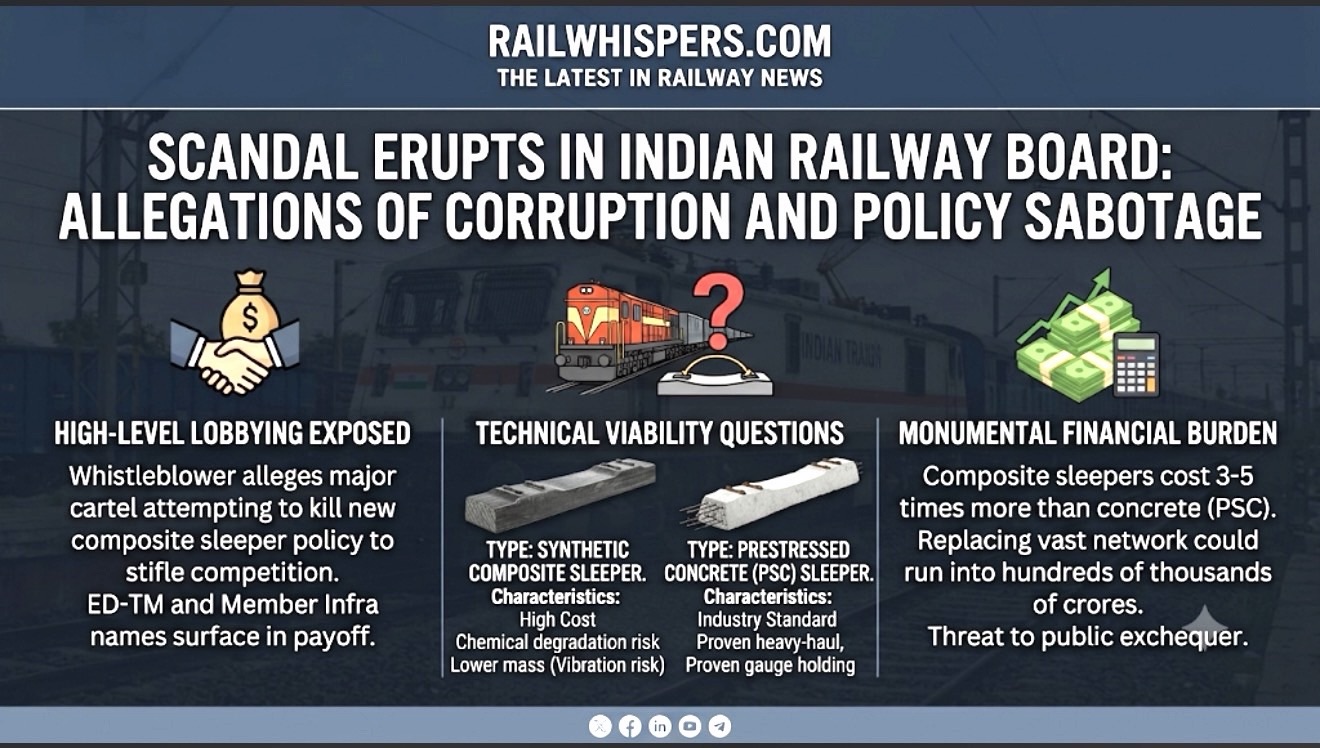
Railway Board Hit by Payoff Allegations and Massive Cost Fears over Composite Sleeper Policy
A major controversy involving allegations of high-level lobbying, illicit financial collections, and manipulation of public procurement policy has surfaced at the apex level of the Railway Board. According to whistleblower disclosures and industry insiders, the proposed modernization policy for introducing advanced carousel-based manufacturing technology for railway sleepers is facing deliberate sabotage by an established cartel of legacy manufacturers seeking to stifle competition, even as severe technical flaws and staggering financial implications threaten the public exchequer.
Ep250: कम्पोजिट स्लीपर पॉलिसी: स्टॉक ब्रोकर बने अधिकारी!
The issue traces back to the Railway Board’s initiative to upgrade track infrastructure by adopting carousel-based sleeper plant technology. Initially, the transition was anticipated to involve only a select few dominant sleeper manufacturers operating multiple manufacturing units across the country. However, when the Research Designs and Standards Organisation (RDSO) formally floated an Expression of Interest (EOI) for the carousel-based system, the procurement landscape shifted dramatically as nearly forty applications poured in from diverse existing manufacturers. This surge in open participation threatened the long-standing monopolistic hold of dominant players, triggering intense backchannel maneuvers to scuttle the modernization drive entirely.
Sources indicate that established manufacturers running multiple plants began aggressive lobbying with apex-level authorities in the Railway Board to abandon or withdraw the proposed carousel policy to prevent wider market entry. More gravely, specific allegations point to an organized collection drive where massive monetary contributions were reportedly extracted from select sleeper manufacturers under the guise of top decision-makers, specifically invoking the name of the Member (Infrastructure) with active facilitation from the Executive Director/Track Modernisation (#EDTM). Disturbingly, certain individuals and manufacturing entities currently under the scanner of the Central Bureau of Investigation (#CBI) in ongoing corruption probes are reportedly playing a central role in coordinating these financial collections and policy manipulation efforts.
These developments have prompted urgent demands for a high-level, independent vigilance and anti-corruption probe. Whistleblowers have urged competent investigative agencies to verify whether illicit funds were collected in the name of senior Railway Board officials, identify the specific intermediaries orchestrating the nexus, examine attempts to derail fair market competition, and establish the complicity of railway officials who may have aided this sabotage for commercial kickbacks.
Beyond administrative integrity, the financial viability of introducing composite sleepers on a large scale presents a monumental threat to the public exchequer. A standard Pre-stressed Concrete (#PSC) mainline sleeper currently costs Indian Railways approximately ₹2,500 to ₹3,500 per piece, whereas a composite synthetic sleeper is exponentially more expensive, typically costing between ₹10,000 and ₹18,000 per piece depending on specialized polymer grades and imports—amounting to roughly three to five times the cost of conventional concrete sleepers.
Across Indian Railways’ vast network of approximately 70,000 route kilometers (spanning well over 1,00,000 track kilometers), where standard broad gauge sleeper density ranges between 1,540 and 1,660 sleepers per kilometer, the requirement runs into nearly 15 to 16 crore sleepers. Replacing or standardizing tracks with composite sleepers across even a fraction of this vast network would translate into an astronomical expenditure running into hundreds of thousands of crores of rupees, placing an unsustainable burden on public funds without commensurate lifecycle advantages over domestic PSC sleepers.
Compounding the financial crisis are serious technical and engineering reservations regarding the deployment of composite sleepers on the Indian Railways network. As Indian Railways rapidly expands high-speed corridors and heavy axle loads—such as 25-tonne and 32.5-tonne axle loads for double-stack container operations on dedicated freight corridors—the structural stability and long-term viability of composite sleepers remain heavily contested. While traditional prestressed concrete (PSC) sleepers offer high mass and track modulus necessary to absorb extreme dynamic lateral and vertical forces, composite synthetic sleepers have a much lower density and mass, raising legitimate concerns about track shifting, resonance, and inadequate track resistance under punishing axle loads at sustained high speeds.
A major technical vulnerability lies in fastener retention and gauge holding capability. Under continuous heavy-haul vibrations and cyclical loading, composite materials are susceptible to micro-cracking, thread stripping, and fastener loosening at the screw-spike interface. Over extended operational cycles, maintaining the required torque and tightness on screws embedded in composite substrates poses significant maintenance challenges, carrying the latent risk of sudden gauge widening and derailments if fastener seating degrades.
Furthermore, the extreme diversity of the Indian climate presents severe operational hurdles for composite materials.
Unlike temperate European or North American conditions where synthetic and recycled polymer sleepers have found niche applications primarily on steel girder bridges, turnouts, and light rail transit to prevent wooden sleeper rot, the Indian subcontinent subjects permanent way components to relentless ultraviolet (UV) radiation, ambient summer temperatures exceeding 45 to 50 degrees Celsius, and intense monsoon humidity. Prolonged thermal exposure and UV degradation can accelerate the aging of composite polymers, causing brittleness, thermal expansion anomalies, and loss of structural elasticity over time.
While European networks have utilized composite sleepers effectively in specialized, low-tonnage segments, their adaptation to standard broad gauge (1676 mm) heavy-haul mainlines in India remains technically challenging. The wider broad gauge track inherently exerts larger bending moments on the center of the sleeper compared to standard gauge systems, requiring exceptional flexural strength and uniform ballast bed reaction. In the absence of rigorous, multi-year broad gauge field trials under peak axle loads and harsh ambient conditions, rushing into widespread composite sleeper policies without resolving administrative integrity, structural viability, and massive financial liability risks compromising both passenger safety and the national exchequer.