

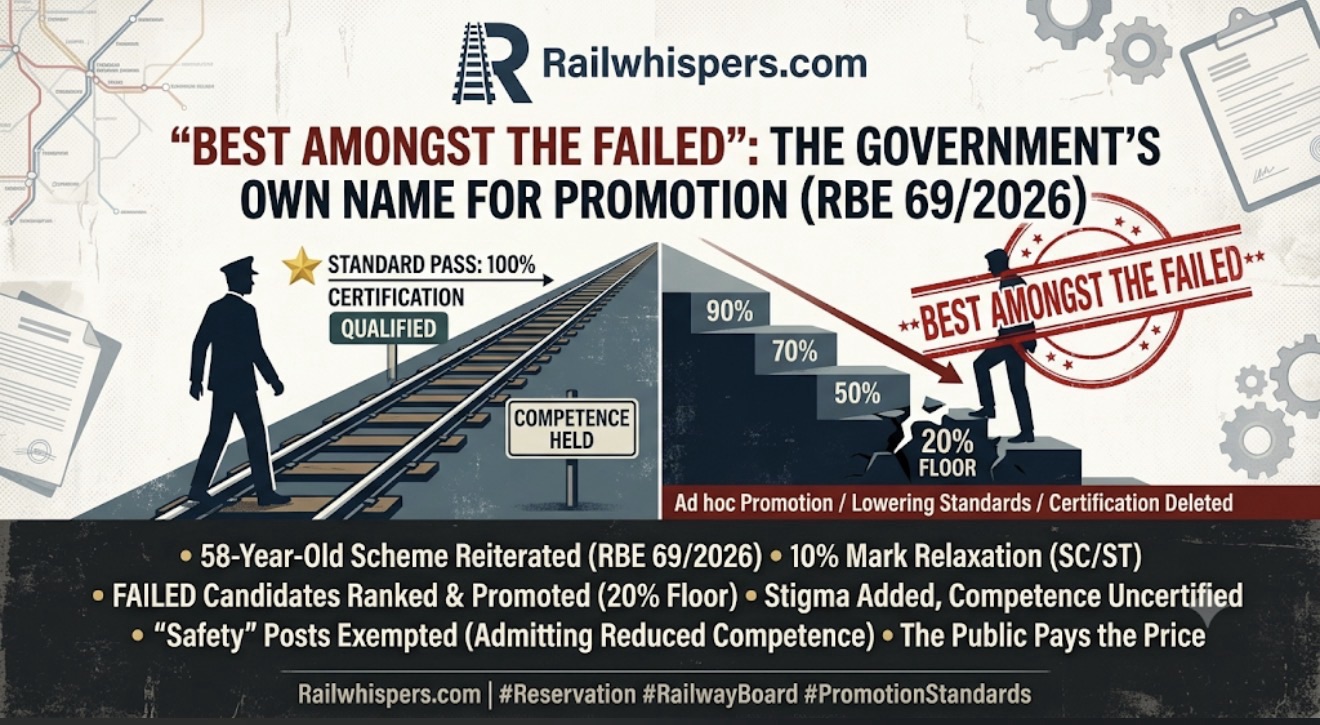
“Best Amongst the Failed”: The Government’s Own Name for What It Does
On 31 August 2026 the Railway Board reissued a 58 year old scheme for filling promotion posts. Its own name for the scheme tells you everything. What follows is not about any community. It is about what the public is being made to pay for, and what every other serious country refuses to do.
Editor’s Note: This publication knows the ground it steps on. #Reservation touches lives, histories and wounds, and nothing below questions reservation at the point of entry into public employment. The question raised is narrower and different: whether, after entry, the assessment of competence for promotion can be diluted. It is precisely because the two questions are so often treated as one that this analysis is published. Readers who disagree are invited to write in. Reasoned counter views will be carried on these pages with the same prominence.
On 31 August 2026 the Railway Board issued a circular RBE No. 69/2026. It is a modest looking document, four pages, two of them a distribution list, and it announces nothing new. It says so itself: “confusion and doubts are persisting”, so the guidelines are “hereby issued/re-iterated”. The reference list at its head begins with a circular of 27 August 1968.
Fifty eight years. Read the provisions slowly. They are the point.
For promotions within Group ‘C’ in non-safety categories, a Scheduled Caste or Scheduled Tribe candidate gets a 10 per cent relaxation in the qualifying marks. If the reserved vacancies still cannot be filled, a second scheme takes over. The Board prints its name in bold type: “Best Amongst the Failed.”
Those are not my words. They are the Government of India’s words, in an official circular, signed by a Joint Director of the Railway Board, circulated to every zonal railway and production unit in the country.
Read the phrase again. Not the best. Not the qualified. The best amongst the failed. Candidates who have failed the examination, failed it after the pass mark was already cut by a tenth, are ranked by their marks, and the top of that ranking is placed on the promotion panel, to the extent of the vacancies reserved for them. The floor beneath this ranking is 20 per cent in each heading. One mark in five. The promotion is ad hoc, reviewed after six months, and then regularised. Regularised by whom? By the panel approving authority. The same authority that made the placement sits in judgement on whether the placement worked. The examiner failed the candidate. The appointing authority promoted him anyway. The appointing authority then certifies its own decision a success. Somewhere in this circle, the office itself, the thing the public pays for, has simply disappeared from the reckoning.
What a pass mark is
Begin from first principles, because the circular never does.
A qualifying mark in a promotion panel is not a favour the administration does itself. It is a certificate issued to third parties. To the subordinates who must take orders from the man promoted. To the other departments that must rely on his signature, and to the citizen whose money pays the salary attached to the post. The mark says: “we, the employer, certify that this person can carry this charge.”
Now hold that against the sentence this argument rests on. An organisation may choose whom it admits, and may weight that choice towards representation. Once it admits a person, it owes every employee the same development and every office the same certified level. Representation is delivered at the point of competition. Competence is certified at the point of investiture. RBE 69/2026 blurs the second to advertise the first. Best Amongst the Failed goes further and deletes the second, leaving a rank where a level stood.
A rank certifies nothing. It tells you only who did better than whom inside whatever pool turned up that year. In a strong year the best of the failed sits just under the bar. In a weak year he sits anywhere above one fifth of the marks. The competence of the promoted grade stops being a level the organisation holds and becomes an accident of the vintage. No private employer would run a workshop this way. The railway runs a subcontinent this way.
And who bears it? These are public offices. Every salary in that circular is paid out of taxes raised from citizens of every caste, including, it needs saying, the Scheduled Caste passenger in the general compartment whose safety and service depend on the competence the Board has stopped certifying. When the state dilutes the certificate, it is not being generous with its own money. It is being generous with yours.
What the rest of the world does
Is this, perhaps, simply what affirmative action looks like everywhere? It is not. The instructive fact is that almost every serious jurisdiction that practises preference has drawn precisely the line this circular erases.
The European Court of Justice, in Kalanke (1995), struck down a Bremen rule that gave women automatic priority in promotion, and in Marschall (1997) allowed preference only between candidates who were equally qualified, and even then only with a saving clause for individual assessment: the preference operates at the tie, and the standard itself is never touched.
The United Kingdom wrote the same line into statute. Section 159 of the Equality Act 2010 permits positive action in recruitment and promotion only where the preferred candidate is “as qualified as” the other. Parliament debated it, the guidance repeats it, and the phrase is the whole point: representation may decide between the qualified, it may not manufacture qualification.
South Africa, with a history of state enforced exclusion far more recent than ours, requires in its Employment Equity Act that the beneficiary of preference be “suitably qualified”. The American federal service rests on statutory merit system principles, and the United States Supreme Court in 2023 shut down race conscious university admissions altogether. One may agree or disagree with that last judgment. But notice what nobody in any of these systems defends: a published government scheme for appointing, by name, the best amongst the failed.
India stands alone here, and stands alone by deliberate constitutional choice. In 1996 the Supreme Court held that relaxed qualifying marks in promotion were impermissible. Parliament answered in 2000 with the Eighty-second Amendment, inserting a proviso into Article 335: nothing shall prevent “relaxation in qualifying marks in any examination or lowering the standards of evaluation, for reservation in matters of promotion”. The Court upheld the proviso in M. Nagaraj (2006), and in B. K. Pavitra II (2019) obligingly redefined the “efficiency of administration” that Article 335 was written to protect. So let there be no mistake: RBE 69/2026 is legal. Impeccably legal. The Constitution was amended, specifically, to overrule the judges who said the standard must hold. That is not a defence of the scheme. That is its indictment. Parliament confused two different instruments, representation and certification, and a confusion does not improve by being ratified. It merely becomes harder to repeal.
The overstretch
Concede, first, what deserves concession. The case for representation at the point of entry is real. Candidates arrive at the gate from unequal schools and unequal histories, and the state compensates at the gate for a disadvantage it did not create. And concede more, because a charge lands heaviest when everything fair has been admitted first. So admit this too: selection instruments inside a service can carry bias. Viva marks are discretionary. Records of service are written by men, and men have prejudices.
But watch what has been done with that concession. It has been stretched from the gate to every rung of a forty year career. From equalising the competition to abolishing the criterion. From a helping hand at the door to a lifetime exemption from measurement. From a corrective to a permanence: “fifty eight years of circulars, and not one of them asks by how much the gap has narrowed since 1968, or when the relaxation might retire.” A corrective that never measures the fault it corrects is not a corrective. It is a parallel standard, made hereditary. Entire careers have begun and ended inside its currency, first posting to farewell garland, and still nobody has asked when it ends. Nobody will.
And here the argument must be pressed to the point that is usually left unsaid. After entry, both candidates have had the same employer, the same training schools, the same seniority channels. The employer controlled every one of those years. If the gap persists, the development system failed, and the marks relief is the cheapest possible way of hiding that failure. If the panels are biased, fix the panels, for everyone. A lower pass mark on a biased instrument preserves the bias and adds a stigma. Note that the circular itself keeps the ledger it pretends does not matter: an SC or ST candidate who qualifies at the full standard, it says, is counted against the unreserved vacancy. So the Government’s own record shows, for every officer, whether that officer cleared the bar or was carried past it. Having written the record with its own hand, in its own circulars, the administration cannot feign surprise that colleagues and subordinates read it.
There is a further perversity, and it is structural. This same society polices discrimination with the most stringent instrument in its statute book. The Scheduled Castes and Scheduled Tribes (Prevention of Atrocities) Act creates statutory presumptions against the accused, dispenses with preliminary inquiry, and bars anticipatory bail, a bar the Supreme Court upheld in 2020. Whatever one’s view of that architecture, its premise is plain: discrimination is a crime, the state will presume much and forgive little, and every workplace in the country stands warned. Very well. Then the state cannot, in the same breath, run its own promotion panels on the opposite premise, that its departments are so incurably prejudiced that their assessments must be discounted by statute and their standards abandoned by circular. Choose one. If the discrimination is real and identifiable, prosecute it with the ferocious law already enacted. If it is not, hold the level. What cannot be honest is to criminalise bias with one hand and institutionalise the presumption of it with the other, forever, against the public’s payroll.
The Board’s own confession
Does relaxation lower competence? Do not ask me. Ask the circular. It contains one exception, stated in a single bare sentence: there is no relaxation of any kind for safety category posts.
Why not? The Board does not say, because it does not need to. Everyone knows why not. A relaxed standard on the footplate produces a wreck, and a wreck is counted, photographed, inquired into and answered for within the week. So the Board has answered the only question that matters: relaxed marks mean reduced competence, which is precisely why it will not permit them where the dead bodies would be visible. In the non-safety posts, where a wrong contract, a padded bill or an inflated appraisal bleeds the exchequer quietly for years and is attributed to nobody, the relaxation runs free, decade upon decade, renewal upon renewal. The exception does not soften the scheme. It convicts it. The line the Board has drawn is not between posts where competence matters and posts where it does not. It is between failures the public can see and failures it cannot.
So state the demand plainly, and let it be answered plainly. Reserve the vacancy if you must. That is representation, and a debate this article has not asked to reopen. But hold the level. If the level defeats the candidate, carry the vacancy, publish the gap, and spend on the training that closes it. A carried vacancy embarrasses the administration into action, which is exactly why the administration prefers to fill it and file the embarrassment under a bold heading. Fifty eight years ago the public was told this was temporary. Ask the Board a single question and insist on a dated answer.
When does the best amongst the failed give way to the best?