

Approved by RDSO | Part VI: “A Policy Built on Confusion About What RDSO Is For”
Parts IV & V showed what the vendor approval policy took from the technical departments and what the committee did with it. This part asks why the policy was written this way. The answer is confusion about what RDSO is for, at both ends of every letter!
Editor’s Note: This article is based on Railway Board instructions in the public administrative record and on the service experience of serving and retired officers. Statements that rest on service experience are marked where they appear. The Railway Board and RDSO are invited to reply, and any reply will be printed in full !
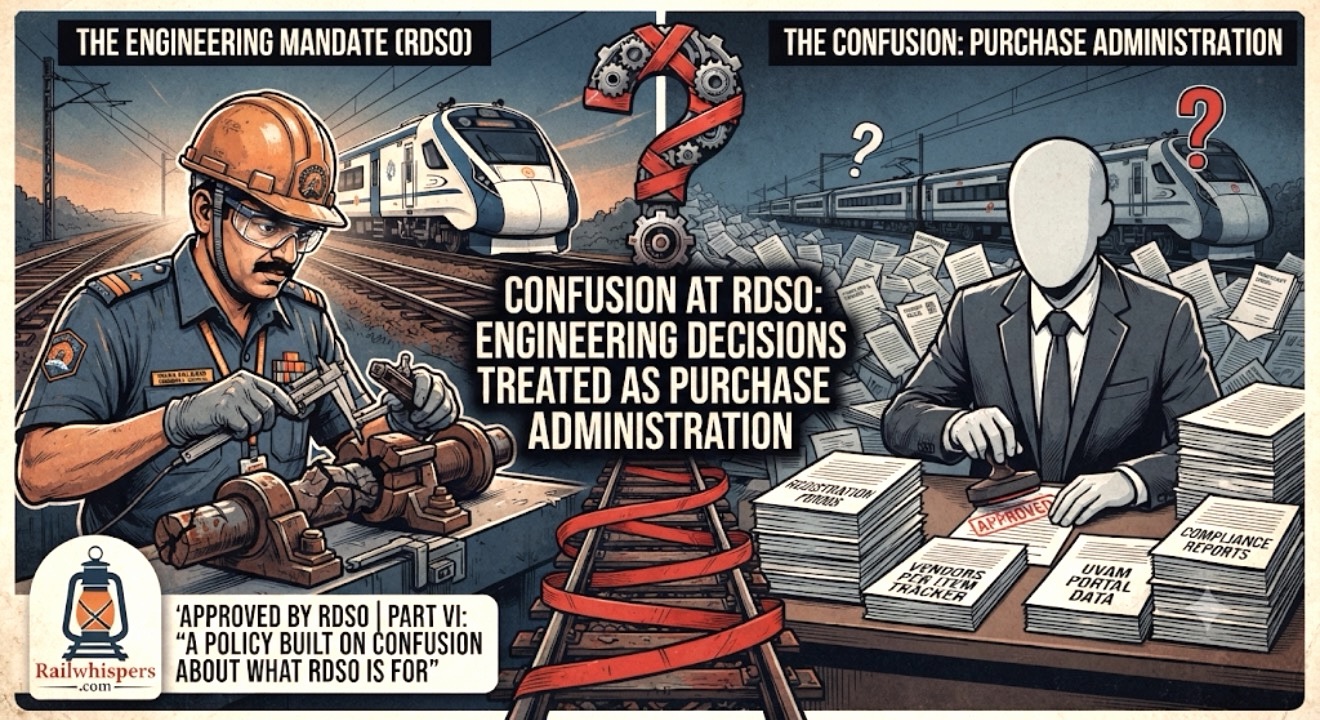
RDSO exists to answer engineering questions
RDSO answers engineering questions for Indian Railways. Which design is safe. Which supplier can make it. Why a part failed in service. What must change in the specification so that it does not fail again.
Each of these is an engineering job. #Vendor development is an engineering job. Service engineering is an engineering job. None of them is a paper exercise.
The #Policy of 18 January 2022 treats them as purchase administration. It measures success in days to register a vendor, vendors per item, and entries on the #UVAM portal. It treats the supplier base as the natural ground of the #Stores department. This publication reported in 2024 that the Stores Directorate had moved into engineering decisions on how many vendors an item should have (“Vendor Approval in Railways: Industry Paying Price of Incompetence of RDSO” 9 April 2024).
That is the confusion this part is about. An engineering question and a purchase question have been read as one question.
Who writes the letters
A Railway Board letter is as good as the officers who draft and approve it.
The author’s account, from service experience, is this. Many Board posts that shape vendor, design and specification policy are held by officers who have never dealt with an asset failure in the field. Some have never led a root cause investigation. Few have worked with international practice in safety and reliability management, where both are built into the design and not just inspected in at the end.
The Railway Board can test that account. It holds the service record of every officer in those posts.
An officer without that exposure can still issue a correct letter. The officer cannot judge what the letter will do on a division.
Who reads them
The same gap exists at the receiving end. The letter is read by officers and staff who have not seen how other sectors of the economy manage suppliers, reliability and safety.
So the letter moves from desk to desk. Each desk complies. No desk asks whether the problem named in the letter is getting smaller.
In the author’s view, many of these officers are expert at managing a post and not at solving a problem. They produce trackers and spreadsheets on time. Vendors who sit across the table find them easy to deal with.
The Board’s own letters record the result
The vendor approval file shows letters that record a problem and do not control it.
- Ten targets, none counted. The policy of 18 January 2022 set sixty days to developmental status, two years to approved status, five approved vendors per item as the benchmark and ten as the norm, a costing and market research cell in every approving agency within three months, and six more. This publication has found no published figure against any of the ten.
- The Board asked whether its own policy was carried out. On 6 September 2024 it wrote to the Director General, RDSO, for progress on paragraphs 16, 15, 13 and 8. That was two years and seven months after the policy issued.
- One order, issued three times. On 30 March 2022 the Board made the UVAM directory the only valid directory from 1 April 2022. It repeated the order on 20 December 2024 and again on 27 April 2026. The third letter records that the instructions are still not followed, and that a breach can lead to unsafe train operations.
- The first order for a new supplier was cut. Paragraph 16.3 set a developmental order at a quantity “sufficient enough for upgradation to approved category”. On 6 September 2024 the Board told RDSO to use that power. On 1 April 2025 it amended the quantity to that “required for listing vendors in the category of developmental vendors”. This publication reported on 15 September 2025 that RDSO had not placed a single developmental order since January 2022 (“New Vendors Shut Out: RDSO Ignores Railway Board’s Directives, Cartel Allegations Surface”).
- The closed list was meant to shrink. Paragraph 5.8 requires a yearly review to take items off the restricted list. Four notifications were due by 2025. This publication has seen none. On 10 November 2025 the Board added sub-components to the list instead.
A letter that repeats an order three times has not solved the problem. It has merely recorded it three times.
Two postings
Confusion about what a post needs shows in who is placed in it.
An officer was posted as Chief Vigilance Officer at RDSO, a sensitive post. The officer had a break in service. During that break, and it was known at the time, the officer worked as a salaried employee of railway vendors. Some of those vendors had cases under vigilance investigation. In the RDSO post the officer would have handled cases against former employers.
When this became public by this publication, the officer was removed from the post. The officer was then allowed to take voluntary retirement (VRS) with all the retirement benefits, without a public inquiry. The officer now works for a supplier for Indian Railways.
The second officer also has a break in service. That officer holds a post that manages the cadre of a large department.
Help a colleague if there is reason to. But should such officers hold such posts? Vigilance at the approving agency and cadre control of a department are sensitive posts. The test for them is not seniority or availability. It is whether the officer carries a conflict.
A trap in Howrah, the same week
On 15 September 2026 the CBI, Anti Corruption Branch, Kolkata, registered a case against a Deputy Director and a Senior Section Engineer of RDSO, Lucknow, and against a Kolkata firm that makes rail clips and three of its people (FIR RC0102026A0007). The same day it arrested the two officers and two company representatives red-handed at a hotel in Howrah, with Rs 4 lakh. Searches in Kolkata, Lucknow and Bihar recovered a further Rs 4.73 lakh. (16 September 2026, StudyCafe, “CBI Arrests Four, Including Two Senior Officers of RDSO Lucknow, in Bribery Case”) The charges are unproven and nobody has been tried. Part VII sets out what the FIR says about the inspection.
Both officers work in the Track Directorate of RDSO. That directorate falls under the Member (Infrastructure), who spent two days at RDSO in the same week before the trap. The visit did not stop an inspection team from the same vertical taking the hospitality of the firm it was inspecting.
The disease is old
RDSO has long been a playground of senior officers and vendors. The CBI has acted against railway staff there at every level. A former Director General was raided by the CBI in Lucknow. Staff down to Section Officer have been caught.
This publication reported in 2023 that appointments at RDSO were manipulated by vendors and their interest groups (“Wither RDSO !” 5 October 2023).
Many people were surprised by Bondamunda and Puri this year. Retired officers were not. They quote a Hindi proverb: plant a babool tree, and do not expect mangoes.
What RDSO needs
In the author’s view, RDSO needs two things.
- Officers who come to Lucknow because the railway needs them there, not because Lucknow suits them.
- A system that protects those officers from two risks: a vigilance case over an honest technical decision, and the pull of the vendor and officer nexus.
Neither can be done by a Board letter. Both need political will.
This publication asked for the first in January 2026, when the present Member (Infrastructure) took charge. It asked that officers trained abroad be brought to RDSO (31 January 2026, Editorial—“On Thin Ice”).
Four management principles the policy breaks
None of these needs a standard or a consultant. Each is taught in the first term of any management course, including at the railway’s own training institutions.
- Match the person to the post. A post that decides engineering questions needs an officer who has solved them. A sensitive post needs an officer with no conflict. The two postings above fail the second test. A posting sought for the comfort of the city fails the first.
- Give authority with responsibility. A person answerable for an outcome must hold the power to affect it. This publication read a Board order against this principle on 7 September 2026 (“Maximum Government at Rail Bhawan | Part 2: Read the Letter with a 1916 Textbook”). Part IV showed the same split here. The technical head answers for the part and does not choose the supplier.
- Hold a person accountable only for what the person controls. Otherwise the person hides information, manages the appearance of the work, or leaves the post. Part V showed all three in the committee that is meant to remove a poor supplier.
- Name the objective that governs. The technical objective is an asset that works for its design life. The procurement objective is a clean and competitive purchase. Both are proper, and they conflict. In eleven instructions from 2015 to 2026, the Board never says which one governs.
Engineering decisions need engineers
The Ministry of Railways spends more than two lakh crore rupees of capital a year. Money on that scale needs steady and expert hands.
An engineer is not trained to be politically correct. An engineer sees a decision in plain terms, because a wrong decision can cost lives. A rail, a bridge or a coach stays in service for twenty to fifty years. The engineer judges a decision by what it does over that life, not by the output it shows this quarter.
Vendor development and service engineering belong with officers who think that way.
What to ask for
- State in one paragraph what RDSO is: “an engineering agency answerable for design and service performance, or a registration office for suppliers.” Print it in every office in RDSO’s and Railway Board.
- For each Board post that drafts vendor, design or specification policy, publish the field, failure investigation and international exposure the post requires. State whether the present holder meets it.
- Publish the figure achieved against each of the ten targets of 18 January 2022, for each year since 2022, or state that it was never counted.
- State the rule for posting an officer with a break in service, or with prior private employment, to a sensitive post. State whether it was applied in the two cases above.
- Publish the background of every vigilance officer posted in RDSO and Railway Board: “What is their background, decision-making positions held, tenders decided, drawings & specifications finalised under their signature!”
- Publish the file noting behind the amendment of 1 April 2025.
Decide what RDSO is for. Then post officers who can do it.
Earlier reports on RDSO in this publication:
- 10 April 2026, Strengthening Procurement Integrity in Indian Railways: The Urgent Need to Address Fraudulent Authorizations
- 31 January 2026, Editorial—”On Thin Ice”
- 15 September 2025, New Vendors Shut Out: RDSO Ignores Railway Board’s Directives, Cartel Allegations Surface
- 16 June 2025, RDSO Engulfed in Corruption Scandal: Deliberate Falsehood Triggers Legal Face-Off before The Court
- 14 June 2025, Explosive Corruption Scandal Rocks RDSO: Director Undermines Own Department, Endangers Rail Safety
- 23 May 2025, Disentangling the Vendor Development Processes of RDSO, Part-I
- 9 April 2024, Vendor Approval in Railways: Industry Paying Price of Incompetence of RDSO
- 5 October 2023, Wither RDSO !
- 3 October 2023, Policy Corruption: Disclosure of Criminal Collusion Between Unscrupulous RDSO Officials and Private Entities, Endangering the Integrity of Train Operations and Maintenance
- Part V of this series: 10 September 2026, Approved by RDSO | Part V: Three Men in a Room, and One of Them Answers for the Bearing
- Part IV: 9 September 2026, Approved by RDSO | Part IV: He Answers for the Part. He Does Not Choose the Supplier
- Part III: 1 September 2026, Approved by RDSO | Part III: The Chair Was Filled. The Job Was Not
- Part II: 1 September 2026, Approved by RDSO | Part II: The Insulator That Does Not Tell You It Has Failed
- Part I: 30 August 2026, Crisis Looms Over Railway Electrification: Two-Supplier Dominance in OHE Insulators, Soaring Prices, and Stalled Projects