

Approved by RDSO | Part IV: He Answers for the Part. He Does Not Choose the Supplier
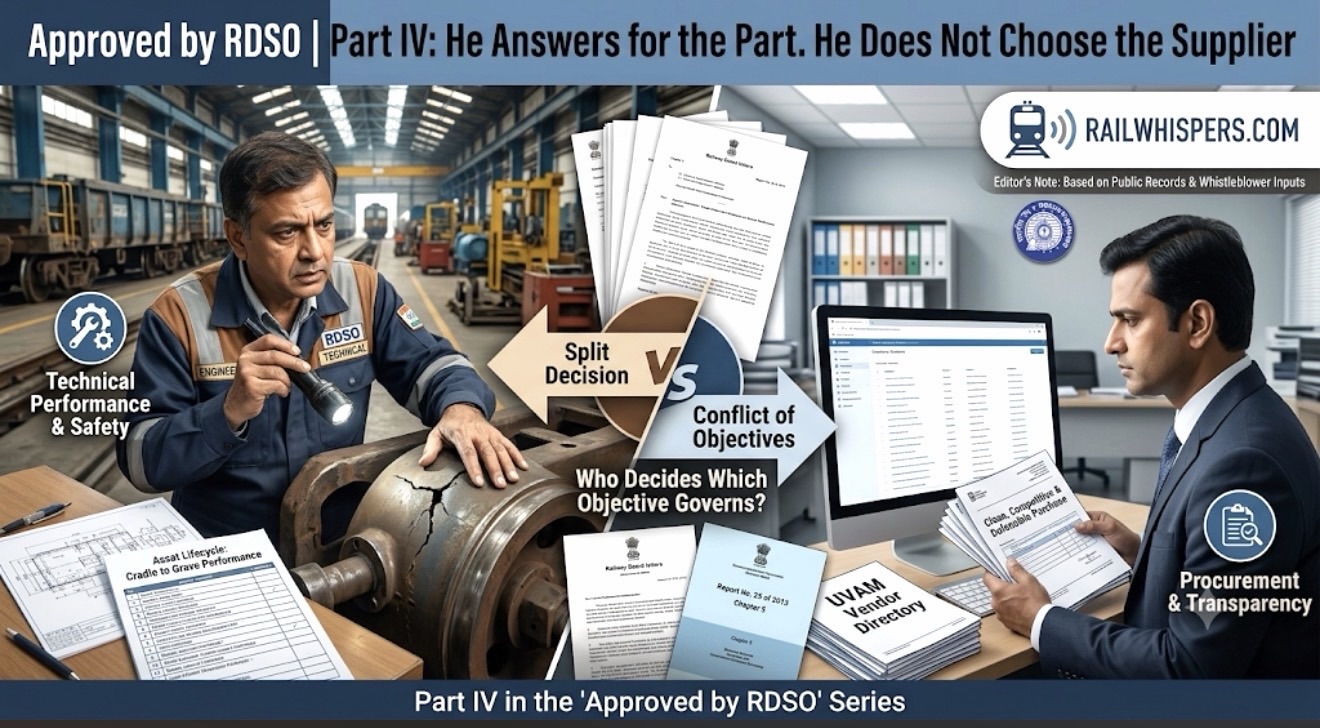
Part II (1 September 2026, “Approved by RDSO | Part II: The Insulator That Does Not Tell You It Has Failed”) ended at a chair. Part III (1 September 2026, “Approved by RDSO | Part III: The Chair Was Filled. The Job Was Not”) asked who had been posted to it. This part asks what that officer is still allowed to decide. A technical head is paid for cradle to grave performance of the item. A Stores officer is paid for a clean, competitive and defensible purchase. Both objectives are proper. Eleven Railway Board letters have moved the decision from the first to the second, and left the answer where it was!
Editor’s Note: This article is based on Railway Board instructions in the public administrative record and on whistle blower’s inputs. The Railway Board and RDSO are invited to reply, and any reply will be printed in full !
Two men can both do their jobs properly and still produce a bad wagon. That is the subject of this part, and it is not a story about bad people. A #technical head is paid for one thing. Cradle to grave performance of the items that go into the railway system. He is judged on whether the part works, on whether it keeps working, and on what happens when it does not, and his name sits against that part from the drawing to the scrap depot. A #Stores officer is paid for something else, and it is equally proper. A purchase that is clean, competitive, on time, correct in procedure, and defensible in audit and before vigilance. Neither man is dishonest and neither is idle. They simply answer to different objectives.
Now ask the only question that matters. When those two objectives pull in opposite directions, who decides which of them governs? Between January 2015 and April 2026 the Railway Board answered that question in eleven letters, without once putting the question to itself in those words.
The Board did not invent the problem
Grant the complaint the #Policy was written to answer, because that complaint was real and the state’s own auditor put it on the record. The Comptroller and Auditor General looked at five years of purchase on Proprietary Article Certificate, in Report No. 25 of 2013, Chapter 5. The finding, in the auditor’s words: “requisite steps were not taken for development of more vendors, and this led to monopoly of existing vendors and procurement of items on higher rates”. The same chapter counted the machinery. Vendor Development Cells, ordered by the Board in September 1999, existed twelve years later in three zonal railways and two production units, and vendor rating existed in four places in the whole railway.
So the Board of 2022 was not acting on a rumour, and it had thirteen years of its own evidence that the departments never built what they were told to build. Hold on to that concession, because it stands through everything that follows in this part and in the next. The Board fixed a real fault, and it fixed it by handing the decision to the second objective.
One sentence took the word safety away from the engineer
Railway Board letter 2021/RS(G)/779/7 of 18 January 2022 is the letter that governs all of this, and its subject line gives the aim: “vendor approval process, ensuring transparency and competition”. Paragraph 3 of that letter says that “only Railway Board will fix the list of safety items”, and then it adds one more sentence—
“Railway Units, including RDSO and PUs, shall not have authority to categorize any item as safety item.”
Read the two names in the middle of that sentence. RDSO writes the technical requirement, sets the test, approves the source and issues the specification the item is bought against. A production unit builds the vehicle the item goes into. Both are told they may not call an item a safety item. Calling an item a #Safety-item is a judgement about what happens when it fails, which is the first objective exactly.
Now notice who it was taken from. #RDSO is an attached office of the Railway Board. So the Board was not reaching outside itself for a technical view. That view already sat in its own office, one line below it on the same chart. It did not have to take the power away to get uniformity. It could have taken the advice.
There is a defence and it is a good one, because a safety item must mean the same thing on #NorthernRailway & on #SouthEasternRailway, and only the Board sits above both of them. But that aim did not need this sentence, because the Board can fix the list and still ask the technical department what it thinks. The sentence sets up no process. It only takes a power away.
Four years later the Board wrote the other half of it. Letter 2026/RS(G)/164/2/VIG of 27 April 2026 says that breaking the #vendor-directory rules can lead to unsafe train operations, because every item on #UVAM has safety implications. So the whole list is a safety list, and yet the men who will be asked why the asset failed may not say which items on that list are safety items.
Approval travels across the country. Failure does not
Paragraph 5.5 is the widest rule in the letter, under which one agency approves a vendor for an item and that vendor is then approved for that item for the whole of Indian Railways. That is procedural economy and it is sound, because no railway should approve again what another railway has already checked.
Now ask what happens to the news travelling the other way, because a bad supplier is found where the item is used, which is a division, a shed, a depot, or a section of track. Approval is given at the centre. Failure shows up in the field. The letter gives one road back, in paragraph 14.3, under which poorly performing vendors are to be weeded out on objective criteria, and the weeding is done by a committee of Technical, Stores and Finance members.
Three departments, and each of these three has a different objective. Technical answers for whether the part works, Stores for a defensible purchase, and Finance for whether the money was correctly spent. Only one of the three will ever be asked why the bogie cracked, and he holds one seat of the three. That room decides whether a poor supplier keeps supplying, and it is a subject of its own. Part V takes it apart.
A Chief Engineer’s letter now changes nothing
Two instructions finished the transfer. The letter of 30 March 2022 made the UVAM directory the only valid one from 1 April 2022, and declared every other form of it, on paper or online, invalid. The letter of 20 December 2024 went further. Any letter written to a vendor, and any Quality Assurance Plan (#QAP) approval granted, has no effect on that vendor’s status unless the contents are amended in UVAM itself.
Here too there is a defence, because it stops a supplier waving a ten year old letter and calling it an approval. Read it the other way and it says something harder. An officer who owns the asset writes to a supplier and nothing has happened, because what counts is an entry made on a portal somewhere else. The act that changes the world is now a clerical act, performed under the second objective.
So one short question decides how much of this matters, and that question is who may make the entry, and how long it takes from the asking. That question has never been answered in public.
One post watches everybody and answers for nothing
Board order ERB-I/2021/23/18 of 7 July 2021 made the Special Director General, Vendor Development (#SplDG/VD), RDSO, the accepting authority for the Task Force on a uniform vendor approval process. The Board letter of 6 September 2024 then gave that post a standing job. Spl.DG/VD must watch that every vendor approving agency puts the instructions of 18 January 2022 on the UVAM portal, and that includes RDSO itself and the production units.
Somebody had to hold the portal, and a coordinating post is not by itself an error. The design is the error. That post has one objective, which is a portal that is complete, uniform and up to date. That is a proper objective for a portal, and the post will never be asked why a part failed in the seventh year.
A technical head answers for that part from the drawing to the scrap depot, which is what cradle to grave means and why the job is worth holding. One letter split the power from the answer, and nobody was asked to say how the two would ever be joined again.
So ask who could have stopped it
Not who is to blame? Who was in a position to prevent it? Take the ordinary case. A source is supplying poorly. The division knows. The zonal technical head knows, and the failures are there to be seen in the shed. He can reject the consignment and he can raise a warranty claim, but neither act cuts what the railway buys next year.
So ask any Principal Chief Engineer (#PCE) or Principal Chief Mechanical Engineer (#PCME) to name the last supplier his railway got downgraded, and the date. The answers to that one question would settle this whole argument in a week.
Publish two lists, and mark one of them in two colours
Publish the standard list of items reserved for approved sources, made under paragraph 4, with the date of every addition and every deletion since January 2022.
Then mark that list in two colours. Items only the railway buys, and items that everybody else buys too. A lift or an escalator goes into hospitals, hotels and office buildings all over the country, against published national standards, from a market that manages perfectly well without a railway list. So does a great deal else on that directory.
Paragraph 5.7 of the same letter already draws that line. Only the listed items are restricted to approved sources, and everything else is to be bought by competitive bidding on generic eligibility criteria. An item with a working commercial market and a published standard behind it has no business on the restricted side of that line.
This publication does not know how many such items sit on the list today, and that is exactly why it is asking rather than asserting.
Publish the four annual notifications due under paragraph 5.8 on 1 July of 2022, 2023, 2024 and 2025.
(Coordinating agencies shall conduct a yearly review for removing items from the “standard list of items for approved vendor list/directory”, for procurement on the basis of generic eligibility criteria, particularly for items with more than five active sources, i.e. those items where technology/ quality has stabilized. Such items shall be notified by Railway Board on 1st July every year.)
If no notification was issued in any of those four years, say so. The second list is either short or empty, and if it turns out to be long then this part is wrong and the Board should say so with the dates attached.
Then answer the question the eleven letters never asked. When the man who answers for whether the part works disagrees with the man whose objective is a clean and defensible purchase, who governs? There are only two honest answers. Give the power back to the man who carries the answer, or move the answer to the man who now holds the power.
The Board has chosen neither, and a cracked bogie does not care which one it chooses. Choose.
Part I of this series: 30 Aug 2026, “Crisis Looms Over Railway Electrification: Two-Supplier Dominance in OHE Insulators, Soaring Prices, and Stalled Projects”
Part II: 1 Sept 2026, “Approved by RDSO | Part II: The Insulator That Does Not Tell You It Has Failed”
Part III: 1 Sept 2026, “Approved by RDSO | Part III: The Chair Was Filled. The Job Was Not”