

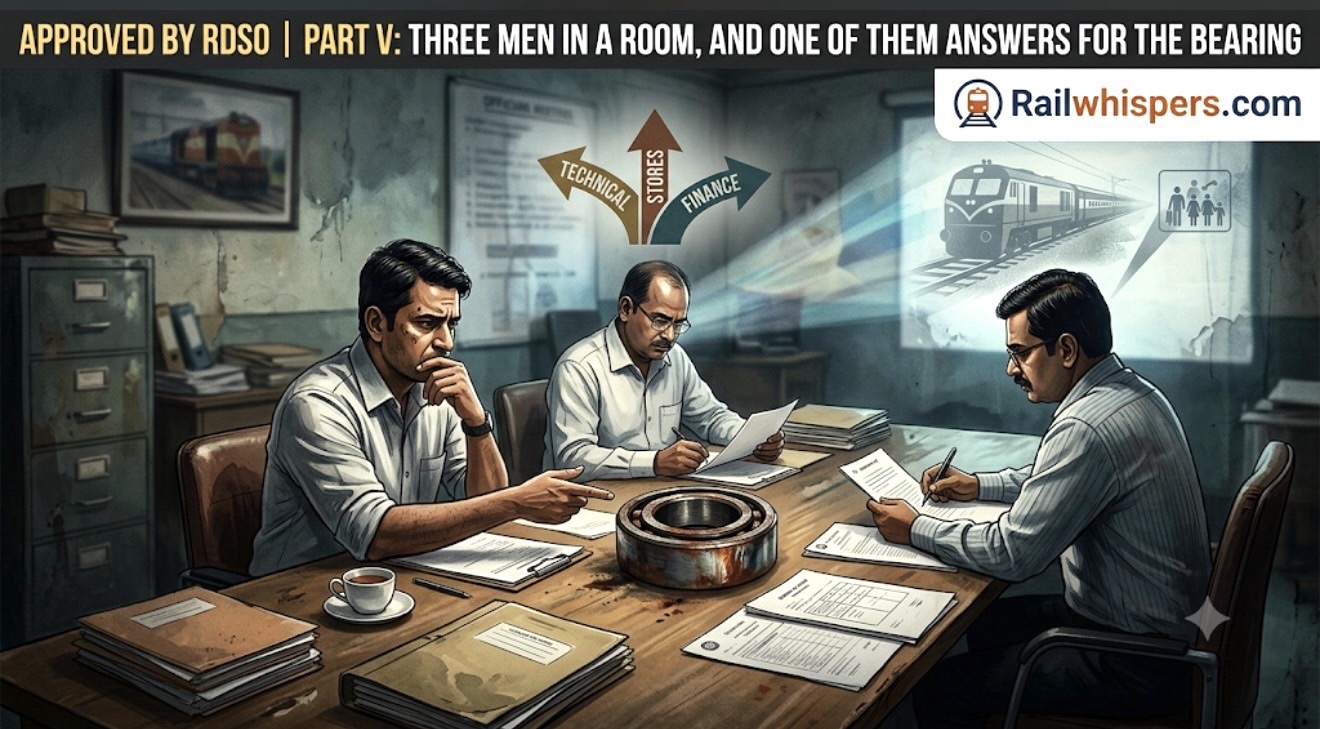
Approved by RDSO | Part V: Three Men in a Room, and One of Them Answers for the Bearing
Part IV, “Approved by RDSO | Part IV: He Answers for the Part. He Does Not Choose the Supplier”, showed the supplier decision moving from the man paid for cradle to grave performance of the item to the man paid for a clean and defensible purchase. It ended at a committee of three departments, which is the one road back for a poor supplier. This part goes into that room. Five things happen there, and by the end of them a bearing that has been seizing is still being bought.
Editor’s Note: This article is based on a Railway Board instruction in the public administrative record and on whistle blower’s inputs. Several statements in it rest on the knowledge of serving and retired officers and on no document held by this publication. The Railway Board and RDSO are invited to reply, and any reply will be printed in full.
Paragraph 14.3 of the Railway Board letter of 18 January 2022 is the only road back, and under it a poorly performing vendor is to be weeded out on objective criteria by a committee of Technical, Stores and Finance members. Part IV set out who those three men are and what each of them answers for, and only one of the three will ever be asked why the bogie cracked, and he holds one seat of the three.
Now go into the room.
The number exists, and that is the trouble
The test the letter names is failures per annum per unit item in service, and that needs a national count of failures, kept up to date, sorted by supplier and by item. It exists. That is the trouble, because a test that exists is exactly what gives the whole procedure the look of a fair and careful system, so the number is there, the committee meets, the file is complete, and the bad supplier keeps supplying.
Two things defeat that number long before it reaches a decision. The first is at the entry. Officers are not rotated, and officers and supervisors of doubtful intent are not moved out. So among the many units that can approve, a few become the known door. A new vendor learns which door to use. So does a dishonest one. Entry is gamed before a single failure is ever counted.
The second is at the exit, and the exit is this room.
Four reasons a bad supplier survives that table
The first is diffused responsibility, because a decision taken by three men is a decision taken by nobody, and afterwards there is no single name against it. The second is competence. The Stores member and the Finance member cannot assess the technical case, and that is not a criticism of either of them, because it was never their training and it is not their work. They can read a paper. They cannot judge whether a fracture is a material fault or a fitting fault.
The third is cost to the dissenter. The technical member who disagrees pays for it outside the room. He meets the same two men tomorrow, on a tender, on a payment, on a variation. A man you must work with every day is expensive to fight once.
And the fourth is the whole matter, so take a real case. A bearing has been seizing. The technical member is worried about the bearing. The Stores member is worried that the pool of suppliers will get smaller. The Finance member is worried that tighter quality control will raise the price. Not one of those three worries is improper. They simply do not point the same way.
So what leaves the room is the lowest common denominator of the three. And only one of the three men will be asked about that bearing the next time it seizes. For every member the safe course is the one the policy lays down. Nobody is ever asked why he followed the rule. Somebody is always asked why he acted differently.
Vigilance decides who is willing to sit in that room
#Vigilance has a real job and it has caught real corruption, so hold that in mind, because what follows is not an argument for less scrutiny. Ask what vigilance actually looks at. It looks at the disagreements on the file, and it weighs one dissenting note by a technical officer against the agreement of Stores and Finance. Then it goes into the merits of the decision itself. Nothing in that process makes vigilance accountable for the merits it has just weighed, and it will not answer for the bearing either. Unscrupulous vigilance officers have made a weapon out of it.
Now see what that selects for. An honest technical officer learns that a dissenting note is a liability with no defence, so he stops writing them, or he stops taking the posting at all. The officers left willing to sit in tender and vendor decisions are the ones who can manage the other stakeholders. Manage is doing a great deal of work in that sentence. That is where the known door of the first mechanism gets its keeper.
Whose defect this is
Now say it plainly. It is not the Stores member’s. It is not the Finance member’s. It is not the vigilance inspector’s either, because a man works the machine he is handed. An institutional mechanism is designed by senior leadership and by nobody else. No officer below that level can write a paragraph 14.3, or leave a competence requirement out of a policy, or seat a committee whose members do not share the consequence of its own decision.
Each of those was a leadership decision. Each was taken in writing. Each is still in force.
A leadership that builds a mechanism which selects against its own honest officers has made a serious error, and it is an error of design rather than of intention. That is not a lesser charge. It is a heavier one, because a design outlasts every officer who suffers under it. And the cost of that selection is not paid in Rail Bhawan. It is paid on the line.
From a purchase decision to a body on the track
So the aim inside that room becomes keeping to the policy, and no longer doing the thing the policy was written to do. The result reaches the passenger, and what follows here rests on the accounts of officers in service. Trains parting on Rajdhani class services. Furnishing material supplied that does not meet the specification it was bought against. And brake pads that smoke or catch fire, often enough now to be a pattern.
Follow that one through, because it does not stop at the pad. The smoke sets off the fire alarm. The alarm brings on the emergency brake. The train stops between stations with an alarm sounding, and the passengers panic.
Then they get down on the track.
There have been occasions when they got down on a curve, where the driver on the other line cannot see them and cannot stop, and they were run over by the train coming the other way. That is the distance between a purchase decision and a body on the track. It is long, and every link in it is ordinary, which is why nobody in that room ever sees the last one. Bad material does not enter the railway by breaking a rule. It enters through a rule that nobody ever checked against the result the rule was meant to produce.
What to ask for, and three of the four are one line answers
Publish four years of the three member weeding committee, for every approving agency, showing cases opened, suppliers downgraded and suppliers delisted.
State who may amend an entry on UVAM, and how long it takes from a technical department’s request to the amendment.
State how many vigilance cases in the last ten years began with a dissenting technical note on a vendor file or a tender file, and how many of those ended in a finding against the officer who wrote the note.
And one that costs nothing and settles the design question. Where the committee does not agree, whose view governs, and can the man who will answer for the failure be outvoted by the two who will not?
The railway can answer that last one in a sentence.
It has never been asked to.
Part I of this series: 30 August 2026, Crisis Looms Over Railway Electrification: Two-Supplier Dominance in OHE Insulators, Soaring Prices, and Stalled Projects
Part II: 1 September 2026, Approved by RDSO | Part II: The Insulator That Does Not Tell You It Has Failed
Part III: 1 September 2026, Approved by RDSO | Part III: The Chair Was Filled. The Job Was Not
Part IV: 9 September 2026, Approved by RDSO | Part IV: He Answers for the Part. He Does Not Choose the Supplier