

Approved by RDSO | Part VII: “One Rule Book for a Poly Ring and a Train Set”
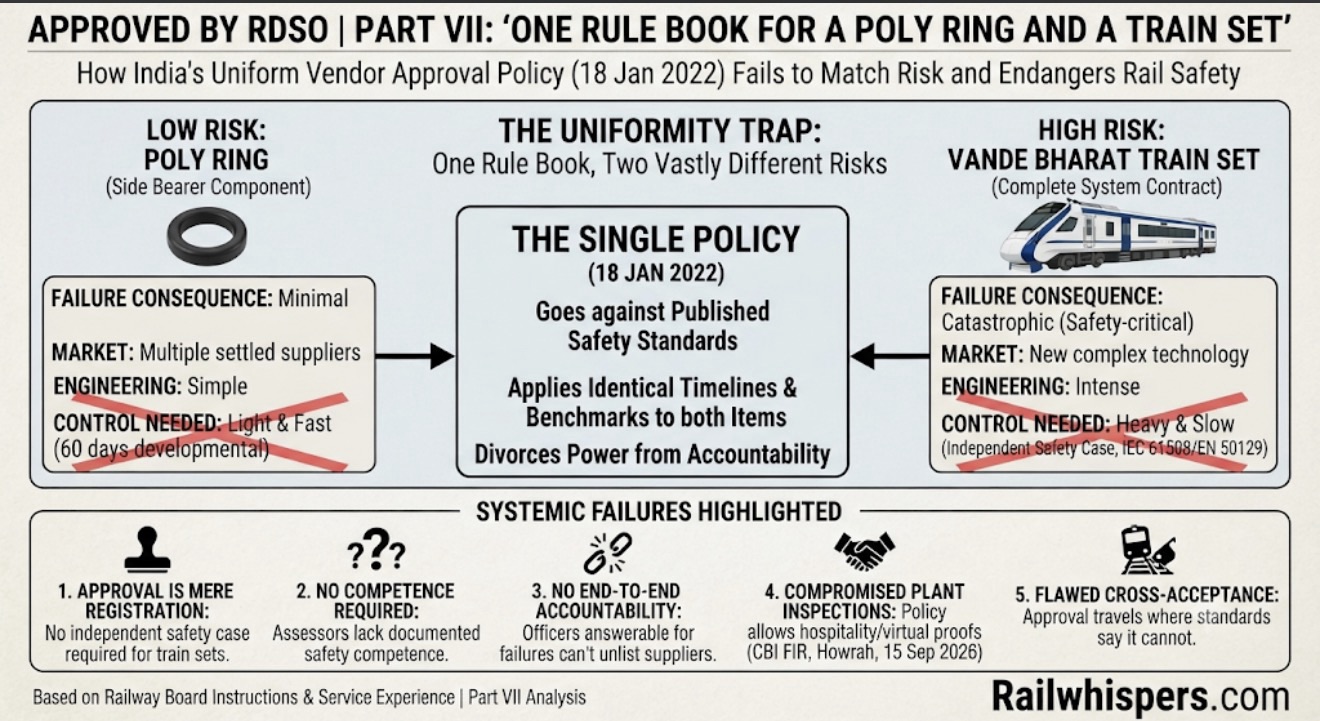
Part VI showed that the vendor approval policy rests on confusion about what RDSO is for. This part shows the first result of that confusion. One rule book governs a rubber ring and a train set, and it does not meet the published practice for approving either one as a safety item.
Editor’s Note: This article is based on Railway Board instructions in the public administrative record, on two published safety standards, and on the service experience of serving and retired officers. Statements that rest on service experience are marked where they appear. The Railway Board and RDSO are invited to reply, and any reply will be printed in full.
One rule for everything, by design
On 10 November 2025 the Railway Board answered a zonal railway on how to buy a poly ring. The ring is a moulded part inside a constant contact side bearer on a wagon bogie. The bearer was on the UVAM portal. The ring was not.
Tender WTA-527 is for two hundred Vande Bharat rakes.
The two share no engineering, no supply market and no failure consequence. They share one rule book. Paragraph 7 of the policy of 18 January 2022 says that the vendor categorisation adopted for RDSO shall be followed by all vendor approving agencies “to bring uniformity”.
Control should match the risk
Control should fit the risk. A cheap, settled item with many suppliers needs a light and fast control. A safety system new to the buyer needs a heavy and slow one.
The policy sets one control for both. Sixty days to developmental status. Two years to approved status. Five approved vendors per item as the benchmark.
Each number suits some items. No number suits all of them.
The eighty per cent rule works the wrong way for a safety item
Paragraph 10 says a change in a technical requirement should be regulated so that eighty per cent of existing vendors stay in the directory.
For a settled item that is a good rule. It stops an officer writing a specification around one favoured maker. For a safety assembly that has just failed in service it is the wrong rule. In safety practice the hazard analysis decides the requirement. How many suppliers survive is a result, not an input.
The paragraph allows two other routes. Existing vendors may bid on their present status if a prototype passes before supply. Otherwise the concerned Board Member approves. The rule is a default, and a default decides most cases.
The purchase decision now turns on one question
The author’s account, from service experience: on major rolling stock items the purchase now runs largely on proforma. The technical decision has shrunk to two questions. Is the source approved? Is it in Part I or Part II?
Performance in service does not enter unless somebody changes the category. Part V showed how hard that is.
The Board had a real problem
The officer and vendor nexus is old. The Comptroller and Auditor General reported in 2013 that vendor development was not done, monopolies formed and the railway paid more. Vendor development cells ordered in 1999 existed in three zonal railways and two production units twelve years later. The Board was right to act. The question is whether the treatment reached the problem.
Moving the decision moved the nexus, not the accountability
The approving agency is still staffed by railway officers. The assessment is still done by people who can be visited. The portal records the outcome and never the reason. It does not always record the outcome either. A brake disc supplier downgraded to developmental on 2 January 2025, and upheld on appeal on 6 June 2025, was still listed as approved on UVAM in June 2025 (14 June 2025, “Explosive Corruption Scandal Rocks RDSO: Director Undermines Own Department, Endangers Rail Safety”).
What moved was power. Accountability stayed where it was. A Principal Chief Mechanical Engineer whose bogies crack still answers for the crack. That officer can no longer declare the item a safety item, or remove the supplier alone. Separation of duties puts a second person on a decision. It does not permit the decision to go to a person who will never answer for the result.
The Board says every listed item is a safety item
Letter 2026/RS(G)/164/2/VIG of 27 April 2026 says that every item listed on UVAM has safety implications. That is the Board’s own sentence.
There is published practice for approving safety items. IEC 61508 covers functional safety in general. EN 50129, published in 2003, covers safety related electronic systems for railway signalling. Measured against them, the policy fails on five counts.
1. Approval is a registration
Clause 5.5.2 of EN 50129 sets the process. An independent safety assessment comes first. The evidence goes into a Safety Case in six parts, with a Safety Assessment Report. Then the safety authority may approve, with conditions.
The policy has an application, a capacity and capability assessment, a fee of ten or fifteen thousand rupees, and a row on a directory.
This publication has reported what that process lets through. The twelve month field performance evaluation was removed in September 2022 (3 October 2023, “Policy Corruption: Disclosure of Criminal Collusion Between Unscrupulous RDSO Officials and Private Entities, Endangering the Integrity of Train Operations and Maintenance”). More than 170 vendors became approved without a service performance evaluation (23 May 2025, “Disentangling the Vendor Development Processes of RDSO, Part-I”). A SCADA vendor entered the approved directory on forged authorisations (10 April 2026, “Strengthening Procurement Integrity in Indian Railways: The Urgent Need to Address Fraudulent Authorizations”). A poly ring does not need a six part Safety Case. A train set does. The policy has one process for both.
2. No competence is required of anybody
Clauses 6.2.13 to 6.2.15 of IEC 61508-1 require every person with a safety role to hold competence for the specific duties, scaled to the consequence of failure and the novelty of the design, and documented. Clause 5.3.3 of EN 50129 says the same for the safety organisation.
The policy of 18 January 2022 sets no competence requirement for the assessor, the committee members or the officer who amends a portal entry.
3. Nobody is appointed to answer end to end
Clause 6.2.1 of IEC 61508-1 requires the organisation to appoint one or more persons with overall responsibility for the system, its lifecycle and the evidence that functional safety is achieved.
The policy appoints a Special Director General, Vendor Development, at RDSO, under Board order ERB-I/2021/23/18 of 7 July 2021. That post watches that approving agencies put instructions on the portal. Nobody is appointed to answer for whether a listed item performs in service.
4. A committee of three colleagues is not independence
Paragraph 14.3 sends the removal of a poor supplier to a committee of Technical, Stores and Finance members. Part V measured that room. Clause 5.5.2 of EN 50129 requires the safety assessor to be fully independent of the project team and to report to the safety authority. Clauses 8.2.15 and 8.2.16 of IEC 61508-1 set independence as a ladder: a person, a department, an organisation. Lack of experience, complexity, and novelty of design or technology push the requirement up a rung.
A train set new to the buyer meets all four conditions. The policy gives it the same committee as a poly ring.
5. Approval travels where the standard says it cannot
Paragraph 5.5 says a vendor approved by one agency is deemed approved for that item across Indian Railways.
EN 50129 allows cross-acceptance for a generic product and a generic application. It says cross-acceptance is “not considered possible for specific applications”. The policy draws no line between the two.
What one plant inspection became, according to the FIR
The CBI FIR of 15 September 2026 describes one RDSO plant inspection at a rail clip maker in Howrah (FIR RC0102026A0007, CBI Anti Corruption Branch, Kolkata). The allegations are unproven. They show what a capacity and capability check becomes when nothing keeps the inspector apart from the firm.
- A Deputy Director and a Senior Section Engineer of RDSO were deputed to inspect supply firms in West Bengal from 5 September 2026.
- On 1 and 3 September the Deputy Director told the firm he would inspect its plant first, out of sequence. On 4 September he asked the firm to book hotel rooms for both officers.
- On 10 September the firm said one machine was still in transit. The Deputy Director assured a favourable Quality Assurance Plan report on the machines present, to be revised when the new machine arrived.
- On 12 September the officers visited Mandarmani, a sea resort, on the firm’s hospitality.
- On 13 September the firm was told that a photograph of the machine in transit would do, installed or not.
- On 14 September the Deputy Director confirmed that the Quality Assurance Plan, the Schedule of Technical Requirements report and the joint inspection report were signed.
- On 15 September the firm’s director agreed to arrange Rs 4 lakh. He advised that three arriving machines be photographed twice, to show six machines received and installed.
The CBI arrested both officers and two company representatives that day, at a hotel in Howrah. (16 September 2026, StudyCafe, “CBI Arrests Four, Including Two Senior Officers of RDSO Lucknow, in Bribery Case”)
The Schedule of Technical Requirements lists the plant and machinery a factory must hold before it can supply Indian Railways. Steps 3, 5 and 7 defeat that check. A machine in transit, a photograph and a doubled count stand in for machinery on the floor.
Set this against count 4, which requires an assessor independent of the pressure on the decision. The author’s account is that no rule in the policy keeps an inspection team apart from the firm it inspects.
The parts inside the parts
The poly ring letter of 10 November 2025 ordered that every sub-component inside a listed assembly must itself be listed. That answer is right.
It also shows that from January 2022 to November 2025 a listed assembly could contain a part from a source nobody had approved. In safety practice an assembly is approved with its bill of materials, and a change of sub-supplier starts a reassessment. The Board has not said how many assemblies were affected.
A train set is bought as a system
The author’s reading: the vigilance episode around the Vande Bharat purchase arose because a new kind of purchase was examined through a system built for repeat supply of catalogue items. A train set is bought as design, manufacture and maintenance in one contract.
Permanent way items and the elastic rail clip
The regular purchase of permanent way items moved to the Stores department. Shortages followed and track renewals were delayed. Elastic rail clips came largely from micro and small enterprises. Those suppliers were squeezed, protested in public and were pressed to withdraw the protest.
This publication reported a tool down strike by nearly 40 small track component makers, including makers of elastic rail clips, from 1 to 7 August 2026. Their stated grievance was repeated testing after supply under version 4.0 of the ISO Apex Guidelines (24 July 2026, “RAIL CRISIS: 40 MSME Track Component Manufacturers Launch Nationwide Strike Against Railway Board”).
The firm in the Howrah FIR makes elastic rail clips. On paper RDSO still approves track items. Approval on paper and supply on the ground are two different tests. The numbers below would settle it.
What to ask for
- Give first of type and system purchases a procedure of their own, and state in writing where the line falls.
- State which standards the vendor approval process is written against: IEC 61508, EN 50126, EN 50128, EN 50129, or none.
- Name the post answerable end to end for whether a listed item performs in service.
- Publish the competence requirement for the assessor, each committee member and the officer who amends a portal entry.
- State, item by item, whether an approval under paragraph 5.5 is generic or for a specific application.
- List the assemblies that carried unlisted sub-components between January 2022 and November 2025.
- For each of the last four years, publish elastic rail clips ordered and received, approved and developmental suppliers, and track renewal done against target. Publish purchase from micro and small enterprises against the twenty five per cent target in force since 1 April 2015.
- State the rule that keeps an RDSO inspection team apart from the hospitality of the firm it inspects. State how a Quality Assurance Plan report is checked when the machinery it certifies is not yet installed.
When the department that answers for a failure disagrees with the approving agency about a supplier, who decides? Print the answer.
Part VI of this series: 18 September 2026, Approved by RDSO | Part VI: “A Policy Built on Confusion About What RDSO Is For”
Part V: 10 September 2026, Approved by RDSO | Part V: “Three Men in a Room, and One of Them Answers for the Bearing”
Part IV: 9 September 2026, Approved by RDSO | Part IV: “He Answers for the Part. He Does Not Choose the Supplier”
Part III: 1 September 2026, Approved by RDSO | Part III: “The Chair Was Filled. The Job Was Not”
Part II: 1 September 2026, Approved by RDSO | Part II: “The Insulator That Does Not Tell You It Has Failed”
Part I: 30 August 2026, “Crisis Looms Over Railway Electrification: Two-Supplier Dominance in OHE Insulators, Soaring Prices, and Stalled Projects”