

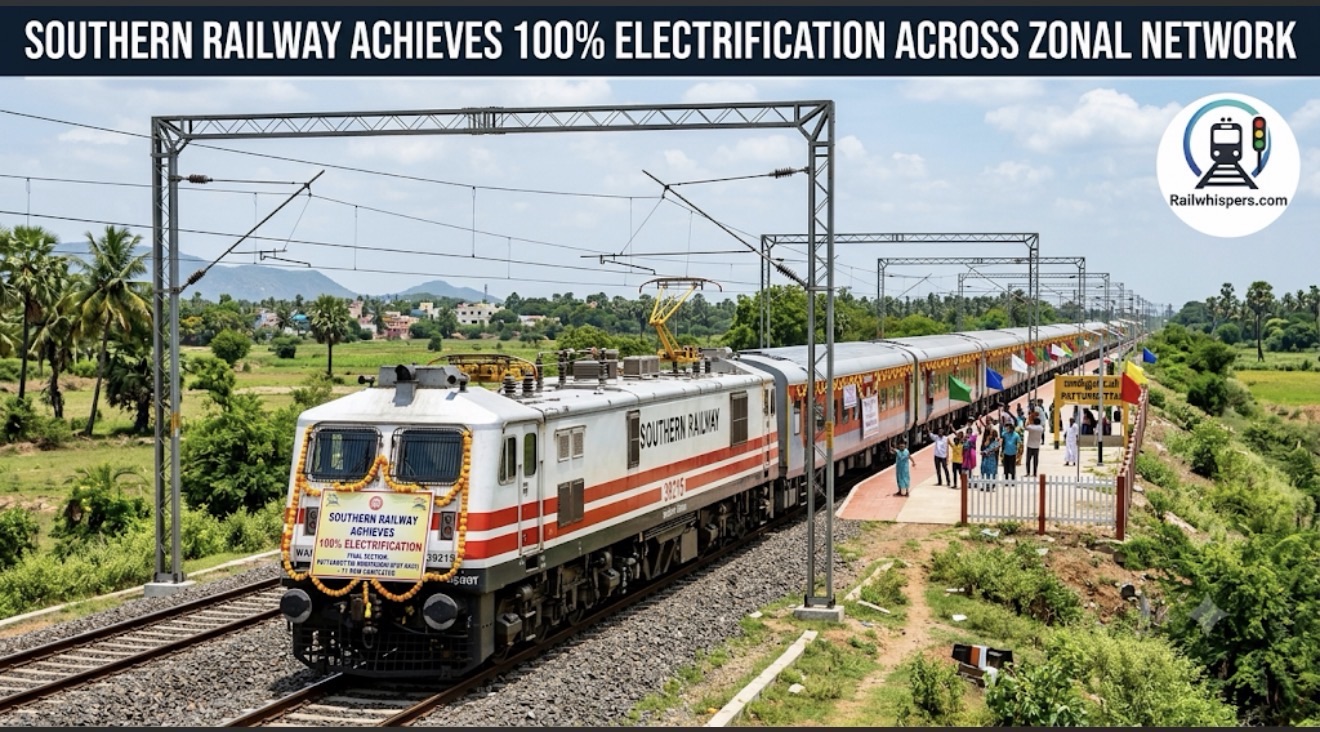
Southern Railway Achieves 100% Electrification Across Zonal Network
CHENNAI: Southern Railway reached a historic milestone on 9 September 2026 by completing 100% electrification across its entire 5,068 route-kilometre (RKM) Broad Gauge network. The achievement was finalized following the successful statutory inspection of the newly energized 71 RKM Pattukkottai–Karaikkudi (PKT–KKDI) section in the Tiruchchirappalli Division by the Principal Chief Electrical Engineer (PCEE).
With this final link commissioned, the zone eliminates the operational bottleneck of traction changes—the time-consuming process of swapping between electric and diesel locomotives. This shift significantly enhances turnaround times, optimizes locomotive utilization, lowers reliance on fossil fuels, and accelerates freight and passenger movement toward Indian Railways’ broader net-zero carbon emission goals.
The Southern Railway’s electric traction journey traces back nearly a century to 11 May 1931, when Madras (now Chennai) became the second Indian metropolis after Bombay (now Mumbai) to run electric suburban services, originally powered by 1,500 V DC. Modern 25 kV AC electrification was later introduced along the Madras Beach–Tambaram corridor in 1968.
While the Broad Gauge system is now fully electrified, the 46-kilometre Nilgiri Mountain Railway (#NMR)—a UNESCO World Heritage site operating on a metre-gauge rack-and-pinion system—will preserve its iconic steam and heritage diesel traction.
Milestone Highlights
- 100% Broad Gauge Coverage: Complete electrification achieved across the entire broad-gauge network of Southern Railway.
- Total Electrified Network: 5,068 Route Kilometres (RKM) now operating under electric traction.
- Final Section Energized: Pattukkottai–Karaikkudi link (71 RKM) within the Tiruchchirappalli Division.
- Statutory Clearance: Formally inspected and approved by the Principal Chief Electrical Engineer (PCEE) on 9 September 2026.
- Heritage Exemption: The 46-km metre-gauge Nilgiri Mountain Railway retains its classic steam and diesel operations to preserve its UNESCO World Heritage character.