

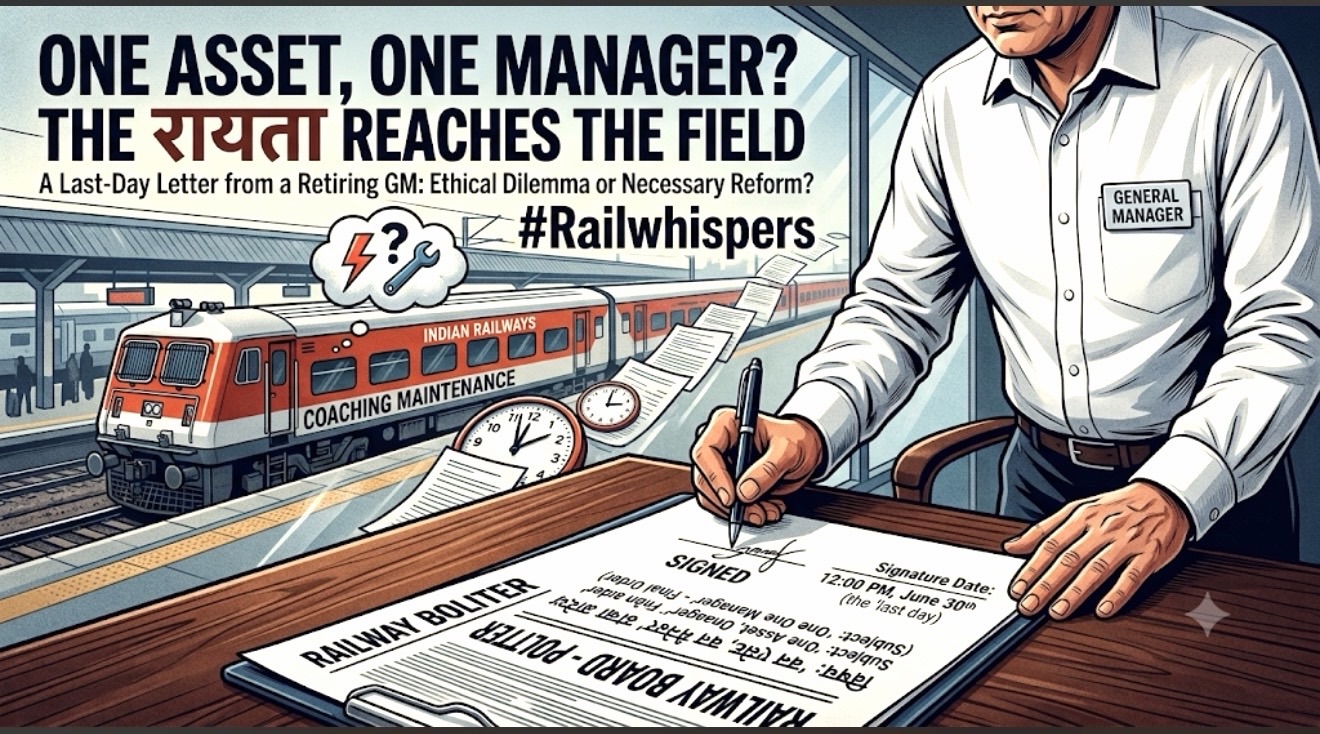
One Asset, One Manager? The रायता Reaches the Field
A three-part series on how a last-day letter from a retiring General Manager tries to make a withdrawn philosophy permanent, and why citizens should care.
Part-I: The Last-Day Letter
A General Manager signs away the electrical department’s last toehold in coaching maintenance and asks the Railway Board to sanction it across all of Indian Railways—doing so with just one working day left in service. As we have maintained before, an officer in the twilight of their tenure has no business altering policy, transfers, or postings. This letter is not a routine administrative decision; it is a revelation.
We have held a simple line: towards the close of their tenure, senior officers should keep their hands off policy, transfers, and postings. Yet, this quintessential officer, just before hanging up his boots on the very eve of his retirement, put his signature to a letter asking the Board to adopt his pet experiment and implement it across the entire railway network.
The timing tells the whole story. The outgoing officer (GM) belongs to the #Mechanical cadre; the incoming successor is from the #Electrical stream. One does not need a decoder ring to read between the lines. The fear, plainly, was that the successor would walk in and straighten what the predecessor had spent a long tenure bending. Consequently, that bending was locked in just twenty-four hours before the chair changed hands. We have long maintained that this kind of eleventh-hour policymaking is unethical—and we maintain it still.
Here is the part the covering letter conveniently omits: “the scheme it now wants made permanent was never intended to be lasting. The very order it leans on—Order 52 of 2024—says so in black and white in clause 22. The arrangement was declared purely temporary, meant to run only until a regular Sr. DEE (Coaching) was posted in the division to report under proper functional control. That post was never filled. Now, instead of filling it, the outgoing GM writes to the Board arguing that the post should never exist at all, calling a dedicated senior electrical officer for coaching “undesirable” and warning that it would breed a dual command structure.”
Read the two documents side by side, and the maneuver becomes nakedly obvious: promise a permanent electrical post to pacify the cadre in 2024, never deliver it, and then, in 2026, declare that unfilled promise an obstacle to be abolished. This is not integration; it is a stopgap dressed in the robes of administrative philosophy, marched past the Board on its author’s final afternoon.
The GM’s central argument is that a separate Sr. DEE (Coaching) would force two senior officers to constantly rely on the DRM to settle disputes, which he claims is wasteful. It would be a fine argument, if his own order didn’t do exactly that. Clause 20 of the very Joint Procedure Order (JPO) he defends explicitly states that any issue not otherwise covered must be mutually decided by the Sr. DME (C&W) and Sr. DEE (G)—and in case of disagreement, resolved by the respective DRM. Thus, his “integrated” model still leaves two senior officers at odds and still routes their disputes to the DRM. The coordination overhead he warns against is baked directly into the scheme he praises; the argument collapses under the weight of the author’s own paperwork.
And what does this integration actually look like at the cutting edge? It is an old, tired trick: take a Junior or Senior Scale electrical officer, park them under a mechanical establishment, and announce to the world that domain expertise has been honored. It has not. A #DEE or #AEE reporting through a mechanical Senior to a mechanical Senior does not equate to professional attention for train lighting, air conditioning, and power cars. It is a fig leaf. Everyone in the field knows it, and the technical staff who service 750-volt and 25-kilovolt systems know it best of all.
The letter wraps all of this in a slogan that reads beautifully on Board stationery: One Asset, One Manager—An integrated framework for all passenger rolling stock. Strip the prose away, however, and what survives is one cadre quietly absorbing another’s work, an unfilled promise being buried, and a retiring officer asking Delhi to ratify both on his way out.
But this North Western Railway (NWR) letter is not a one-off quirk of a single zone. It is a field-level symptom of a policy disease authored in Delhi nine years ago—one that the Board itself has already been forced to back away from once. To see why the GM’s request is not a bold reform but the revival of a proven failure, we must examine the original order that started the bleed. That is the focus of Part-II.
References
Prior railwhispers.com articles drawn upon—
27 July 2025, “The रायता !“
15 August 2025, “The रायता ! Part-II“
Primary documents
- 29 June 2026, GM/NWR letter, “Integration of Passenger Rolling Stock Maintenance,” No. NWR/HQ/MECH/C&W/CHG/3
- 15 July 2024, NWR Memorandum (JPO) No. 52/2024, “Improvement in reliability of Electrical Assets,” esp. clauses 20 and 22
- 25 July 2025, Railway Board letter No. 2025/O&M/8/2, “Manpower Management of Mechanical & Electrical officers/staff involved in Maintenance of Train sets, LHB/ICF coaches, EMU/MEMU/DEMUs & Diesel Locos,” signed by Joint Secretary/Railway Board (uploaded)
Corroborating sources. - 2 August 2025, AIRF letter to Member (Traction & Rolling Stock), “Request for Revision & held in abeyance of Instructions issued on Manpower Management…”
- 13 May 2019, AIRF DO letter to CRB on cadre control of Mechanical & Electrical staff (Electricity Act / EIG / electrical-engineering history argument)