

THE 9-YEAR TRACK SYSTEM DETOUR: How Rail Files Bend to Bypass Tender Conditions
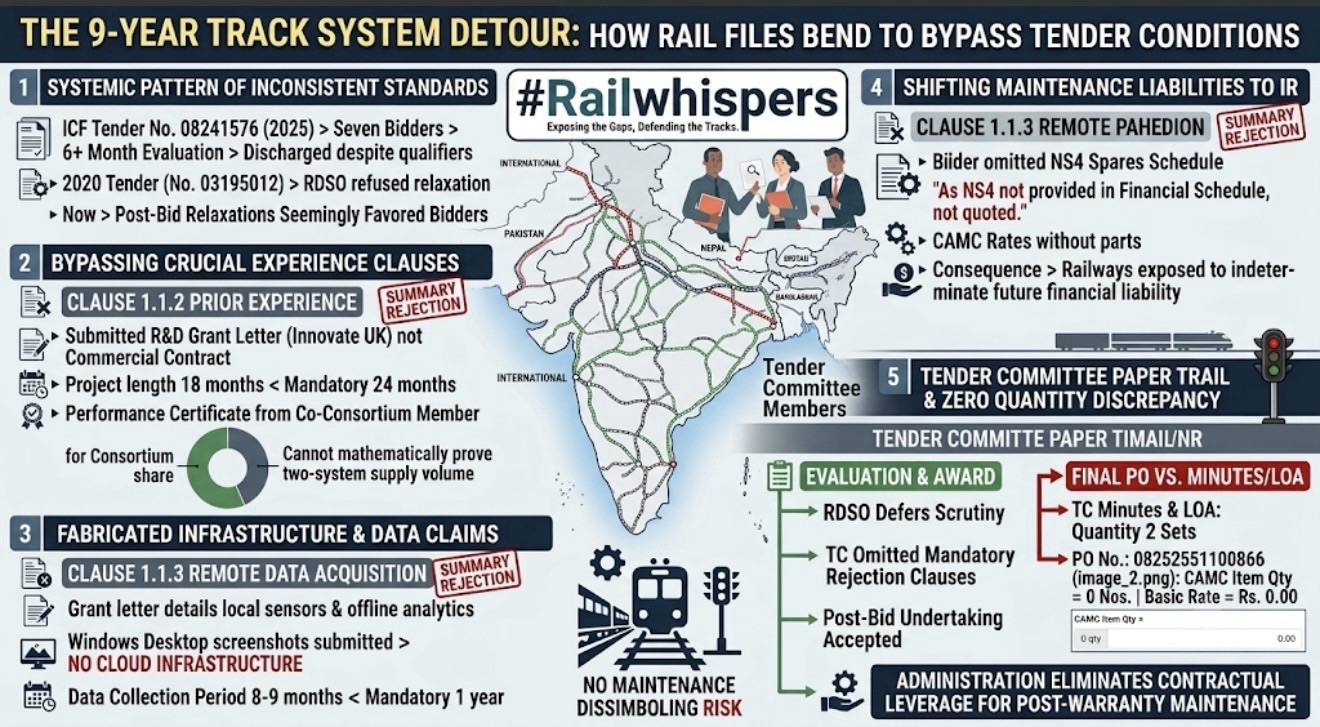
A highly troubling pattern of selective compliance and questionable evaluation standards has emerged within Indian Railways’ procurement system, sparking urgent calls for an independent review. The handling of Tender No. 08252551 by the Integral Coach Factory (#ICF) exposes how strict eligibility thresholds were systematically modified to clear a preferred, non-compliant bidder.
This technical gridlock mirrors broader issues examined in our article, “An Overlay for the Headlines, Nothing for the Tracks”, and further explored in the detailed investigative video report, “#Ep223: A device the world has run for decades, Nine years on Indian files!” While international rail networks seamlessly utilize these safety systems, Indian procurement files remain entangled in bureaucratic maneuvering.
A Systemic Pattern of Inconsistent Standards
The controversy is rooted in a historical trend of shifting procurement baselines. In the immediately preceding tender for the Unattended Axle Box Acceleration Measurement System (#UABAMS)—ICF Tender No. 08241576 (dated 17/02/2025)—seven bidders participated in an evaluation process that dragged on for more than six months. It was ultimately discharged despite two bidders clearing the techno-commercial evaluation.
Historically, during the 2020 tender (No. 03195012), the Research Designs and Standards Organisation (#RDSO) firmly refused to grant any eligibility relaxations before or after the opening of bids. However, subsequent actions reveal a complete reversal in conduct, with post-bid relaxations seemingly introduced during the evaluation of ICF Tender No. 08241576 to favor specific participants.
Crucial Experience Clauses Bypassed
Under Clause 1.1.2 (Prior Experience), the tender mandates the submission of a valid Contract/Purchase Order from a railway organization alongside a Performance Certificate confirming two years of satisfactory operation. The clause explicitly warns: “Submission of Performance Certificate and Contract/Purchase Order is mandatory otherwise the offer will be summarily rejected.”
The selected bidder failed to meet this requirement on multiple accounts. Instead of a commercial purchase order, they submitted a research grant offer letter from Innovate UK (UKRI, Application No. 103294), an R&D funding body. This project was a jointly funded consortium research project rather than a commercial supply contract.
Furthermore, the grant was awarded to a four-member consortium (including the University of Birmingham, Network Rail HS Ltd., and Eurostar International Ltd.), and the required two-system supply volume cannot be mathematically proven through the technology transfer partner’s undisclosed share. The relied-upon Performance Certificate was issued by Network Rail (High Speed) Ltd.—a fellow consortium member rather than an independent buyer. Crucially, the hard timeline of the 18-month grant project (July 2021 to December 2022) makes the claimed 24-month operational period physically impossible.
Fabricated Infrastructure Claims
Similar irregularities compromised Clause 1.1.3, which governs remote data acquisition experience. The clause requires at least one year of experience in acquiring remote data from moving vehicles via networks like GPRS and processing it at a cloud station.
The selected bidder relied on the same Innovate UK grant letter, which documents local sensor installations and offline analytics, with no mention of cloud-based transmission. Physical inspection of the evidence submitted in the bid (as shown on pages 50-53) reveals a standard Windows desktop application interface completely lacking a cloud URL, web interface, or remote credentials. Additionally, the project’s documented data collection period lasted only 8 to 9 months, falling well short of the mandatory one-year threshold.
Maintenance Liabilities Shifted to Indian Railways
The financial evaluation was further distorted by the bidder’s total omission of the mandatory NS4 spare parts schedule and Comprehensive Annual Maintenance Contract (CAMC) specifications. The tender conditions obligated all participants to submit an all-inclusive 5-year CAMC rate covering spares, personnel, and consumables.
The selected bidder completely omitted the NS4 spare parts list and explicitly stated in their financial schedule: “As NS4 is not provided in the Financial Schedule, the same has not been quoted.” By failing to account for spare parts costs, the bidder bypassed the post-warranty cost-ceiling mechanism. This left Indian Railways exposed to unrestricted future financial liabilities and rendered any comparison with compliant bidders invalid.
RDSO Defers Critical Scrutiny
While the technical evaluation agency, RDSO, flagged that the bidder had submitted an R&D grant letter instead of a commercial purchase order, it failed to perform a rigorous analysis. RDSO passed the responsibility down, stating, “This aspect should be examined by the tender committee,” and similarly deferred scrutiny of the technology transfer and consortium share distributions.
RDSO did not cross-reference the claimed operational duration against the actual project timeline, failed to flag the conflict of interest regarding the consortium-issued certificate, and ignored the lack of web infrastructure evidence.
The TC’s Paper Trail of Adjustments
The official records from the Tender Committee (TC) reveal a systemic effort to normalize these deviations:
- Deletions of Disqualification Clauses: The mandatory rejection sentences in Clauses 1.1.2 and 1.1.3 were completely omitted from the text reproduced in the TC minutes, allowing the evaluation to proceed as if the mandatory penalties did not exist.
- Unilateral Status Upgrades: The TC arbitrarily declared the R&D funding document as a commercial agreement, noting: “The firm has submitted Grant offer, its acceptance and execution of the project. Hence TC unanimously considered it as contract.”
- Post-Bid Accommodations: Violating standard procurement guidelines (including GCC Clause 6.1) which require immediate rejection for missing documents, the TC accepted a post-bid undertaking from the firm promising future compliance regarding CAMC conditions.
The Zero-Quantity Procurement Discrepancy
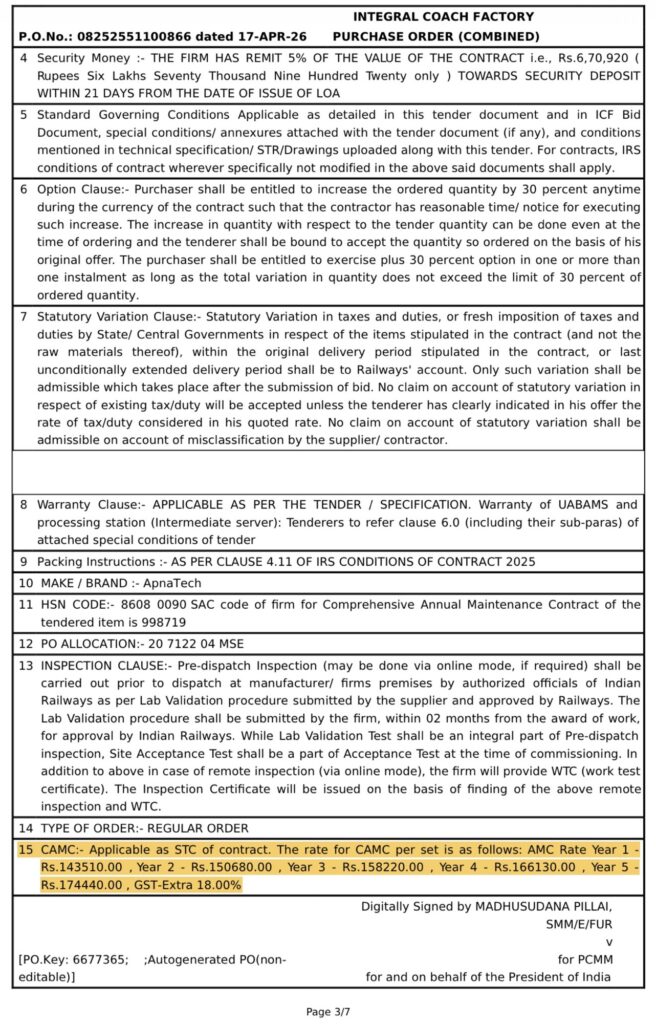
The final execution phase introduces the most glaring contradiction, as captured in the official procurement documentation. In the Purchase Order (P.O. No.: 08252551100866 dated 17-APR-26) explicitly shows the Item Qty for PL No. 3171N005—the Comprehensive Annual Maintenance Contract (#CAMC)—set to 0 Nos. with a Basic Rate of Rs. 0.00 (Rupees Zero only).
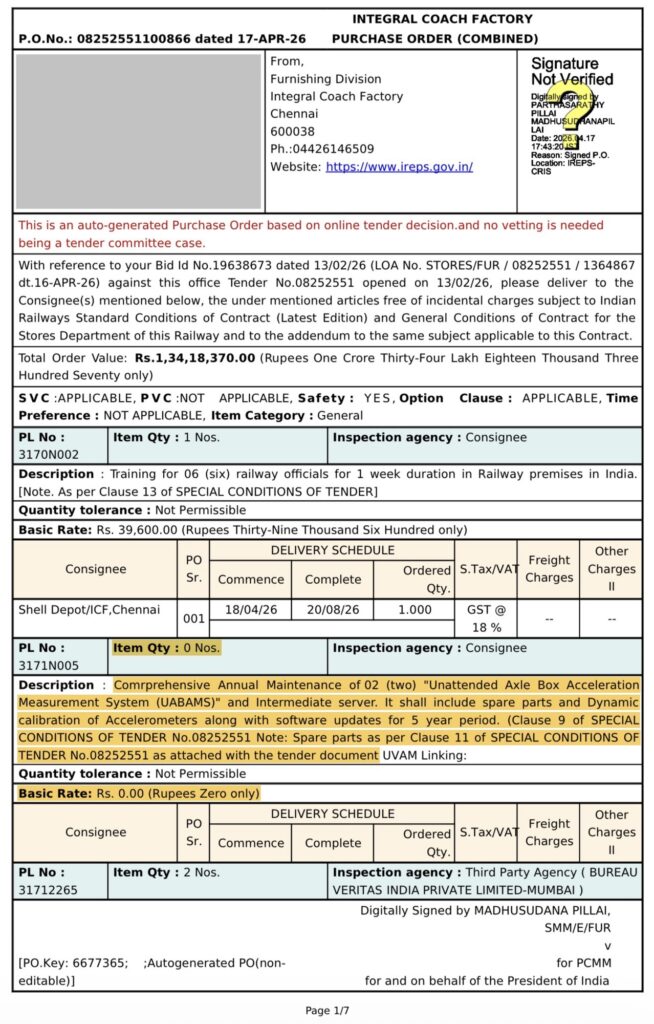
- PL No: 3171N005 | Item Qty: 0 Nos.
- Description: Comprehensive Annual Maintenance of 02 (two) “Unattended Axle Box Acceleration Measurement System (UABAMS)” and Intermediate server. It shall include spare parts and Dynamic calibration of Accelerometers along with software updates for 5 year period. (Clause 9 of SPECIAL CONDITIONS OF TENDER No.08252551 Note: Spare parts as per Clause 11 of SPECIAL CONDITIONS OF TENDER No. 08252551 as attached with the tender document.
- Basic Rate: Rs. 0.00 (Rupees Zero only)
This zeroed-out allocation directly contradicts the TC minutes and the Letter of Acceptance (#LOA), which originally approved a quantity of two sets. While contains text in Item 15 outlining a future scale of AMC rates, the primary procurement ledger reduces the active ordered quantity to zero.
By stripping the maintenance quantity from the binding purchase order without an official corrigendum, the administration has eliminated its immediate contractual leverage to enforce post-warranty maintenance. This leaves critical safety systems exposed on the tracks without a legally binding, fully funded maintenance safety net.