

EXCLUSIVE: The Deepening Corruption in Indian Railways’ Private TPI System
#Railwhispers Investigation
NEW DELHI: The ambitious shift by Indian Railways to introduce private Third-Party Inspection (#TPI) agencies across all Zonal Railways and Production Units—originally designed to clean up procurement and root out systemic #corruption—has severely backfired. Shocking #whistleblower inputs obtained by #Railwhispers reveal that the transition to private players has not only failed to stop the #harassment of suppliers but has actively worsened both financial #extortion and structural #safety hazards.
According to highly placed sources, the decentralized inspection mechanism has devolved into an aggressive extortion racket, raising alarm bells over the structural integrity of critical railway assets.
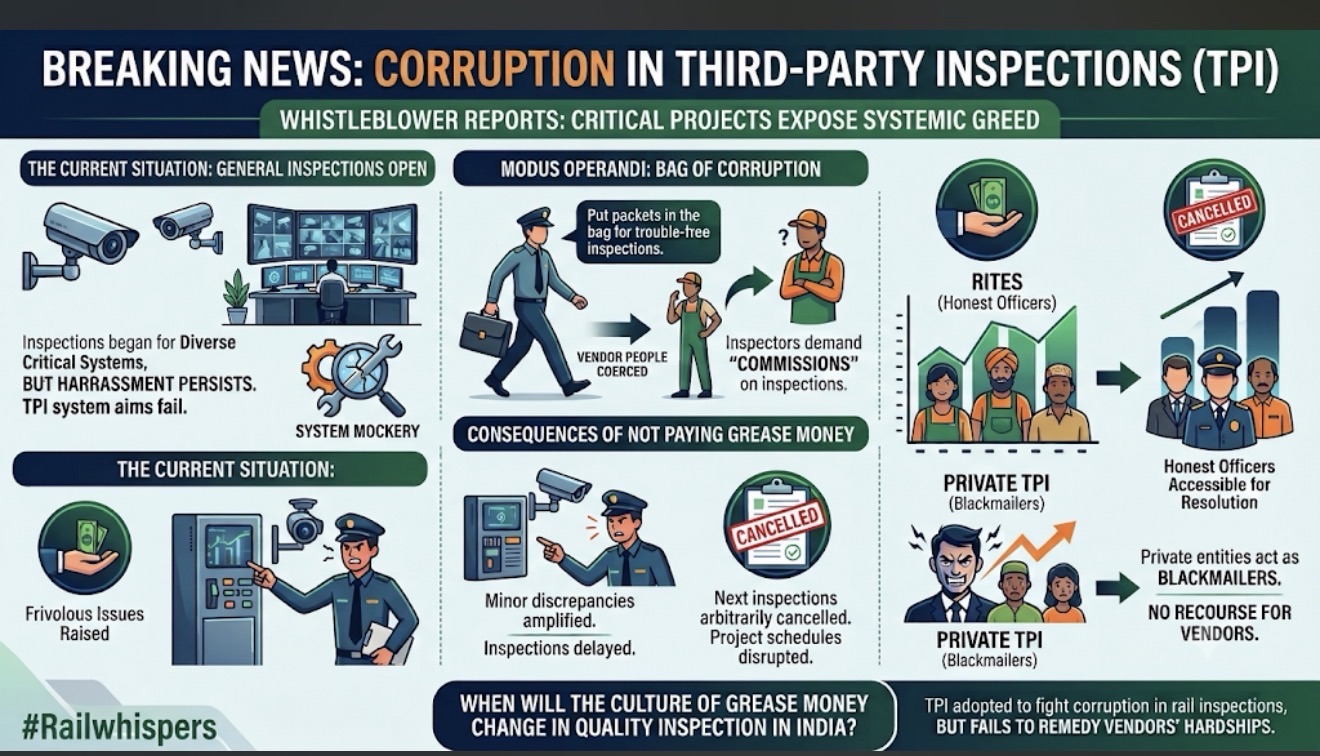
The Modus Operandi: “Packets in the Bag”
The #whistleblower report outlines a brazen methodology adopted by private TPI inspectors. When deployed to evaluate procurements nominated by the Zonal Railways and Production Units, inspectors reportedly arrive equipped with an explicit demand for “commissions.”
“The private party inspectors carry a bag and openly instruct the vendor’s representatives to place ‘packets’ inside if they want trouble-free clearances,” the whistleblower input states.
If a vendor refuses to comply with these illicit demands, the repercussions are swift and punitive:
- Arbitrary Cancellations: Subsequent scheduled inspections are abruptly cancelled without valid administrative grounds.
- Frivolous Objections: Inspectors raise trivial, non-consequential technical issues to intentionally stall clearances, trapping vendors in expensive operational delays.
Beyond Bribery: A Dangerous Threat to Structural Quality
While corruption under legacy public-sector inspection systems typically involved speed money to clear standard goods, the private TPI crisis has introduced a far more dangerous element: collusion that actively compromises safety.
Investigative findings indicate that some private agencies are working hand-in-hand with compromised entities to alter technical parameters at the foundational stage. Instead of enforcing strict quality control, these inspectors are allegedly allowing a significant drop in material quality while simultaneously inflating the quantity of steel required in the actual engineering drawings and designs. This artificial inflation of raw materials serves to maximize illicit profit margins at the taxpayer’s expense while delivering structurally compromised infrastructure to the railways.
RITES vs. Private TPI: The Collapse of Redressal
The current crisis highlights a stark contrast between the legacy inspection system run by #RITES (Rail India Technical and Economic Service) and the newly inducted private agencies.
Under the RITES regime, vendors and suppliers maintained that even when systemic bottlenecks occurred, there was a hierarchy involving accessible, honest officers who could be approached to resolve genuine grievances and override unfair rejections.
In sharp contrast, the newly appointed private TPI entities operate with complete structural insulation, leaving vendors with absolutely no channels for escalation or recourse. The whistleblower input pull no punches, flatly labeling these private inspection parties as unchecked “blackmailers.”
Practical Suggestions to Reform the TPI System
To prevent the total collapse of the railway procurement ecosystem and ensure public safety, immediate structural reforms are required:
1. Mandatory Dual-Layered Auditing & Random Cross-Verification
The Ministry of Railways (Railway Board) should establish an independent, centralized oversight body (comprising technical experts from RITES, RDSO, and the Vigilance wing) to conduct surprise, random counter-inspections on clearances granted by private TPIs. If a private agency’s report contradicts the oversight body’s findings, their license should be instantly suspended/cancelled.
2. Digitalization and Cryptographic Locking of Engineering Drawings
To eliminate the dangerous practice of altering design drawings to artificially inflate steel and other material quantities, all approved structural designs must be uploaded to a secure, cryptographically locked digital repository before tenders are opened. Any deviation during the inspection stage should trigger an automatic administrative red flag.
3. An Anonymous, High-Level Vendor Grievance Portal
Suppliers must be given a secure, encrypted platform directly under the Railway Board to report extortion demands, frivolous objections, or sudden inspection cancellations. Every cancellation by a TPI agency must require a mandatory, written technical justification that can be audited.
4. Implementation of Strict Criminal Liability & Blacklisting
Private TPI firms must no longer be treated merely as vendors facing civil penalties. Collusion that alters designs or compromises material quality must be treated as criminal sabotage against national infrastructure, resulting in immediate blacklisting, forfeiture of bank guarantees, and criminal prosecution of the firm’s directors.