

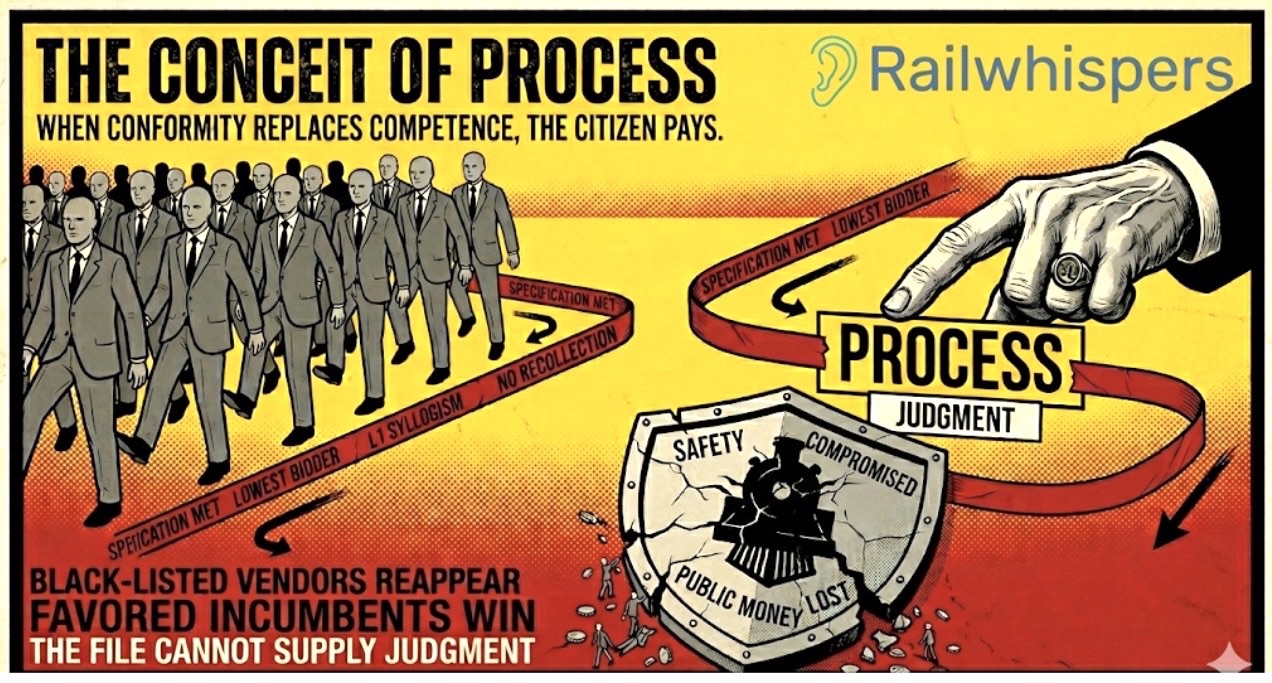
Editorial: “The Conceit of Process”
When the state mistakes conformity for competence, the country pays the bill
The temptation, watching the #CBSE examination episode unfold, is to file it as an isolated administrative lapse: “a tender gone wrong, a vendor who should have been caught, a venerable institution humbled by a teenager.” That reading is comforting precisely because it is narrow. The harder truth is that nothing aberrant happened at all. The state behaved exactly as it has been trained to behave — faithfully, procedurally, and without judgment. The #scandal is not that the system broke. It is that the system worked.
Look at how it happened, at least as the open record suggests. A #specification was drawn up. Two rounds of #tendering drew no bidders. The bar was lowered — that almost autonomic reflex of the #sarkari apparatus before any contest it cannot otherwise win — and a #bidder duly materialised. He was the lowest, he met the specification, and so, by the iron syllogism of L1, the work was his. That the firm carried, in an earlier #avatar, a history of conspicuous failure was beside the point; it had been reincarnated under a new name, and our rules do not permit institutional memory. Everyone followed the process. The process is exactly what failed.
This is not only a CBSE-disease, and that is what should worry us. Anyone who has watched #Railway procurement will recognise the pathology on sight, for the railways have been its most accomplished laboratory. “A #vendor blacklisted for forgery keeps supplying against live purchase orders; the same vendor reappears under a fresh name, and on the strength of those very supplies, secures approval all over again. A manufacturer downgraded on the load-bearing members that make up most of a locomotive shell’s weight goes on delivering, and no stores officer regards it as his business to object — the purchase order, he will tell you, is a contract.” The single question nobody in that room is paid to ask is the only one worth asking: “who is protecting the buyer?” In this elaborate choreography of clearances and noting-sheets, “who speaks for the citizen whose #Money and #Safety are being disbursed?”
The deeper one looks, the clearer it becomes that the absence of that voice is not oversight but design. Consider the #locomotive tenders this publication has documented at length, where a #procurement was built around an already-faltering specification so that the favoured incumbent was a guaranteed winner — until competition arrived and exposed the price the country had been paying. Consider the long monopoly over #braking systems, where a quarter-century of locomotive production left a single firm in command of the very mechanism by which a train is supposed to stop, and trains began, lethally, not stopping. None of this required cinematic villainy. It required only that competent-seeming men keep following the file.
What the file cannot supply is judgment, and judgment is the faculty the Indian state has spent two decades quietly selecting against. We have built an elaborate machinery of evaluation — the 360-degree review, the integrity matrix, the vision statement — that is exquisitely good at identifying the inoffensive and nearly useless at identifying the capable. The officer who never took a position, never pushed an envelope, never got his hands dirty enough to make an enemy, sails through. The officer who actually decided something, and therefore occasionally erred, is precisely the one a risk-averse screen will flag. We have optimised for the absence of a record rather than the presence of one. A #bureaucracy that prizes a clean slate over a written-upon one will, with perfect reliability, elevate the men who have never written anything.
It is worth being precise about what is being indicted here, because not all #loyalty is the disease. The economist Rohit Lamba, writing recently in the Times of India, draws the distinction better than the railways usually permit themselves. There is a loyalty that governance cannot do without — “once a decision is taken, ministers must carry the cabinet’s line and officers must implement the policy; that is administration.” What hollows a council out is the other kind: “loyalty demanded as the price of admission, the requirement to agree in advance before one is even allowed into the room where judgment is supposed to happen.” The first is government. The second, in Lamba’s telling, is courtly rule — and it is courtly rule that has colonised too much of the Indian state.
The corrective is not mysterious, and the country has practised it before. Lamba’s reading of India’s genuine successes finds in them a single recurring architecture: “a politician built a room for an expert, and stood at the door.” Nehru did it for Homi Bhabha, placing atomic energy under his own office and giving a Cambridge physicist the cover to build what the civil service could not. Shastri and Indira Gandhi did it for the agronomists who delivered the Green Revolution; Narasimha Rao, running a minority government, absorbed the political risk while a small group of economists wrote the 1991 reforms; Vajpayee did it for the men who built the Golden Quadrilateral. And — the point is worth making precisely because this kind of writing is so often dismissed as one-sided fury — “the present government did the same, backing the architects of the India Stack and a scale of welfare delivery few had thought achievable.” Different parties, identical practice. When India has produced anything world-class, a politician built the room and then had the confidence to stand aside.
The railways, and increasingly the wider government, have spent their energy on the inverse: “building rooms for the loyal and posting the expert out.” The bill for that choice, as Lamba observes, does not arrive on a convenient schedule. It accrues invisibly for years and then presents itself, all at once, as a crisis. A currency slides quietly until someone finally calls it a collapse; an examination system absorbs small compromises until two cohorts in a single season — some twenty-two lakh medical aspirants and eighteen lakh school students — find their futures suspended; an institution decays through a hundred unremarkable appointments before anyone notices the capability is simply gone. The CBSE failure that opened this argument is not, on this view, a railway-adjacent curiosity. It is the same disease in a neighbouring ministry.
That the railways should furnish the most expensive single illustration is almost fitting. In May the Supreme Court held that #IndianRailways is not a deemed distribution licensee but an ordinary consumer of electricity, exposing it to a surcharge liability that observers place between fifteen and twenty thousand crore. Read the judgment and what stares back is not misfortune but a decade of unforced error: “a claim rested on a ministry letter rather than the statute; binding precedent left unengaged; failed legislative amendments that the other side then produced as the government’s own admission that it had no such status.” The officers who shepherded that file were, by every account, comfortably headquartered in Delhi throughout. The organisation’s interest was, apparently, nobody’s brief — which is what a posting in the capital has come to mean: proximity to power as the whole of a career, the actual work reclassified as a junior’s concern.
It is against this backdrop that the most recent appointments invite a question rather than an accusation. “If it is true that a man from the semiconductor industry now heads a rail university with no grounding in the academy, while an accounts officer presides over a semiconductor mission, then the country is not matching competence to task; it is shuffling bodies and calling it talent management. One need not impute motive to be unsettled by the result.”
So the address, finally, is to the Prime Minister, whose own early diagnosis of an entrenched establishment was never wrong — only incompletely acted upon. Our oldest stories already grasped the stakes; Lamba is right to reach for one. The #Mahabharata is, among much else, the account of a king who had #Vidura in the next room and chose instead to heed #Shakuni, and the kingdom did not survive the preference. The problem is not intention; it is the metric of merit. Competence cannot be read off a candidate’s recital of five good deeds and a tidy vision statement — that is the genre a machine now produces on demand, and it reveals nothing about whether the person can decide under pressure and own what follows. The instrument the state needs is the well-worn pencil, the one that has written and erased and written again, not the bright unused one that has never had to make a mark. A leader at the height of his authority has more latitude than any predecessor in decades to reach for it. He need only build the room, and then have the nerve to stand at the door.
Related reading on #Railwhispers:
15 May 2026: “How Indian Railways Switched Off Its Own Power—When Incompetence Represents—The Current Goes Out, Part-1”
17 December 2024: “Modi ji, incompetence and corruption must be dismantled from the Railways”
10 April 2024: “Vendor Approval in Railways: Industry Paying Price of Incompetence of RDSO”
12 February 2023: “Competence Poverty of #KMG – Machinations Exposed! Part-II”
29 January 2023: “Competence Poverty of #KMG – Machinations Exposed!”
20 January 2023: “KMG_2.0: Crisis of Competence!”
23 November 2022: “Kalyug – Now Train Climbs Platform and Kills”
Cited: #RohitLamba, “Prime Ministers & Their Pros“