

TMM Outweighs RPF’s Unique Operational Style; Pending Transfers Beyond June Jeopardize Future of Force Personnel’s Children
Beyond the crisis of children’s education, the rigid implementation of the TMM module has dealt a severe blow to the most senior and veteran members of the force
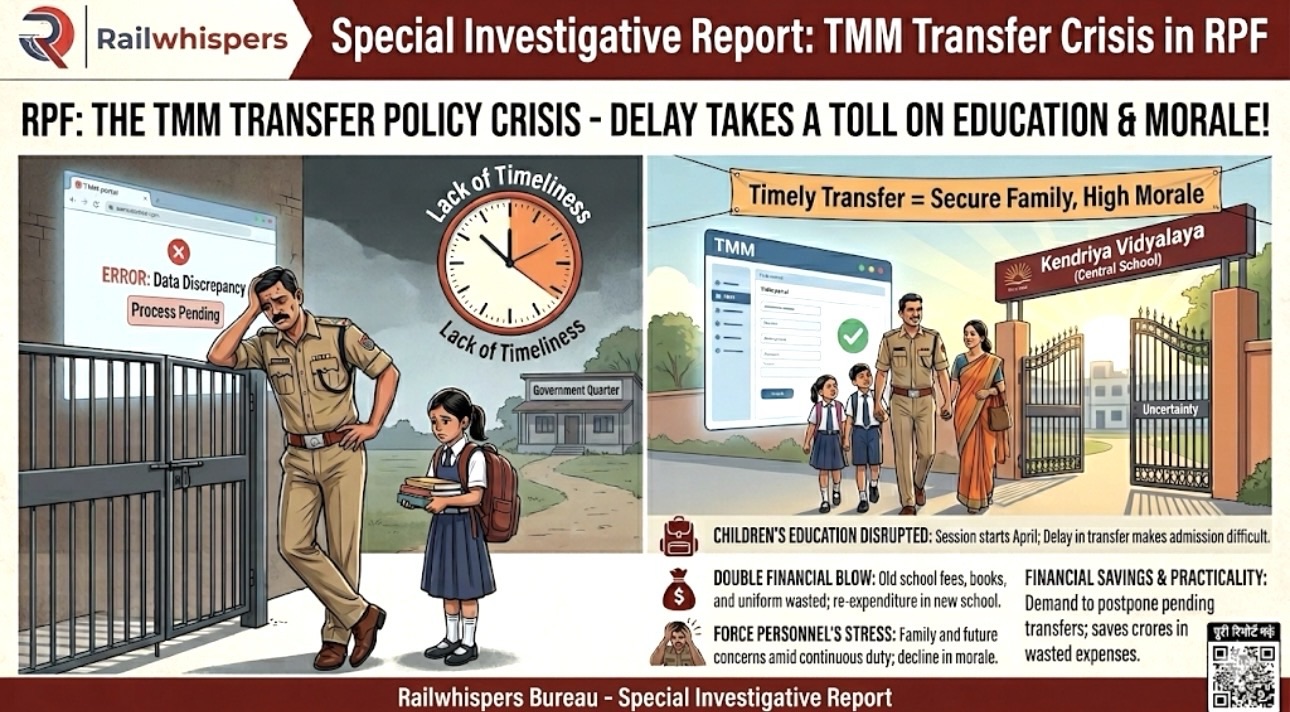
Railwhispers Bureau, New Delhi: The digital ‘Transfer Management Module’ (TMM), implemented with the objective of bringing transparency and streamlining the transfer process in the Railway Protection Force (#RPF), has now manifested into a severe crisis due to a lack of administrative coordination and a disconnect with ground realities. The annual tenure transfers proposed for February and March 2026 have not been completed even by the beginning of June 2026. This unprecedented administrative delay has not only pushed force personnel into severe mental and financial dilemmas but has also cast a shadow of uncertainty over their children’s future due to the commencement of the new academic session.
Blind Imitation of Paramilitary Framework: Disregard for RPF’s Practical Needs
Force experts and employees clearly believe that the core framework of the current Transfer Management Module (TMM) has been developed keeping in mind the organizational requirements of paramilitary forces like the Border Security Force (#BSF) and the Central Reserve Police Force (#CRPF). In paramilitary forces, the transfer process generally takes place at the battalion level from one location to another, which is relatively straightforward and collective.
In contrast, the structure, operational methodology, and responsibilities of the RPF are entirely different and highly complex. Operating on lines similar to a police organization, the RPF requires intricate human resource management parallel to railway operations across diverse and sensitive tiers such as Zones, Divisions, Posts, Outposts, Escorting Duties, Crime Intelligence Branch (CIB), Special Intelligence, and Reserve Lines. Tasks like local crime control, maintaining law and order, intelligence gathering, and ensuring the safety of railway property alongside millions of passengers demand highly practical and swift decision-making.
This is precisely why extensive discussions on an online transfer system were held at various levels in the past, but it was repeatedly deferred due to ground-level practicalities. Currently, even after the implementation of TMM, persistent technical glitches, data discrepancies, and frequent revisions in transfer lists clearly demonstrate that this system is failing to align with the unique organizational structure of the RPF.
Violation of Retirement Settlement Policy: The Agony of Veteran Personnel
Beyond the crisis of children’s education, the rigid implementation of the TMM module has dealt a severe blow to the most senior and veteran members of the force. Under long-standing establishment guidelines, personnel who have two years or less remaining before their superannuation (retirement) are exempt from disruptive routine transfers and are rightfully entitled to a “choice posting” or settlement posting of their preference. This humane provision ensures they can smoothly transition into retirement, plan their post-service settlement, and look after their health and aging spouses.
Tragically, the automated and insensitive programming of the TMM system has completely bypassed this policy. Personnel with merely one, one and a half, or two years left of active service have found themselves swept up in these mass tenure transfers. Forcing veteran security personnel to uproot their entire lives and relocate to unfamiliar territories at the twilight of their careers is not just a gross violation of administrative protocol; it is an egregious disregard for their lifelong dedication to the force, causing them profound psychological distress and logistical hardship.
Commencement of Academic Session and Double Financial Blow to Families
Across most parts of the country, the new academic session for schools and colleges has already commenced from April 2026. Due to the excessive delay and uncertainty in transfer orders, RPF personnel have been compelled to enroll their children in schools at their current place of posting. For this, employees have spent substantial amounts from their limited income on admission fees, annual development charges, books, uniforms, and other essential educational expenses.
If transfer orders are issued midway through the session now, employees will have to vacate their government quarters immediately. Moving to new cities poses the biggest challenge of disrupting children’s education mid-session. Since admissions are already closed in most reputed and Central Schools due to limited seats, securing a vacancy at a new location at this stage is virtually impossible. In many instances, helpless parents are being coerced into paying hefty ‘donations’ or exorbitant fees, which is beyond the financial capacity of a middle-class railway security personnel. Furthermore, the hefty fees already deposited in the current schools are generally non-refundable, dealing a double financial blow to the employees.
Escalating Administrative and Financial Burden
Administrative experts assess that if the transfer of force personnel is executed now, with the month of June already underway and the new academic session fully established, it will not only uproot the families of the employees but will also inflict a heavy financial burden on the government exchequer. Consequently, the Railways will have to bear additional expenses worth crores of rupees in Transfer Allowance (TA), travel costs, and incidental administrative expenditures, all of which could have been entirely avoided through timely decision-making.
Absence of Morale and Humane Approach: The Need for Policy Reform
According to the established principles of security forces, the morale of any disciplined organization is determined not just by its duty conditions, but heavily by the familial stability and peace of mind of its personnel. If a jawan deployed on sensitive 24-hour duty remains consumed by anxieties regarding his children’s education, the disruption of his family, or his own impending retirement settlement, it is bound to have a direct and severe adverse impact on his operational efficiency and the internal security mechanism of the force.
While digital and transparent systems are undoubtedly a welcome step, the success of any administrative reform depends entirely on how responsive it is to humane sensitivities and ground realities. The distressed RPF personnel have appealed to the top administration to view the TMM system not merely as a software tool but to make it practical, time-bound, and sensitive, ensuring that these processes are concluded well before the commencement of the academic session in the future.
Just Resolution: Demand to Defer Transfers for the Current Year
Considering the prevailing circumstances, the welfare of employees, administrative practicality, and fiscal prudence (financial savings) demand a concrete and compassionate decision. Since the academic session has advanced significantly, the only justified and practical recourse appears to be the immediate deferment or cancellation of these pending 2026 tenure transfers for the next six months or until the upcoming full academic session. The Railway Board and the RPF Directorate-General must take immediate cognizance of this grave anomaly and adopt a clear, humane perspective so that both the young families and the retiring veterans’ faith in the organization is sustained, allowing them to guard the lifeline of the nation with dignity and peace of mind.