

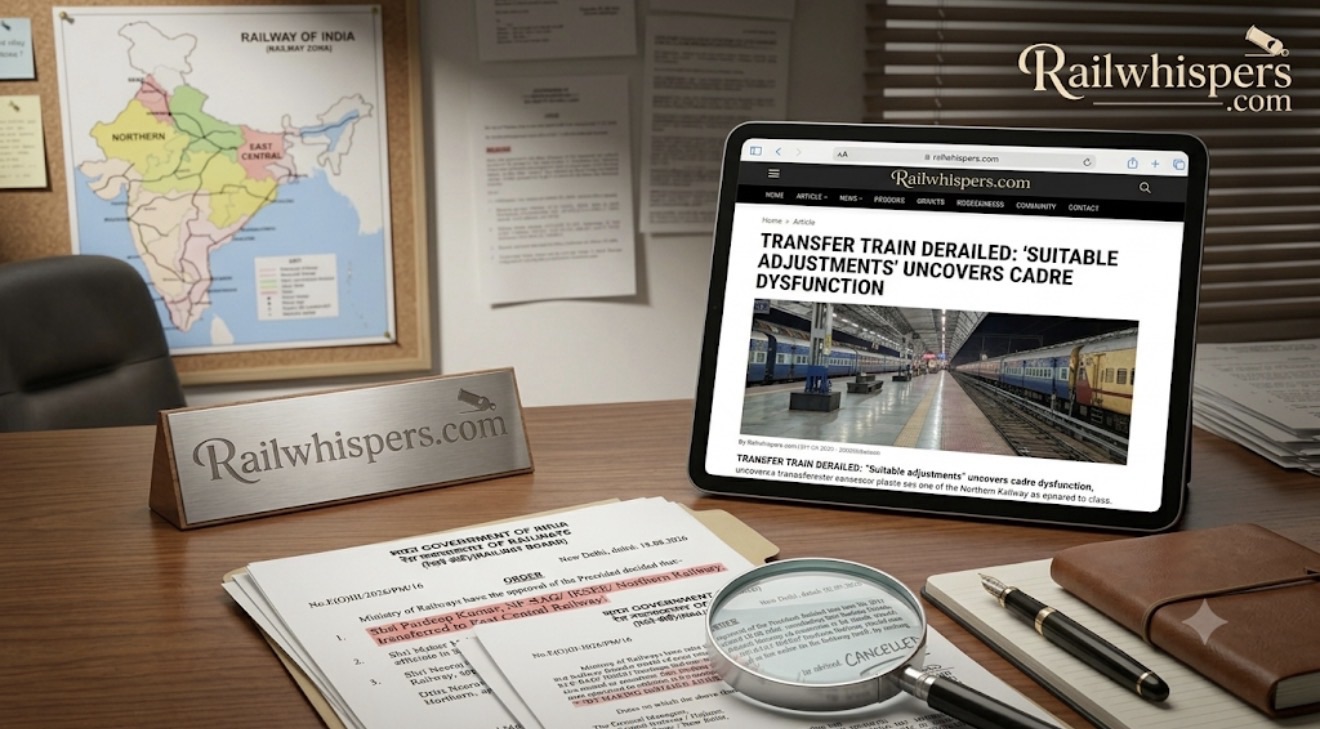
Rotation Policy Derailed: How Executive Capitulation and “Suitable Adjustments” Subvert Cadre Governance in Indian Railways
The foundational premise of an all-India cadre lies in objective mobility, broad administrative exposure, and the periodic disruption of entrenched local fiefdoms. Yet, in the Ministry of Railways, presidential transfer orders appear increasingly tentative, subservient to lobbying and executive convenience rather than institutional discipline.
A string of recent administrative reversals in the Indian Railway Service of Electrical Engineers (IRSEE) cadre highlights a chronic governance deficit. Rather than enforcing transfers to operational zones or production units, Rail Bhawan continues to modify, stall, or cancel formal orders, bending establishment cadres to accommodate individual preferences.
Historical Amnesia: Forgetting the Baroda House CBI Trap
The institutional push to mandate inter-railway transfers upon elevation to Senior Administrative Grade (SAG) was not a procedural whim—it was an essential integrity safeguard born out of acute embarrassment for Rail Bhawan.
The policy was strictly enforced following a high-profile corruption scandal in Northern Railway itself, where a Deputy Chief Materials Manager (Dy CMM) was promoted in situ and posted as Chief Materials Manager (CMM) at the same headquarters Baroda House. Operating within the very same corridors and networks he had cultivated over years, the officer was subsequently trapped red-handed by the Central Bureau of Investigation (CBI) while accepting illegal gratification.
That watershed scandal forced the Railway Board to confront an uncomfortable administrative truth: promoting and retaining officers within the same geographic zone and executive circle breeds local nexus, blunts vigilance oversight, and creates entrenched monopolies of discretion. The mandate to post officers out of their parent zones upon promotion to SAG was established precisely to dismantle these comfort zones and sever illicit administrative conduits.
By reviving the practice of retaining favored officers on promotion through arbitrary “suitable adjustments,” the current leadership is exhibiting alarming institutional amnesia—dismantling anti-corruption barriers that were instituted at great institutional cost.
The Anatomy of an Adjustment: The Case of Pradeep Kumar
The official orders issued for #PardeepKumar, IRSEE-2006, (NF-SAG/Northern Railway) provide clear evidence of this pattern:
- 18.08.2026 (Order No. E(O)III-2026/PM/16): The Ministry of Railways, with Presidential approval, ordered the transfer of Pardeep Kumar to East Central Railway (#ECR) upon promotion to officiate in the Senior Administrative Grade (SAG). The transfer came after approximately 20 years of continuous service in one zone/location.
- 02.09.2026 (Order No. E(O)III-2026/PM/16): Exactly 15 days later, the Ministry revoked its own directive. The cancellation order explicitly decreed that Pradeep Kumar should instead be posted on Northern Railway itself “by making suitable adjustments.”
The operational phrase—”by making suitable adjustments”—is an administrative euphemism. It acknowledges that no sanctioned vacancy warranted the retention, compelling the administration to carve out or distort cadre posts purely to satisfy an officer’s reluctance to move.
A Pattern of Privilege: The CLW Reluctance
The #NorthernRailway reversal is not an isolated event. It follows an established trend where senior SAG officers deployed to distant zones or key production units like Chittaranjan Locomotive Works (#CLW) successfully nullify their transfer orders through executive intervention:
The Stalled Relieving of Ved Prakash (CR):
Under Order No. E(O)III-2026/TR/382, dated 17.08.2026, #VedPrakash (SAG/IRSEE-2000) was transferred from Central Railway to CLW. Despite nearly 24 years spent continuously within #CentralRailway and in Mumbai only since his induction, the official order has faced informal roadblocks. Reliable reports indicate verbal directives from high offices within the Railway Board halting his formal relieving, leaving a presidential order in administrative limbo.
The Formal Cancellation of Sameer Dighe (SR):
A similar playbook unfolded in Southern Railway. Under Order No. E(O)III-2026/TR/190, dated 22.04.2026, #SameerDighe (SAG/IRSEE-2000)—who has similarly remained stationed in #SouthernRailway for roughly 24 years—was posted to CLW. Following sustained bureaucratic lobbying reaching top technical and infrastructure board members, the transfer was formally quashed on 11.08.2026, securing his continued retention.
Institutional Decay Behind the “Bungalow Culture”
As independent railway platforms such as #Railwhispers have consistently highlighted, the Indian Railways is steadily compromising its operational edge because it has abdicated the principle of merit- and need-based cadre deployment. Postings are no longer aligned with operational necessity or technical competencies, but with personal convenience and geographic comfort.
This practice is deeply intertwined with the broader issue of entitlement, particularly the retention of sprawling accommodations, flats, and bungalows in prime metropolitan zones. Entrenched tenures spanning over two decades foster deep-seated local patronage networks, breed administrative lethargy, and compromise vigilance standards.
When officers in SAG and higher grades successfully resist transfers, the burden of cadre mobility falls disproportionately on juniors and uninfluential officers who lack the leverage to secure “adjustments.”
The Cost to Railway Modernization
When formal orders signed in the name of the President of India are routinely countermanded within days by verbal halts or administrative reversals, executive authority loses its moral and operational weight. Accommodating bureaucratic privilege directly undermines the political leadership’s ability to execute critical rail infrastructure and safety reforms.
A high-density national transport network cannot operate on arbitrary exemptions. If the Ministry of Railways is to preserve cadre morale and basic organizational integrity, the Comprehensive Transfer Policy must be enforced uniformly, rather than discarded whenever an entrenched officer resists a change of station.