

WCR’s PVC Manipulation: A Textbook Case of How Public Money Disappears
How a routine price adjustment clause became a tool for financial irregularity at Kota Division?
Date of Publication: December 2025
Documents in Possession:
(1) Letter No. Misc/1, dated 23.12.2025, Sr.DEN/Co./Kota, West Central Railway
(2) GCC April 2022, Railway Board, Ministry of Railways
The Story in One Line
A Senior Divisional Engineer at West Central Railway’s Kota Division has quietly rewritten the list of items eligible for Price Variation Clause (#PVC) payments — without any visible Finance concurrence, without Railway Board sanction, and in apparent violation of the #GCC-2022 rules laid down by Railway Board itself.
What is PVC—And Why it Matters
The Price Variation Clause (Clause 46A) under the Indian Railways Standard General Conditions of Contract, April 2022 (GCC-2022), is a legitimate mechanism that protects contractors from market price fluctuations in materials like steel, cement, fuel, and labour during long contracts.
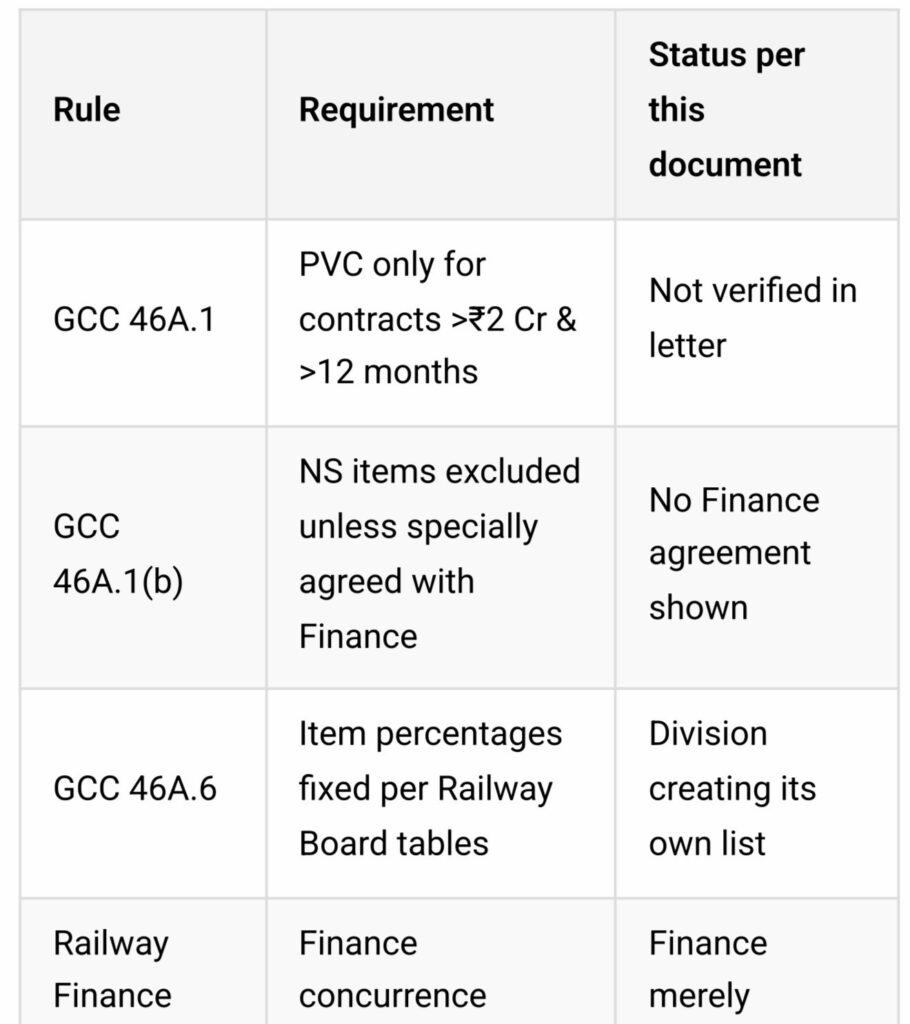
GCC-2022 Clause 46A.1 is crystal clear: PVC shall be applicable only in tenders having advertised value above ₹2 Crores and having completion period above 12 months.
The clause also specifies exact item categories (A, B, C, D, E), their components (Labour, Material, Fuel, Steel, Cement etc.), and the precise WPI/CPI-based formulae through which any variation is calculated.
There is no discretion left to divisional-level engineers. The Railway Board has fixed everything.
The Document That Raises Red Flags
On 23 December 2025, a letter bearing number Misc/1 was issued by the office of Sr.DEN (Co.), West Central Railway, Kota — addressed to the Senior Divisional Finance Manager, West Central Railway, Kota.
The letter states it is a corrected/revised list of USSOR-2011 and DSR-2021 items to be covered under PVC for GCC-2022 contracts — a revision of a list previously sent on 12.11.2025.
At first glance, this appears administrative. Look closer, and the questions multiply.
Red Flag #1 — Who Auditioned this Item List
GCC-2022 Clause 46A.6 states that item percentages and classifications “shall be as specified for all item(s)/Bill(s) of Quantities in tender document” — i.e., determined at the tender stage, governed by Railway Board’s own tables.
The Kota Division letter creates a separate, division-level list mapping USSOR-2011 item numbers and DSR-2021 item numbers to PVC categories (A, B, C, D, E).
Key questions:
- Under which Railway Board authority did the Sr.DEN create this mapping?
- Was this list vetted by the Principal Chief Engineer (PCE), WCR?
- Was it approved by Railway Board’s Civil Engineering Directorate?
- The letter references a HQ letter (Kota/WA/विविध/2025-26, dated 11.09.2025) — but was that letter itself lawful?
Red Flag #2 — No Finance Concurrence Visible
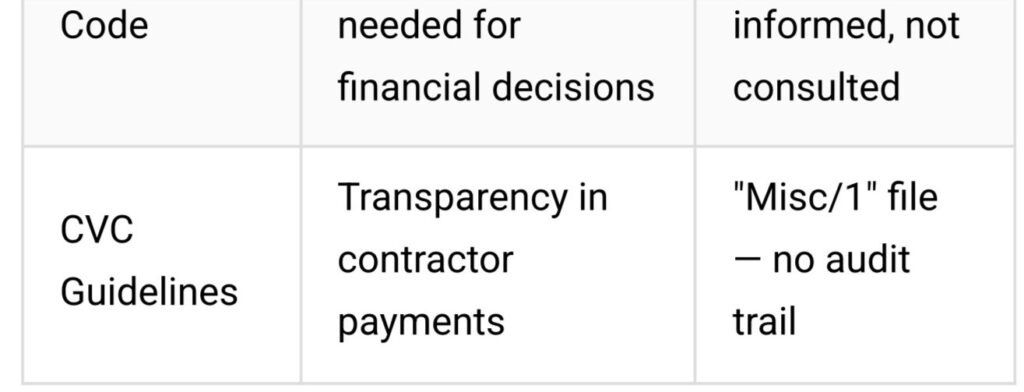
The letter is addressed TO the Sr. Divisional Finance Manager — meaning Finance has not yet seen or approved this list. It is being informed, not consulted.
GCC-2022 itself was issued “with the concurrence of Finance Directorate of Ministry of Railways” (as stated in the Railway Board’s covering letter dated 27.04.2022).
Any division-level deviation or interpretation that expands the scope of PVC payments must similarly carry Finance concurrence — at minimum from the Divisional Finance, ideally from HQ Finance (WCR/Jabalpur) or the PFA’s office.
If this list was implemented without Finance concurrence and payments were made to contractors — that is a financial irregularity under Railway Finance Code.
Red Flag #3 — The “NS Items” Column
Column 5 of the table in the letter is headed “NS Items” (Non-Schedule Items) — and against categories D and E (steel fabrication and erection items), the entry reads: “Copy Attached.”
Attached page 3 of the document shows specific NS item descriptions — including large bridge girder erection works, HSFG bolting, girder launching, and protective screen fabrication.
NS Items under GCC-2022 require special treatment. GCC Clause 46A.1(b) explicitly states that extra items falling outside the Bill of Quantities under Clause 39(1)(b) are EXCLUDED from PVC — unless applicability and Base Month have been “specially agreed” while fixing rates of such extra items.
Who specially agreed? When? In writing? With whose Finance concurrence?
The document is silent. The attached page carries only the signature of Sr.DEN/Co./Kota — no Finance sign, no HQ approval, no Railway Board nod.
Red Flag #4 — Three Letters in Three Months, All “Misc/1”
The document references three prior letters:
- Kota/WA/ववध/2025-26, dated 11.09.2025 (from HQ)
- Misc/1, dated 07.11.2025
- Misc/1, dated 12.11.2025
All three carry the same file number Misc/1 — a catch-all miscellaneous file. This raises a serious procedural question: Why is a matter involving crores of rupees in contractor payments being handled under a “Misc” file rather than a properly registered works/finance file with an audit trail?
A matter of this financial magnitude should be in a named, numbered file open to inspection by Accounts, Audit, and Vigilance.
Red Flag #5 — Timings: Year-End Rush
The revised list is dated 23 December 2025 — just 8 days before the financial year’s third quarter closes (31 December 2025). PVC payments under GCC-2022 are calculated quarterly.
A revised list issued in the last week of the quarter could be used to:
- Backdate the applicability of PVC to items not previously covered
- Rush through PVC bills for the quarter before year-end audit scrutiny
- Inflate contractor payments in items like steel erection and bridge fabrication — where NS item rates are already high
What the Law & Rules Say
The Larger Pattern
This is not about one letter. This is about a system in which:
- Divisional engineers interpret PVC eligibility in ways that favour contractors
- Finance departments are treated as post-facto rubber stamps
- Large payments flow through NS items that technically fall outside PVC
- Documents travel through miscellaneous files with no formal audit trail
- Corrections are issued in December — just before
- quarterly bills are processed
Contractors who win Railway tenders at competitive rates know that PVC is where the real money is. A contract worth ₹10 crore can yield ₹1–2 crore extra through PVC if the item list is generous. If the item list is created by a divisional engineer without checks — the contractor and the engineer both benefit.
Questions that demand Answers
To Sr.DEN/Co., Kota — West Central Railway:
- Under which specific Railway Board circular did you create this USSOR/DSR-to-PVC mapping?
- Has this list been approved by PCE/WCR or Railway Board’s Civil Engineering Directorate?
- Have any PVC payments been made to contractors based on this list?
To Sr.Divisional Finance Manager, Kota:
- Have you concurred with this list — or merely received it?
- Have you raised any objection in writing?
- Have contractor bills been passed based on this item mapping?
To General Manager / West Central Railway:
- Is the HQ letter dated 11.09.2025 (Kota/WA/विविध/2025-26) on record?
- Was PFA’s concurrence taken before that HQ letter was issued?
- Has any Divisional Audit flagged this matter?
To Railway Board / Ministry of Railways:
- Has any Zonal Railway sought clarification on NS item eligibility under GCC-2022 PVC?
- Are spot checks being conducted on divisional-level PVC item lists?
To CVC / CAG:
- This matter warrants an inquiry into PVC payments at Kota Division, WCR, for FY 2024-25 and 2025-26.
CONCLUSION: The Price Variation Clause exists to protect contractors from genuine market risk. It does not exist to be a bonus payment window engineered at
the divisional level.
The document dated 23.12.2025 from Kota Division raises serious questions about financial propriety, procedural compliance, and possible contractor-official nexus. The absence of visible Finance concurrence, the use of a miscellaneous file for a crore-level financial matter, the inclusion of NS items without proper authorization, and the suspiciously year-end timing — all point to a matter that deserves immediate scrutiny.
The CVC, the CAG, and the Railway Board’s Vigilance Directorate should take note.
This editorial is based on documents in the public interest. The facts stated are drawn directly from the two documents referenced above. No allegations are made beyond what the documents reveal. Concerned officials have not been given a right of reply — we invite them to respond publicly.
RTI applications on this matter may be filed with the PIO, West Central Railway, Jabalpur.
— Editorial Desk