

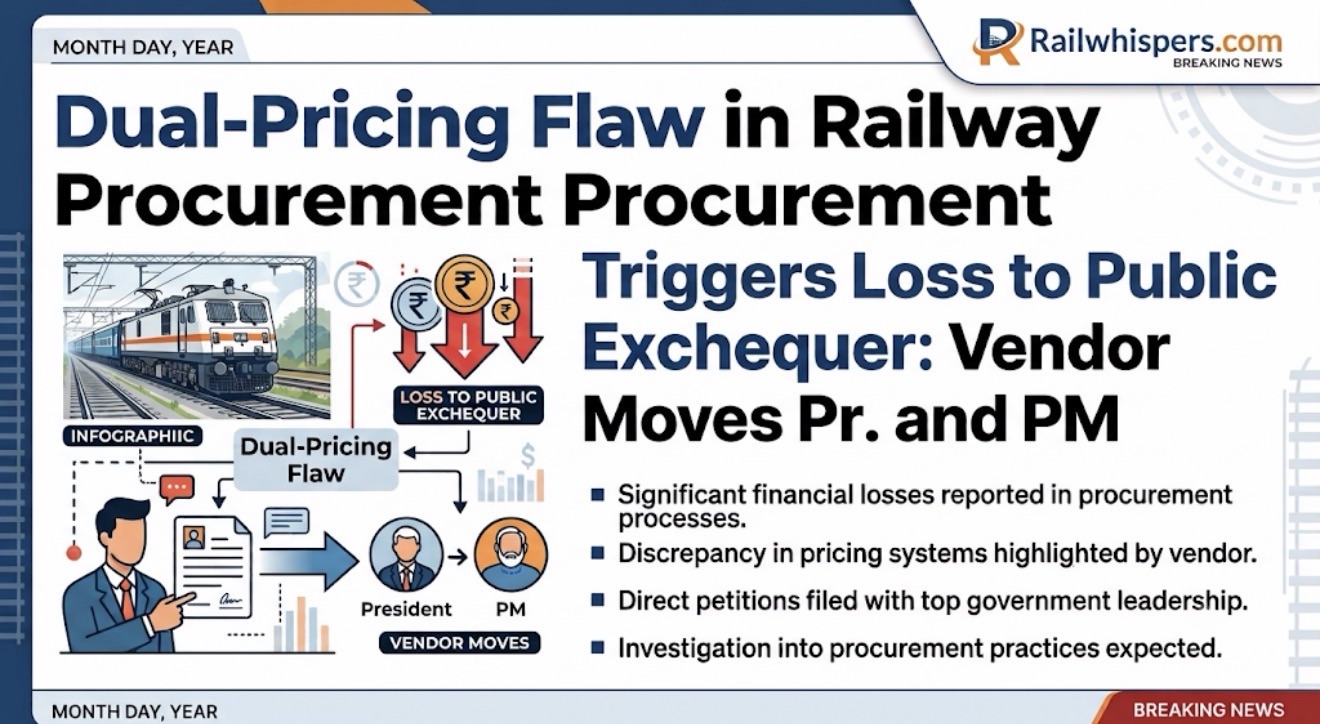
Dual-Pricing Flaw in Railway Procurement Triggers Massive Loss to Exchequer: Vendor Moves President & PM
Matter Referred to CBI & CCI: Track Fittings Maker Flags 80% Policy-Driven Price Premium in Railway Tenders
Seven Approved Firms Corner 80% Orders Despite 23 Developmental Vendors Holding Majority Capacity: Representation Exposes Flawed System
NEW DELHI: In a formal representation dated August 14, 2026, railway track fittings manufacturer Surya Alloy Industries Limited has raised serious concerns regarding the vendor classification system of the Indian Railways, alleging that the prevailing dual-pricing mechanism defeats the objectives of competitive procurement and causes substantial financial losses to the public exchequer. The communication, signed by authorized signatory Shrivar Rungta, has been formally submitted to the Hon’ble President of India at Rashtrapati Bhavan and the Hon’ble Prime Minister of India at South Block.
Copies of the detailed representation have been forwarded for action and consideration to key railway and regulatory oversight authorities across the country, including the Director General of the Research Designs and Standards Organisation (#RDSO) in Lucknow, the Chairman/Railway Board, the Member-Infrastructure of the Railway Board, the General Managers, Principal Chief Materials Managers, and Principal Chief Engineers across all Zonal Railways, the Central Bureau of Investigation (CBI) at the CGO Complex in New Delhi, and the Competition Commission of India (CCI) at both its Bhikaji Cama Place and Kidwai Nagar East offices in New Delhi.
The representation centers on the procurement policy for High Viscous Nylon (#HVN)-66 Insulating Liners under RDSO Item ID 3100587, governed by IRS Specification T-44 (2025, Third Revision), STR TDG 0005 Rev. 03, and Railway Board letter No. 2013/TK-II/22/7/4 dated April 17, 2023. Under the extant policy, newly approved suppliers are placed in the Developmental (Part-II) category and are restricted to a maximum order share of 20 percent of the tendered quantity even when they emerge as the lowest bidder (L-1), while the remaining 80 to 100 percent of the bulk volume is reserved for Approved (Part-I) vendors. Upgradation to Part-I requires a vendor to successfully supply a prescribed quantum of 2,00,000 units alongside applicable cooling periods.
Surya Alloy Industries Limited—a BIS, ISO 9001:2015, and ISO 14001:2015 certified company founded in 1990 with plants in Barjora, Durgapur, and Angadpur, West Bengal, and a supplier of Elastic Rail Clips, Grooved Rubber Sole Plates, Fish Plates, Metal Liners, and SGCI Inserts—stated that it was enlisted under Vendor ID 13062 on July 13, 2026, with an assessed annual capacity of 16,95,708 units after prototype approval.
According to data extracted from the IREPS/GeM RDSO Vendor Directory as of July 24, 2026, a stark structural disparity exists in the sector. Out of 30 total enlisted sources, 23 are classified under Developmental Part-II, representing 17,07,21,848 units per year or 68.58 percent of the total assessed national capacity of 24,89,23,830 units. In contrast, only 7 vendors belong to the Approved Part-I bulk category, holding an aggregate capacity of 7,82,01,982 units per year, or just 31.42 percent of the industry capacity.
The representation emphasizes that both vendor classes manufacture identical products against the exact same RDSO drawings (RT-3702, RT-3706, RT-3707, RT-3708, RT-8751, RT-8752, and RT-8753), adhere to identical technical specifications, and undergo identical inspection processes. Despite this technical parity, Part-I vendors routinely quote between 1.5 to 2 times the rates submitted by Part-II vendors, knowing that bulk order allocation is guaranteed to them by policy.
This structural flaw leads to the Railways paying a policy-created premium of 40 to 80 percent on the majority of procurement, effectively penalizing the exchequer based purely on vendor vintage rather than quality or supply security. Concurrently, the 20 percent allocation cap starves new manufacturers of the order volume needed to achieve the 2,00,000-unit threshold, keeping advanced injection-moulding infrastructure and approved raw materials underutilized for years.
To address these market distortions, the representation prays for three specific policy interventions: capping the ordering rate for Part-I bulk vendors at a maximum of 10 percent above the discovered L-1 developmental rate whenever a Part-II vendor is L-1 (with unaccepted volumes reallocated to willing developmental sources), rationalizing the developmental quota from 20 percent to a minimum of 40 percent to match manufacturing capacity, and introducing a time-bound upgradation mechanism based on consistent accepted supplies when delivery shortfalls occur solely due to tender allocation caps. The company affirmed its readiness to place complete tender-wise rate comparisons before any designated government authority.