

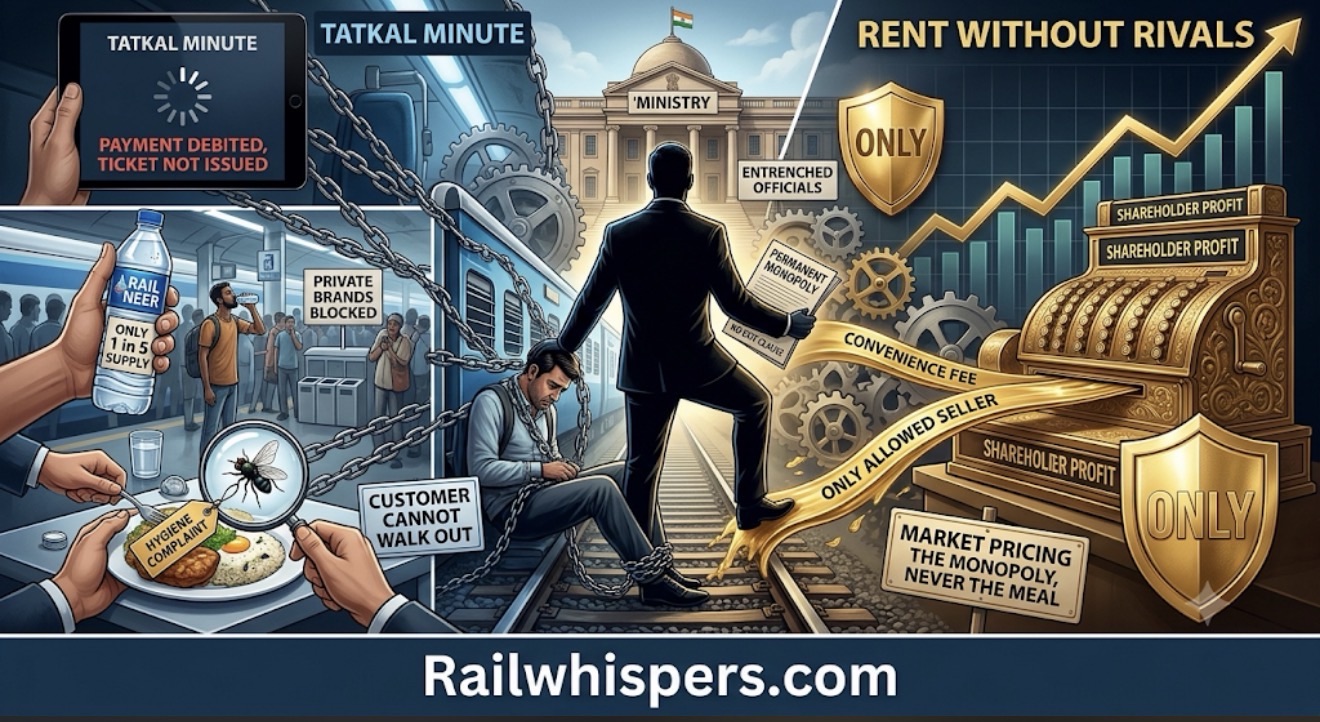
TOO BIG TO FAIL, Part IV, “Rent Without Rivals”
This series began with #Railwhispers’ “Too Big to Fail ???” 2 April 2026.
6 July 2026: “TOO BIG TO FAIL, Part II: The Cartel You Cannot Sack!”
7 July 2026: “TOO BIG TO FAIL, Part III: The Steel You Cannot See”
There is a particular kind of #company the #stockmarket loves, the one that owns a thing nobody else is allowed to sell. The Indian Railway Catering and Tourism Corporation (#IRCTC) is the purest specimen of it on the exchanges. It is the only #seller of a railway ticket online, the only #caterer permitted on the train, the only brand of #water the platform is meant to stock, the #operator of the special #tourist trains that run under the national banner. Its worth rests on one small word, only. Take that word away and there is not a great deal of business left to admire.
Consider what the word does. What disciplines an ordinary firm is a customer who can walk out of the door, and #competition is simply the standing threat of his departure. The corporation’s #customer cannot walk out. He has a #ticket to a fixed place at a fixed hour, he is hungry somewhere past #Itarsi with no rival counter to cross to, thirsty on a platform where a single brand is meant to be sold. A passenger who cannot take his custom elsewhere is left with only one instrument, the #complaint. And a #monopoly has little reason to fear it, because a complaint cannot take back a sale already made.
This is why the failures of such a company sound so much louder than their share of the traffic. When a firm with rivals stumbles you shrug and go next door. When the only firm stumbles you are trapped inside the stumble. Watch the #booking-system in the one minute the #tatkal window opens. There have been reported crashes and outages through the festival rushes, screens that will not load, and the particular cruelty of a payment that is debited while the ticket is not issued. The #corporation has tended to blame the weather of the internet, the user’s device, the network, and has added a button to retry. A shopper locked out of one website opens another. The railway passenger has no other website. Every outage, for him, is total.
Water is the cleanest illustration a textbook could ask for. The protected producer reportedly makes about 6.14 lakh litre-bottles a day against a requirement close to 30 lakh. A monopoly meeting a fifth of the need it exists to meet. And note what is done when it falls short. Zones are instructed to allow private brands back onto the platform for a few weeks at a stretch, in one belt until June, in another until May. The instant the monopoly cannot deliver, the very competition it is built to exclude is waved in as the emergency. Which tells you plainly what the exclusivity was ever worth. It kept the rivals out. It did not put the water in.
The food carries the same signature. In one recent case a passenger found a fly in his meal, and the caterer was fined a lakh and marked to lose his licence. In another, a complaint aboard a premium train brought a ten lakh penalty on the corporation itself and a far larger one on the #contractor, with the #contract ordered terminated. Hygiene complaints are reported to have climbed steeply across two years. These are not the marks of a market correcting itself. They are the marks of a system where the correction can only arrive as a fine after the fact, because the #diner cannot vote with his feet in the middle of a journey, and the money for feeding him is collected whether he is fed well or fed a fly. The man who eats the meal is not the customer whose satisfaction pays for it.
The most telling evidence is where the corporation sells to a customer who can walk away, and still struggles. Its tourist trains face a buyer free to book any holiday he pleases, and there the monopoly instinct meets its limit. Packages have been cancelled for want of passengers, fares marked down by a fifth or more, an eighteen day tour priced at sixty two thousand rupees a head in coaches past their prime. A firm schooled in captive demand does not easily learn to court the free kind.
Put the picture together and a strange thing stands out. The very feature that makes the company a poor servant is the feature that makes it a fine investment. Its convenience fee, a charge on a booking the customer has no way to avoid, reportedly throws off the greater part of its operating profit, and its margin on the digital ticket is the envy of firms that must actually fight for a sale. When the government once obliged it to share half of that fee, the share price fell hard and thousands of crores in value evaporated inside a fortnight, not because the service had altered by a single rupee, but because the rent had. The market was pricing the monopoly, never the meal. The passenger and the shareholder look at one company and see opposite things, and nothing in the ordinary working of the market forces the first view to answer to the second.
In a normal industry the discipline the passenger cannot apply is applied for him by a competitor. This corporation has none, by design, so the discipline has to come from the only party that can stand in for one, the state that granted the monopoly. Take away the customer’s exit and you take on the duty of supplying its substitute. Fail to, and the monopoly keeps the one thing it always keeps, the money, and sheds the one thing it was meant to provide, the service.
There is a cleaner fix, and it follows the same economics. If competition cannot exist inside the market, put competition for the market in its place. A monopoly should not be a permanent possession. It should be a licence, re-won at fixed intervals, held only as long as it is earned. Put each service out to open tender for a fixed term: the catering on a route, the water at a cluster of stations, the tourist train on a circuit. IRCTC bids for these rights alongside every other interested party, on the same terms, and wins only when its bid is genuinely the best. A franchise held for a fixed term and re-contested at its end is a different creature from one held forever by default. The first must keep earning its place. The second only has to keep its friends. One rule protects the whole design. Award the franchise to the bidder promising the lowest fare and the firmest service, not the one offering government the largest cheque. Auction a monopoly to the highest bidder and the rent simply moves from company to treasury. The captive passenger still pays it.
So the demand on the Ministry of Railways is plain, and it is not a reshuffle. Break the single monopoly into contestable franchises and tender them in the open, decided on the passenger’s price and not the size of the payment. Clear out the entrenchment that made the present arrangement possible, the officials who have sat long enough to treat the corporation as a personal estate and the vendors grown too close to the offices meant to judge them. A clean boot, in short, and not a caretaker’s polish. Entrenchment is not a side effect of a permanent monopoly. It is what a permanent monopoly is for.
None of this will hold unless the incentive behind it changes, in the offices that decide who holds these monopolies and on what terms. “Part V follows the question onto that floor, where the contracts are written and the postings are made.”
The clean boot, concretely
Seven demands on the Ministry of Railways, each checkable later:
- Hold a competition for the market where none exists in it. Break the single monopoly into contestable franchises, the catering on a route, the water at a cluster of stations, the tourist train on a circuit, the ticketing platform, and put each out to open tender for a fixed term. Award on the lowest passenger fare and the firmest service guarantee, not on the largest cheque to government, and re-tender at the term’s end. Let IRCTC bid like any other firm and win only when it is genuinely the best.
- Order a clean boot, not a reshuffle. Move out the officials entrenched long enough to run the corporation as a personal estate, and sever the vendors grown too close to the offices that are meant to judge them.
- Treat the complaint stream as the market that does not exist. Publish, by contract and by zone each month, complaint rates, fines levied, and licence actions, so a caterer’s record is public before the contract comes up for renewal.
- Tie catering and food-court renewals and payments to an independently audited hygiene and quality score, not to the bid alone.
- End the water monopoly’s exclusivity wherever it cannot supply. Since Rail Neer meets a fraction of demand, keep approved private brands on permanent sale at the fixed price rather than as an emergency, and enforce the fifteen rupee cap with visible checks.
- Price the ticketing right like the utility it is. Justify or cap the convenience fee against published uptime at the tatkal minute, and publish payment-failure and refund times.
- Open the books the monopoly shelters behind. Publish the occupancy, cost recovery and per-passenger economics of #BharatGaurav and the luxury trains, and the payments made to and from dominant vendors, so the public can tell rent from exclusion apart from reward for service.