

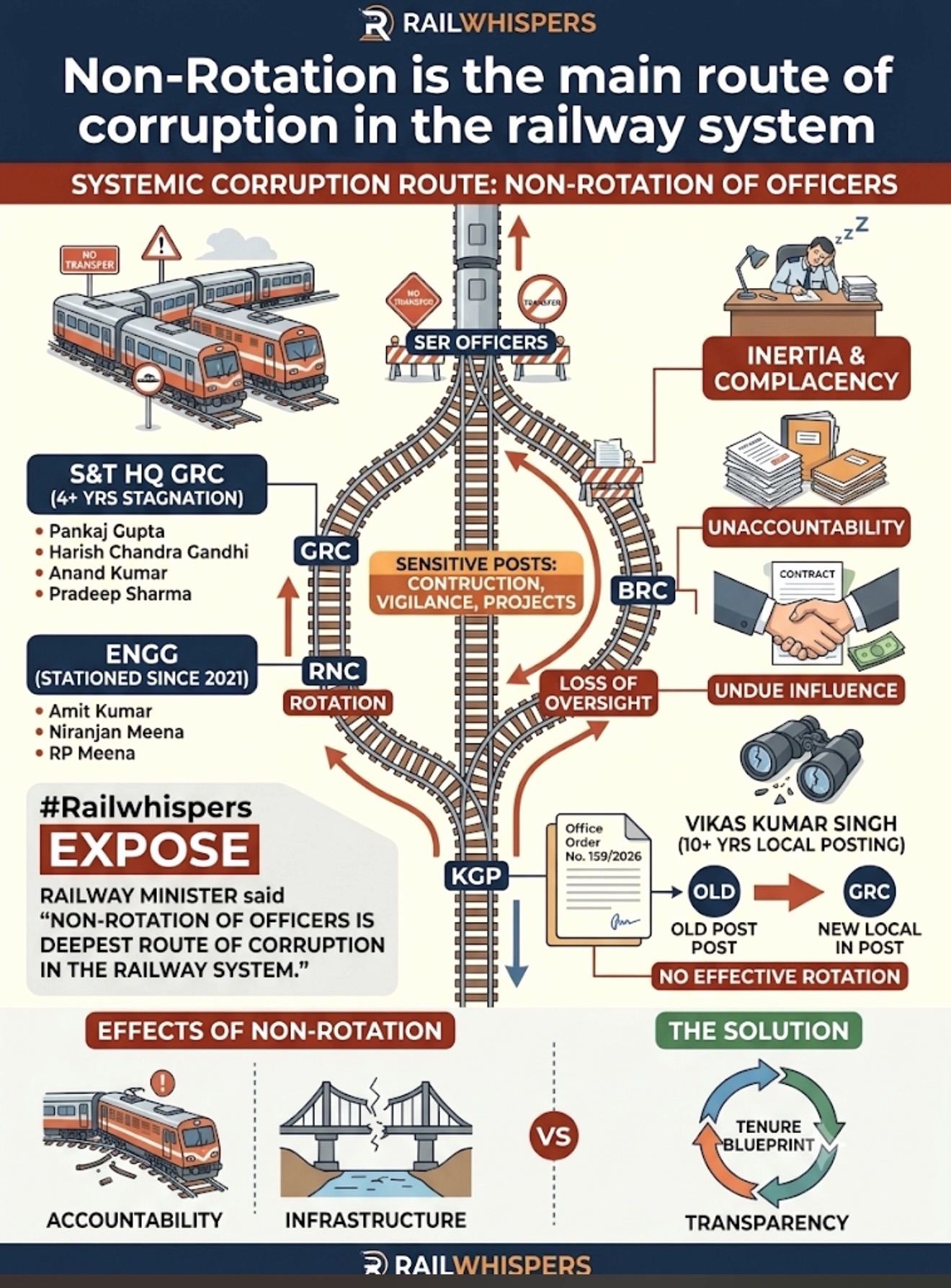
ADMINISTRATIVE STAGNATION: Questions Arise Over Compliance with Officer Rotation Policy
To safeguard the credibility of the Indian Railways network, it remains critical for apex administrative authorities to review these placements and execute prompt, transparent rotations across all designated sensitive posts
KOLKATA: Compliance with administrative checks and balances has come under scrutiny within South Eastern Railway (#SER) as internal data and official records raise questions regarding adherence to the Ministry of Railways’ mandatory officer #rotation policies. Observers and whistleblowers within the system argue that prolonged tenures in sensitive wings—such as #Construction, #Vigilance, and divisional engineering operations—directly challenge the fundamental tenets of administrative transparency and fair institutional governance.
The foundational core of systemic integrity in public infrastructure management relies heavily on the regular #rotation of personnel. When senior officers occupy highly sensitive posts for extended, unbroken durations, it risks creating institutional inertia and disrupting the objective checks and balances required for robust procurement and operational oversight. Within several key departments of SER, an ongoing trend of long-term local postings suggests a systemic omission of standard tenure-tracking frameworks.
As evidenced by the official South Eastern Railway Headquarters Personnel Department Office Order No. 159/2026 dated June 25, 2026, recent administrative adjustments have highlighted localized re-postings. The order outlines that Vikas Kumar Singh, the former Dy. CSTE/CON/KGP, has been posted as Dy. CSTE(Con)/Contracts/GRC, while simultaneously looking after construction works at Ranchi (#RNC) and Adra divisions in addition to his new role. Internal reports indicate that this placement continues a decade-long trajectory within the SER Construction wing, dating back to his tenure as #DSTE Post and subsequent posting at Kharagpur, fueling systemic concerns over whether standard rotation procedures are being routinely bypassed for specific portfolios.
Analysis of the current administrative layout indicates long-standing tenures concentrated at the Garden Reach (GRC) Headquarters and major operational divisions. Within the Signal and Telecommunication (S&T) department, multiple direct officers have crossed the typical three-to-four-year threshold at HQ:
- Pankaj Kumar Gupta (#DGM/G): On-site since 2021.
- Harish Chandra Gandhi: Stationed at GRC since the 2018–19 period.
- Anand Kumar (#DyCSTE P&D): Retained at HQ since 2022.
- Pradeep Sharma (Dy. CSTE Project): Positioned continuously since 2020.
A similar pattern emerges within the Engineering wing, where key personnel handle highly sensitive infrastructural portfolios without external rotation:
- Amit Kumar (#DyCE/Con/KGP): Stationed at Kharagpur since the 2021–22 cycle.
- Niranjan Meena (Dy. CE/Con/RNC): Handling Ranchi operations since 2022.
- RP Meena (#SrDEN/Co/CKP): Occupying a vital divisional slot since 2022.
- Anoop Patel: Recently transitioned locally from Sr. DEN/KGP to #ADRM Chakradharpur (CKP).
The systemic challenge is further compounded by extended tenures within the very mechanism designed to police them: “the Vigilance department.” Concerns have been raised regarding the positioning of #DyCVO Chanchal Adhikari, who has reportedly completed approximately six years within the vigilance wing. Established Central Vigilance Commission (#CVC) directives mandate strict tenure limits and subsequent transfers outside the parent vigilance structure to ensure complete independence.
Furthermore, personnel managing crucial operations during severe systemic failures—such as #DyCSTE/Project Nand Kumar Azad and Sachendra Verma (formerly #SrDOM/KGP, now #SrDOM/Adra), both of whom held critical responsibilities during the period encompassing the major #Balasore accident framework—continue to hold highly influential administrative positions across vital divisions like #Adra and #Kharagpur without external re-assignment.
The persistence of these localized tenures raises urgent administrative questions regarding the oversight exercised by Principal Heads of Departments (#PHODs) and the General Manager. Observers are calling for an immediate, standardized, and publicly tabulated tenure blueprint to govern sensitive construction and project management portfolios. To safeguard the credibility of the Indian Railways network, it remains critical for apex administrative authorities to review these placements and execute prompt, transparent rotations across all designated sensitive posts.