

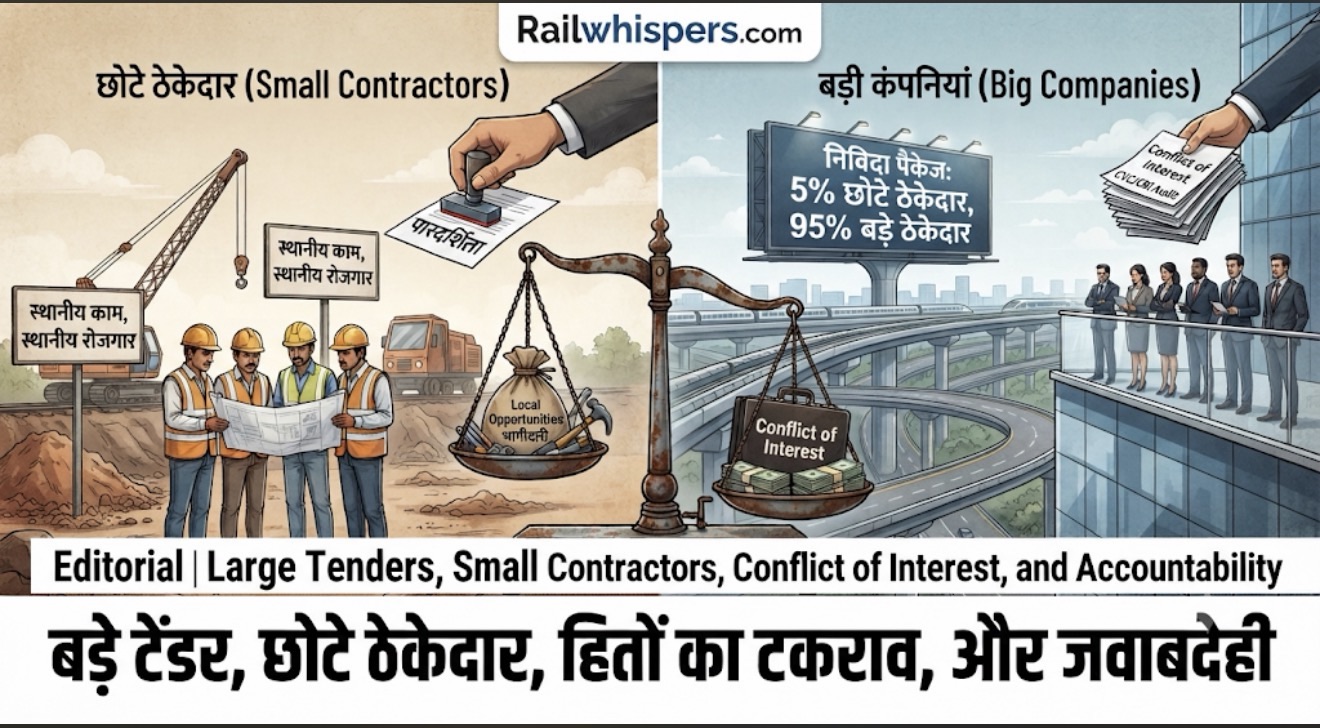
Editorial | Large Tenders, Small Contractors, Conflict of Interest, and Accountability
The continuously expanding scale of tenders in government construction works has created serious challenges for the participation of small and local contractors. If the size of tenders grows so large that local or small contractors are pushed out of competition and participation, it directly impacts local employment, regional economy, and the livelihood of thousands of workers.
Along with this, Conflict of Interest is a major issue. If an officer or decision-maker has to make decisions related to a company’s tenders, technical approval, payments, or contracts, a transparent investigation must be conducted into any financial interests of their direct beneficiaries and close relatives in that company.
This may include spouses, parents, parents-in-law, siblings, sons and daughters, sons-in-law and daughters-in-law, brothers-in-law (husband’s or wife’s brother) and sisters-in-law (husband’s or wife’s sister), brothers-in-law and sisters-in-law (spouse’s siblings’ spouses or other relations), and other designated close relatives.
The issue is straightforward—do the decision-making officers or their direct beneficiaries/close relatives hold shares in that company, purchase them, or derive economic benefits from it in any other way?
If any such conflict of interest exists, the concerned person should be recused from decisions related to that company, and this must be made mandatory through a public declaration.
This is not an allegation against any individual or company, but a demand for public funds, fair tendering, and transparency.
There is a demand from the ED, CBI, CVC, Ministry of Finance, and Ministry of Home Affairs to conduct an independent audit of potential conflicts of interest, beneficial ownership, shareholding, and the financial interests of related persons in large government tenders.
Giving large tenders or making large projects is not wrong—but those large packages must be fair and transparent.
If the small contractor is strengthened, local employment will be strengthened, and public trust in the government machinery will be strengthened.
Small contractors say—they remember the days when thousands of small and medium work tenders ranging from ₹2 lakh to ₹2 crore were floated across the country. They believe that during that era, work was distributed more locally—small contractors got opportunities, local workers got employment, and money circulated in the regional economy.
Today, when even small works are being clubbed into large packages and opportunities for contractors executing works below ₹5 crore are shrinking, their concern is natural.
Small contractors ask: “Does development mean only large tenders and big packages?” Their demand is that the development model should be such that it includes both large projects and small local works—so that contractors, workers, and local businesses all maintain their participation.
In their words—“That time was good when work was also in small hands; development was local and participation was shared.”
If the small contractor is strengthened, the local worker and local economy will also be strengthened. If the government continuously wants to award large tenders, there must be strict rules regarding Conflict of Interest.
Along with the officer or decision-maker having a direct/indirect connection with a company’s tender, payment, or work, there should be clear restrictions and mandatory disclosures on close relatives holding or purchasing shares in the concerned company.
A tender can be large, but transparency must be even larger.
The issue is—will government works go to local small contractors and hardworking people, or will they continue to be restricted to large companies associated with the share/stock market through mega tenders?
There should be transparency in the system, fair competition, and equal participation of local contractors. If any officer, public representative, or system is accused of favoring a company for personal gain, there should be an impartial investigation and public accountability. If the small contractor is strengthened, the local worker will also be strengthened.
Small contractors are now raising serious questions—
- When only 5% of tenders up to ₹5 crore are reserved for small packages, what will be the future of millions of small/medium contractors in the country?
- On one hand, crores of people still depend on 5 kg of free rations, while on the other hand, government construction tenders are continuously growing larger.
- Why is the voice of small contractors not being heard?
- Is the large-package tender system actually in the interest of MSMEs and small contractors?
Now, small contractors and MSME entrepreneurs do not want mere assurances, they want equal opportunities. If the size of tenders continues to grow in this manner and opportunities keep shrinking, this protest will become even more vocal at the local level. The country needs a system where public work is not limited only to companies connected to the stock market, but workers get their own local companion and regional contractor who can stand with them and generate real local employment. Now the government needs to think about this, because large contractors or big companies do not bring votes—large contractors and big companies can only provide big bribes or large party funds, but they cannot deliver votes; this job is done solely by small, medium, and local contractors and workers!