

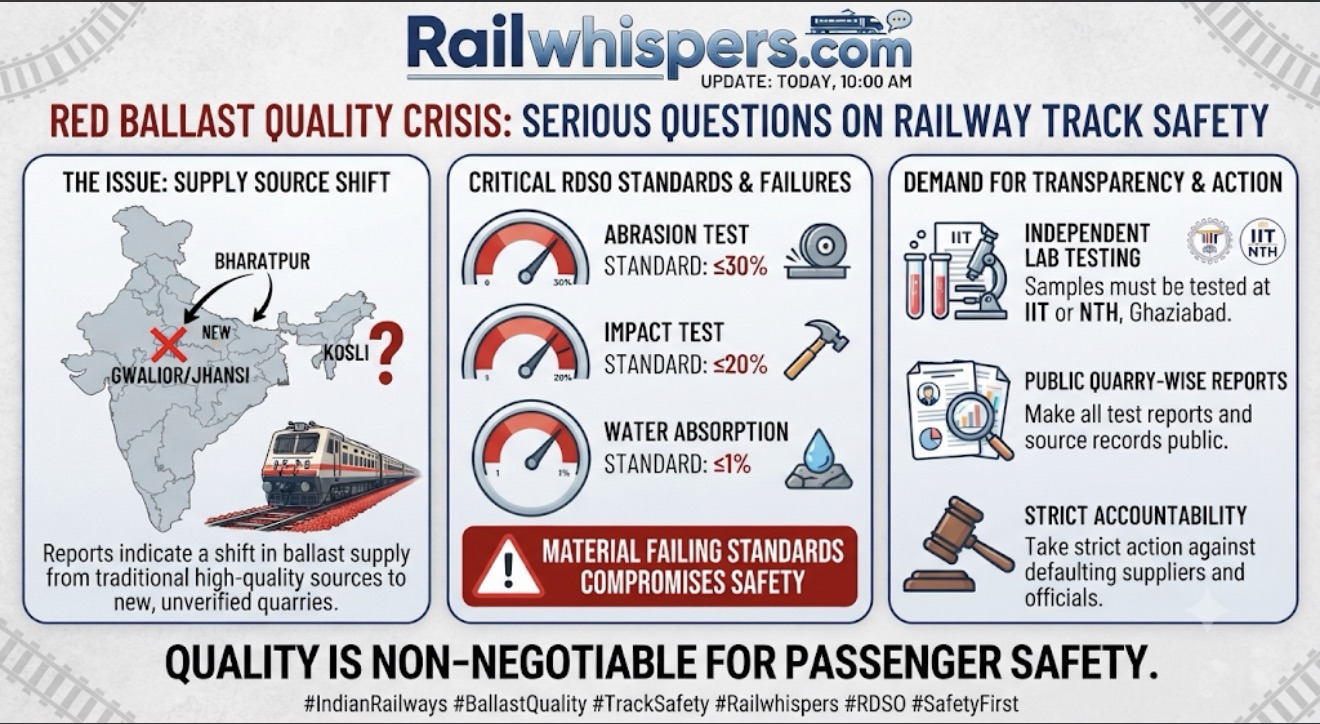
Red Ballast Quality Crisis: Urgent Need for Independent Investigation
Indian Railways is the lifeline of the country, and the safety of its tracks is directly linked to the lives of millions of passengers. Recently, serious questions have been raised regarding the quality of ‘red ballast’ (crushed stone) laid on railway tracks and the railway contracting system. Any negligence in track safety and quality is intolerable. Various aspects of this issue require an independent and impartial investigation.
1. Quality of Red Ballast and the Need for Independent Investigation
The Commissioner of Railway Safety (CRS) duly inspects railway tracks, examines every minor and major structure from a safety perspective, and grants approval. In this scenario, why is there no comment on the red ballast laid on the tracks?
If the red ballast fails the prescribed standards of Abrasion, Impact, and Water Absorption, an independent investigation is essential.
The railways should have ballast samples tested by independent and recognized institutions such as IIT or the National Test House (NTH), Ghaziabad. Decisions regarding its acceptance or rejection should be made strictly based on test reports.
There should be no compromise on quality in rail safety.
2. Key Demands
- Independent Laboratory Testing: Representative samples should be collected from each source or lot, and ballast testing should be conducted by independent, recognised laboratories like IIT or the National Test House.
- Transparency: Test reports, source/quarry details, and relevant supply records must be made public.
- Strict Action: If the material fails to meet the prescribed specifications, responsibility should be fixed and strict action taken.
3. Contracting System and the Future of MSMEs
In addition to quality concerns, serious anomalies have also surfaced regarding the railway tender structure. If small enterprises and contractors account for 75% of the sector, the tender structure should be designed accordingly:
- 75% Small Works: Reserved for small/local contractors.
- 24% Medium Category/MSME: Designated for MSMEs.
- 1% Large Works: For large contractors.
However, the current scenario appears reversed—whether the work is small or large, the tender is massive! Based on single-project costing, tenders should be divided into smaller parts to provide real opportunities to local small contractors and MSMEs. If small contractors perish, employment and market competition will both weaken.
Conclusion
The quality of ballast in railway tracks must be proven not just on paper, but through laboratory testing. Railway administration needs to take prompt and concrete steps on both quality and transparency fronts to ensure the safety of millions of passengers.
#IndianRailways #Ballast #TrackSafety #QualityControl #RDSO #RailwaySafety #Investigation #NTH #IIT