

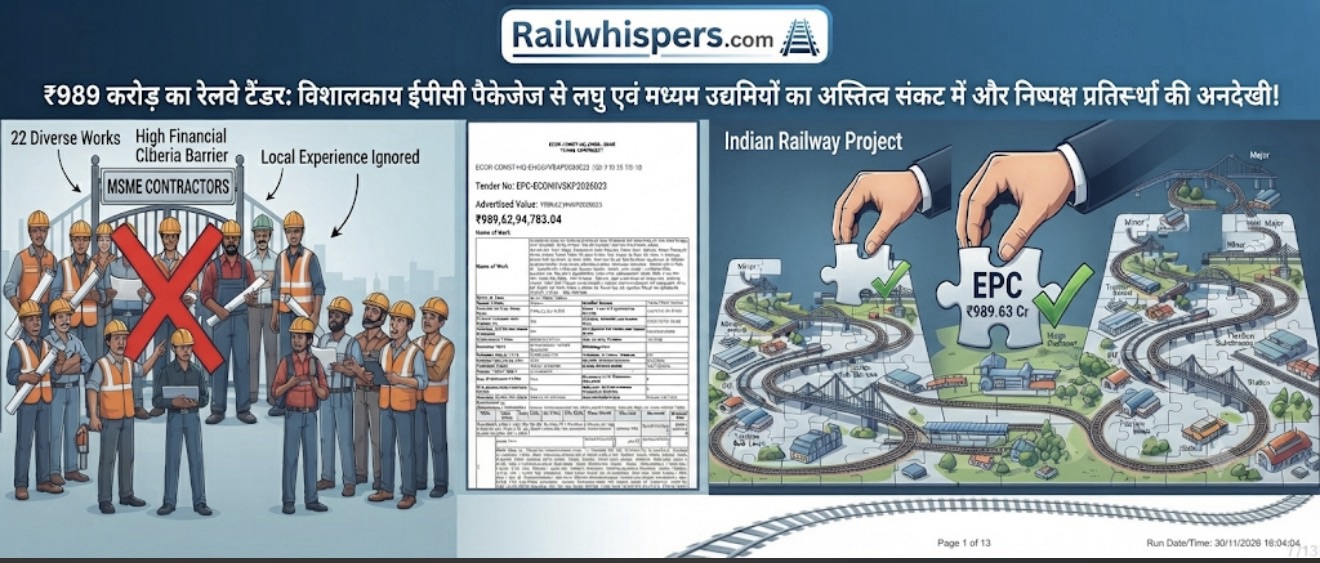
₹989 Crore Railway Tender: Mega EPC Packages Threaten the Existence of MSMEs and Overlook Fair Competition!
Indian Railways is the backbone of the country’s infrastructure, and billions of rupees are spent annually for its development. However, a massive EPC (Engineering, Procurement, and Construction) tender recently issued by the Rayagada Division of East Coast Railway has raised serious questions about railway tendering policies and their long-term impacts.
This issue is not just about a single tender, but about policy shifts that—intentionally or unintentionally—are pushing small and medium-scale contractors out of the race.
Key Features and Scale of the Tender
- Tender No.: EPC-ECONIIVSKP2026023
- Project: Jeypore–Malkangiri New BG Railway Line (Km 69.60 to Km 125.18).
- Advertised Value: Approximately ₹989,62,94,783.04 (approx. ₹989.63 Crore).
- Period of Completion: 913 Days.
- Tender Closing Date: 30/11/2026
32 Different Works in a Single Tender: Expertise or Arbitrariness?
The biggest anomaly of this tender is that it clubs approximately 32 different works—spanning civil, electrical, and signaling/communication sectors—into a single massive package. The list includes the following major works:
- Design and construction of the new BG railway line
- Earthwork in formation, embankment, cutting, and blanketing work
- Minor and major bridges, ROBs (Road Over Bridges), and RUBs (Road Under Bridges)
- P.Way track works
- Construction of station buildings, service buildings, residential quarters, and platforms
- Indoor and outdoor electrification, and water supply works
- 1×25 KV OHE (Overhead Equipment), TSS (Traction Sub-Stations), SP (Sectioning Post), and new sub-stations
- Foot Over Bridges (FOBs), Goomties, and modification/conversion of HT/LT power line crossings to underground
Bundling such diverse and technically distinct works under a single contract compels one to wonder whether this is an attempt to benefit select companies under the guise of operational efficiency.
Why Are Doors Closing for Small and Medium Contractors?
The structure of such mega-tenders is framed in a way that participation demands exceptionally high financial capacity, large turnover, bank guarantees, and massive resources.
- Monopoly of Large Corporate Houses: Corporate giants, equipped with the capacity to raise capital from the stock market and mobilize massive financial resources, easily meet these criteria.
- Marginalization of Local and Experienced Firms: Conversely, small and medium contractors—who possess years of ground-level experience across various railway sectors—are squeezed out solely due to rigid pre-qualification criteria.
Practical Demand of Stakeholders: Rational Division of Works
Industry stakeholders and experts strongly believe that if this project is divided into smaller, logical packages, it could yield several positive outcomes:
- Division Based on Chainage and Nature of Work: Works such as earthwork, minor/major bridges, ROBs/RUBs, ballast and blanketing, track works, station buildings, water supply, electrification, and OHE/sub-stations should be awarded as separate packages or tenders.
Benefits of Unbundling:
- Small and medium-scale local contractors will get opportunities to grow.
- Specialized agencies will be able to execute work within their core domains with high quality.
- Ensuring project monitoring and accountability will become much easier for the railway administration.
Direct Questions to the Railway Board and Policy Makers
In a government system driven by public tax money, transparency and fair competition must be paramount.
- Does the current railway tendering policy of PM Modi ji align with the core mantra of ‘Sabka Sath, Sabka Vikas’ (Together with all, Development for all), or is it merely paving the way for the expansion of a handful of large corporations?
- Is there any consistent written rulebook governing this policy of mega EPC packages, or is it purely subject to local administrative arbitrariness and individual interpretations?
The Railway Board must take cognizance of this matter and immediately review the packaging policy of large EPC tenders to ensure that contractors from every strata get equal opportunities in the nation’s construction sector and that public funds are utilized optimally.
#SabkaSathSabkaVikas #IndianRailways #RailwayTender #FairCompetition #Infrastructure