

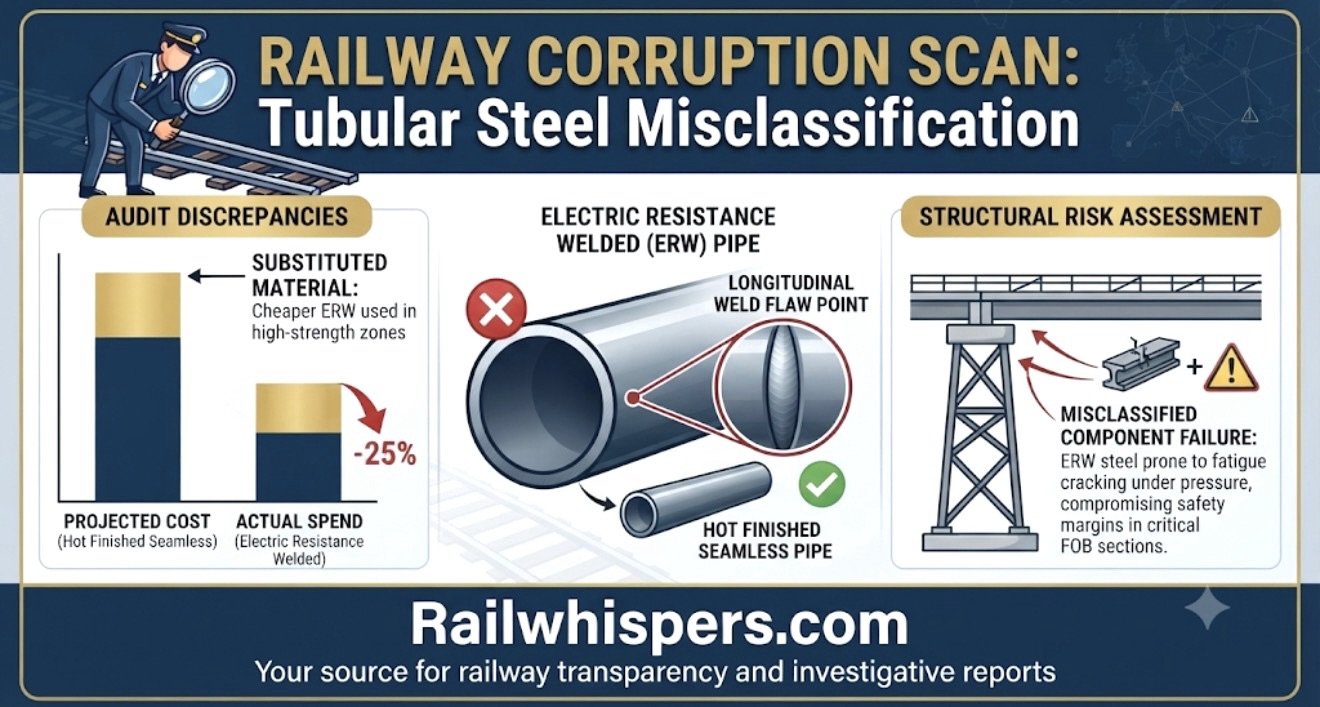
The ₹1 Lakh Crore Question: Railway Tubular Steel Under Audit Radar
Railways, DFCCIL & IRCON Under Scanner Over Tubular Steel Misclassification
DSR Item Misclassification: Railway Infrastructure Projects Face Audit Probe
Are Seamless Tube Payments Made for Welded Steel in Railways?
Paper Engineering: How ERW Pipes Billed as Seamless Threaten Railway Projects
#Railwhispers Exposes Potential DSR Misclassification Across Railway Zones
Executive Summary: Serious questions have arisen over the classification and payment of tubular steel work under #DSR-2021 Item 10.16.2 instead of Item 10.16.3 in works executed by Indian #Railways, #DFCCIL, and #IRCON. Whistleblower inputs and platform discussions under #Railwhispers have exposed potential large-scale engineering and financial discrepancies regarding whether electric resistance or induction butt-welded (#ERW) tubes were supplied while payments were recorded under higher-priced seamless tube items.
DSR-2021 Item Specification & Rate Discrepancy
DSR-2021 clearly distinguishes the two tubular steel items, establishing a material difference in manufacturing processes and pricing:
- Item 10.16.2: Hot finished seamless type tubes — ₹168.95/kg
- Item 10.16.3: Electric resistance or induction butt welded tubes — ₹140.85/kg
- The Rate Difference: The direct rate gap is ₹28.10/kg (₹168.95 − ₹140.85).
The Core Issue:
The corresponding descriptions continue to be separately identified in subsequent #CPWD DSR publications. The fundamental question is straightforward: if the material actually supplied and incorporated at the site was ERW/welded tube, on what basis was payment made under the higher-priced seamless-tube Item 10.16.2? Engineering powers cannot be used to convert one manufacturing process into another on paper.
Conclusive 10-Point Technical Check Framework
The whistleblower input stresses that the issue cannot be settled merely by what is written on a bill—it requires verifying what steel was actually manufactured, supplied, tested, and incorporated. This can be conclusively checked through ten specific records:
- Mill Test Certificates (MTCs)
- Third-party laboratory test reports
- Ultrasonic or other NDT reports, wherever specified
- Purchase invoices and manufacturer/supplier certificates
- Inspection certificates
- Measurement Books (MBs)
- RA bills and final bills
- Approved drawings/specifications
- Material identification/heat numbers recorded at the site
- Payment abstracts showing the DSR item actually operated
With #Railwhispers having reportedly obtained copies of several Measurement Books and supporting documents, these records must be independently matched with #MTCs and test reports to establish if welded/ERW tubes were paid for as seamless items, warranting a formal technical, contractual, and financial audit. If found systematic across Indian Railways, DFCCIL, IRCON, and other projects, the total financial impact over the last 5 years could potentially exceed more than ₹1 lakh crore.
Official Accountability & Departmental Complicity
The whistleblower input highlights that for works concerning Road Under Bridges (#RUB), Low Hight Subway (#LHS), and station sheds (including platform shelters, maintenance coach sheds, and sheds on washing lines):
- If misclassifications, wrong measurements/descriptions in Measurement Books (#MB), or incorrect rate payments are confirmed, responsibility must not fall solely on the contractor.
- The roles of SSE, AEN, ADEN, XEN, Dy. CE, Chief Engineer, and respective Finance & Accounts officers must be investigated.
- Action and responsibility must be fixed on officials who recorded measurements, checked/certified them, passed bills, or consented to the payment process.
- Payments/adjustments for suspicious items must be frozen pending final bill investigations, and proven wrongful payments must face strict recovery.
Warning and Guidance for Contractors
Contractors who have executed or are executing works related to RUB, LHS, platform shelters (#COP), coach maintenance sheds, washing line sheds, or station roofs—must take immediate protective steps:
- Ensure independent verification of DSR items, approved rates, Measurement Books, test reports, and actual payments.
- If any item shows misclassification or overpayment risks, lodge formal written objections on the remaining payment of final bills immediately.
- Claim adjustments or recoveries under available contractual and legal provisions to avoid bearing the risk of subsequent heavy recoveries.
Conclusion
Supplying ERW pipes while logging payments under seamless pipe items represents a major issue of specification, measurement, and public fund management. Every such case demands an independent zone-wise investigation, public disclosure of findings, and mandatory recovery wherever excess payments are established.