

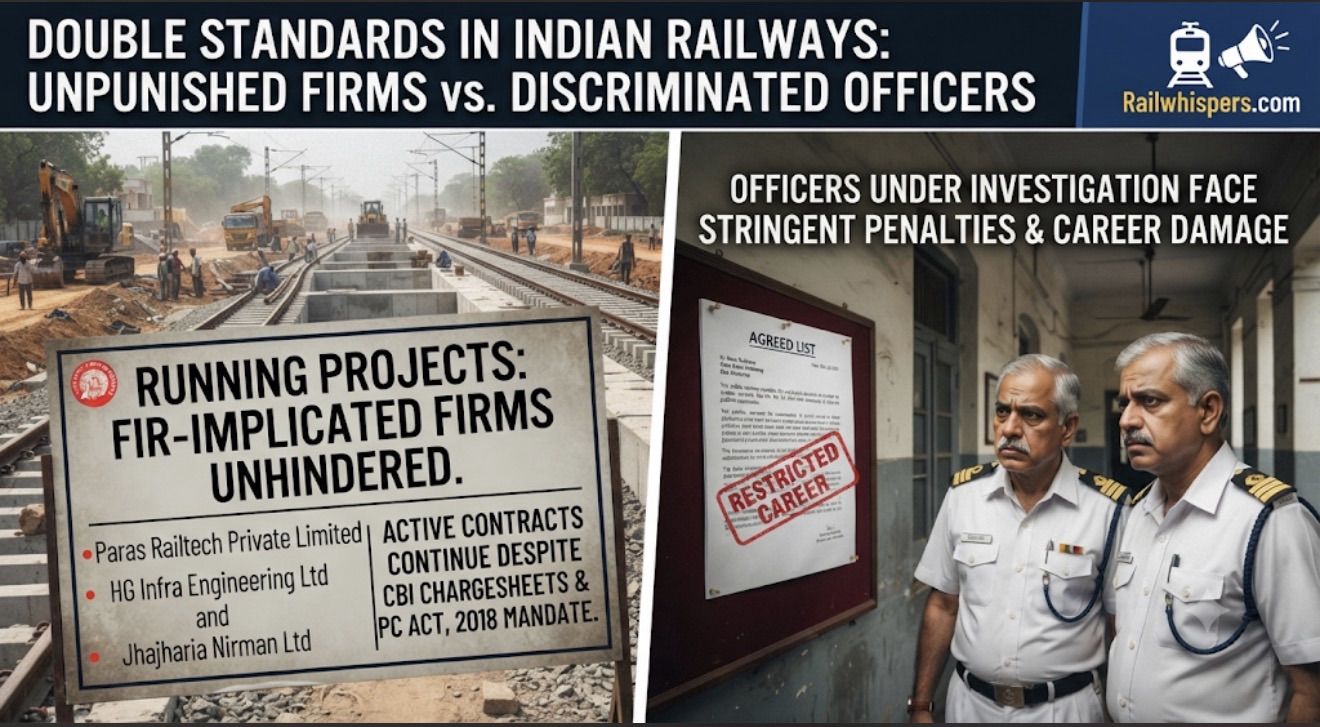
Double Standards: Unpunished Firms in CBI Crosshairs While Officers Face Institutional Discrimination
NEW DELHI: A major accountability crisis has emerged within Indian Railways following explosive whistleblower inputs highlighting severe double standards in the enforcement of anti-corruption laws. Despite clear statutory mandates under the Prevention of Corruption (PC) Act, 2018, major construction firms implicated in central investigative agency probes continue to operate unhindered, while public servants face stringent administrative penalties.
Legal Mandates and Contractual Obligations Ignored
Under the 2018 amendment to the Prevention of Corruption Act (PC Act), criminal liability explicitly extends to the bribe-giver. Public infrastructure contracts strictly incorporate clauses under “Corrupt or Fraudulent Practices” or “Integrity Pacts,” mandating that any contractor offering, giving, or agreeing to give an “undue advantage” to secure or execute a project commits a severe criminal offence.
Despite these statutory requirements, the Railway administration has failed to take action against prominent corporate entities named in Central Bureau of Investigation (#CBI) First Information Reports (FIRs) and chargesheets, including Paras Railtech Private Limited, HG Infra Engineering Ltd, and Jhajharia Nirman Ltd.
Active Operations Despite Authority to Terminate
While Construction Units and the Udhampur-Srinagar-Baramulla Rail Link (#USBRL) project possess full administrative competency to terminate these contracts, firms facing active corruption charges continue to execute lucrative projects. Rather than cooperating with judicial processes, these entities are actively challenging investigative bodies and bypassing established institutional guidelines.
Systemic Double Standards and the “Agreed List” Controversy
The whistleblower disclosure highlights a striking contradiction: while private firms tied to CBI chargesheets face no commercial blacklisting or termination, government officers involved in the same matters are placed on the “agreed list” and subjected to career-damaging restrictions. There cannot be two rules for the same crime. The Railway administration and the CBI cannot grant de facto immunity to corporate entities while penalizing individual public servants.
Furthermore, internal sympathizers sheltering these corporations or firms—whether positioned within regional Construction offices or the Railway Board—must be investigated and held administratively accountable. Affected officers placed on the agreed list are advised to challenge their inclusion legally, pointing to the stark immunity granted to private contractors as evidence of unequal treatment under the law.
#AgreedList #Discrimination #IndianRailways #CBI #CVC