

Cartelization in IPIS Tenders: Exposing the Monopoly of Approved Firms and Demanding Immediate Suspensions
Unmasking the IPIS Syndicate: How Rotational Bidding and Inflated Contracts Exploit Public Funds
Bypassing Fair Competition: The IPIS Tender Scam, Monopolistic Practices, and the Call for Re-Validation
Collusion in Railway Telecommunications: The IPIS Cartel Crisis and Urgent Demands for Accountability
Monopoly, Manipulation, and Inflated Bids: Exposing the True Cost of Railway IPIS Procurement Failures
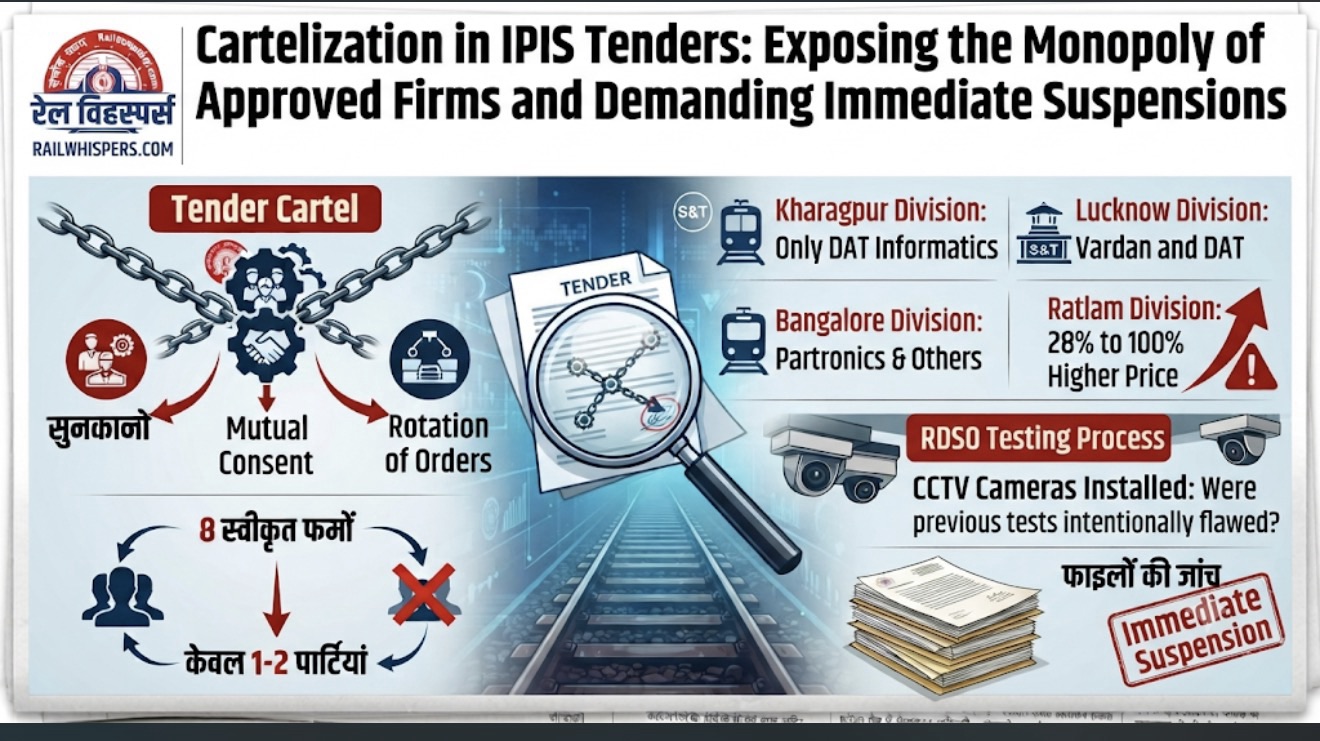
An analysis of tenders and financial bid tabulation statements issued across various divisions of different Zonal Railways’ Signal & Telecom (S&T) Department for the Integrated Passenger Information System (#IPIS) reveals a severe and organized corruption scheme. Instead of participation by all eight approved firms (vendors) recognised by the RDSO, tender processes exhibit the participation of only a single approved party at a time, proving that a ‘calculated cartel’ is at work, with these firms acquiring IPIS orders from the railways at exorbitant prices through a system of rotation.
Data compiled from various divisions of different zonal railways clearly exposes the operational mechanics of this cartel. In the South Eastern Railway’s Kharagpur Division IPIS tender (Tender No: ST-OT-IPIS-KGP-HIJ-26_27), only DAT Informatics Pvt Ltd participated out of the eight approved firms, with no other authorized firm entering the contest.
Similarly, in the Northern Railway’s Lucknow Division tender for Janghai Junction (Tender No: 106-Tele_Tender_24_26-27), limited competition was staged between only Vardaan Electronics Industries Private Limited and DAT Informatics.
In the South Western Railway’s Bangalore Division tender (SBC-BAND-CGDB-TIB-IPIS), only Partronics Eboards Private Limited and two other firms maintained a nominal presence among the eight approved entities.
Furthermore, in the Western Railway’s Ratlam Division tender for Simhastha-2028 preparations (Tender No: SnT-RTM-26-Tele-09R), only select firms such as Tilak International and Vardaan Electronics entered the field, submitting bids at steep premiums ranging from roughly 28% to 100% above estimated market costs.
According to inputs from whistleblowers and insiders, this ‘syndicate’ operates in a highly coordinated manner. When eight approved firms possess the requisite technology and qualifications, the consistent presence of only one or two selected parties in any given division’s tender proves that these firms are colluding to partition tenders amongst themselves (rotation of orders). Through this rotation game, these companies are pocketing sky-high, inflated prices from the railways for the supply and execution of IPIS.
The role of the Railway Board and the Research Designs and Standards Organisation (RDSO) in this entire episode is also a matter of serious concern. It has recently come to light that cameras are now being installed inside the RDSO laboratory during sample testing. The most startling question is: why was this transparent digital video recording and monitoring system not implemented earlier when the samples and prototypes of these eight parties were tested? Were the previous testing procedures intentionally left compromised to easily clear these select cartel companies?
In light of these grave irregularities and evidence, the railway administration and the Railway Board vigilance must immediately inquire into the whole matter and suspend all ongoing procurement processes for IPIS Revision 2. Furthermore, the prototypes and samples of all eight approved parties should also be re-tested and re-validated through a strict, independent, and high-level technical monitoring committee to protect public money from being plundered by such an organized syndicate.
It remains astonishing that despite the exposure of such a massive financial and administrative scam, the officers and staff of the Telecom Directorate of the RDSO continue to sit tight in their positions without any disciplinary or punitive action taken against them. To be Contd.