

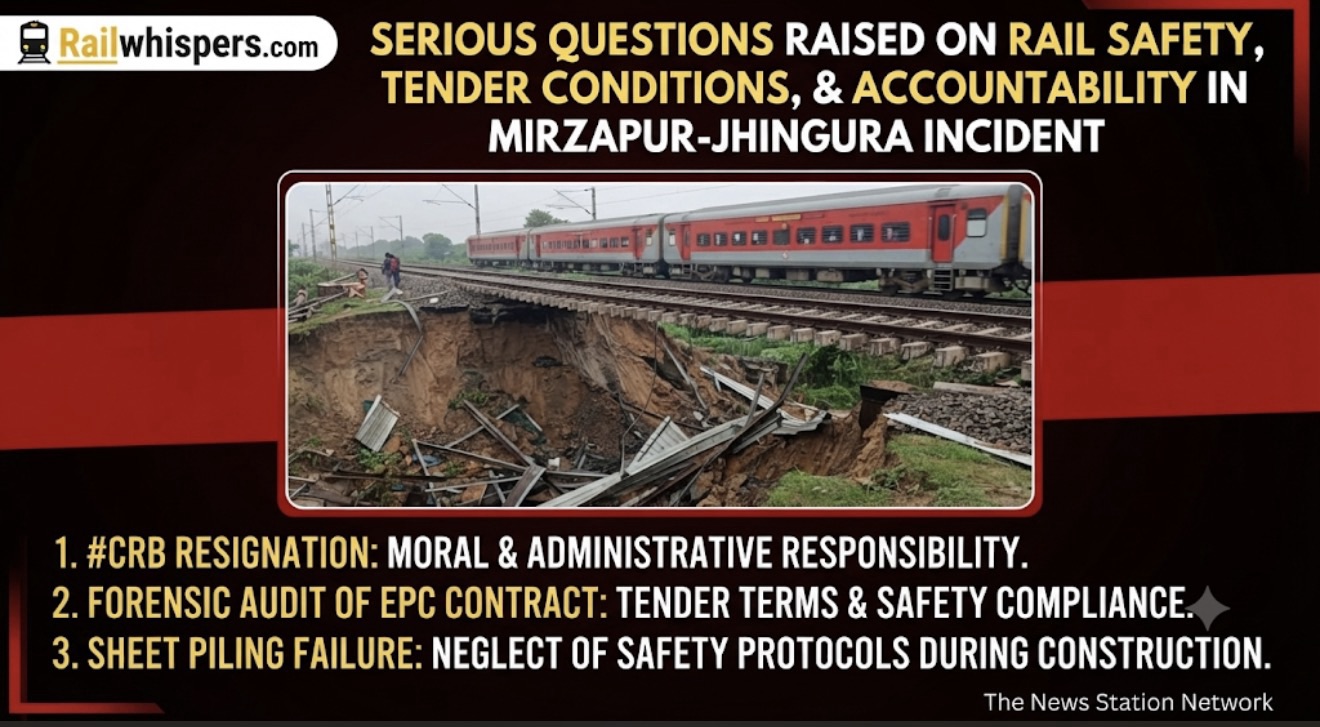
Serious Questions Raised on Rail Safety, Tender Conditions, and Accountability in MZP-JHG Section Incident
The incident of formation collapse during the third rail line construction on the Mirzapur-Jhingura (MZP-JHG) rail section has raised serious question marks on Indian Railways’ safety preparations, monitoring, and administrative accountability. This incident cannot be ignored as just a routine accident, as it is directly linked to the lives of passengers and employees.
Following this incident on the evening of November 10, 2026, train operations on the down line had to be suspended. Although operations were later restored with the passage of a trial locomotive and passenger trains, its technical and safety aspects remain a matter of grave concern.
Following this entire incident, several direct and fundamental questions have arisen, to which the public and experts deserve clear answers. First of all, it must be clarified whether this contract was awarded on an EPC (Engineering, Procurement, and Construction) basis, and what robust arrangements for safety measures were stipulated in the tender conditions.
Additionally, questions are being raised on whether sheet piling was done at the construction site as per rules, and why necessary safety protocols and monitoring were overlooked during construction. On all these fronts, questions are also being asked as to why responsible officers failed to assess the potential risks in a timely manner.
In view of the gravity of the incident, demands for strict investigation and action at various levels are gaining momentum. It is being demanded that an independent investigation into the tender conditions, approved design, and safety compliance be conducted by the Central Vigilance Commission (CVC) and the CBI.
Furthermore, there is a need for a comprehensive forensic audit of the entire project, meticulously examining construction records, site inspection reports, security audits, and the contractor’s accountability. Demands have also been made to remove prima facie responsible officers from active duty as per rules until the probe is completed, and to fix strict accountability on the culprits. Not only this, demands are also rising for the Chairman of the Railway Board (CRB) to take moral responsibility and resign over the matter.
Experts and the general public believe that merely announcing compensation and superficial probes after any railway accident is not sufficient. The public has every right to know how such a major safety lapse occurred and who is ultimately responsible for it. The priority of the railways should be the safe movement of passengers and employees rather than merely accelerating construction speed.
The photographs of the accident site depict an extremely dangerous situation, making it clear that negligence can no longer be tolerated under any circumstances. Railway Board Vigilance must take immediate action to investigate procedural lapses so that such severe engineering failures can be completely prevented in the future.