

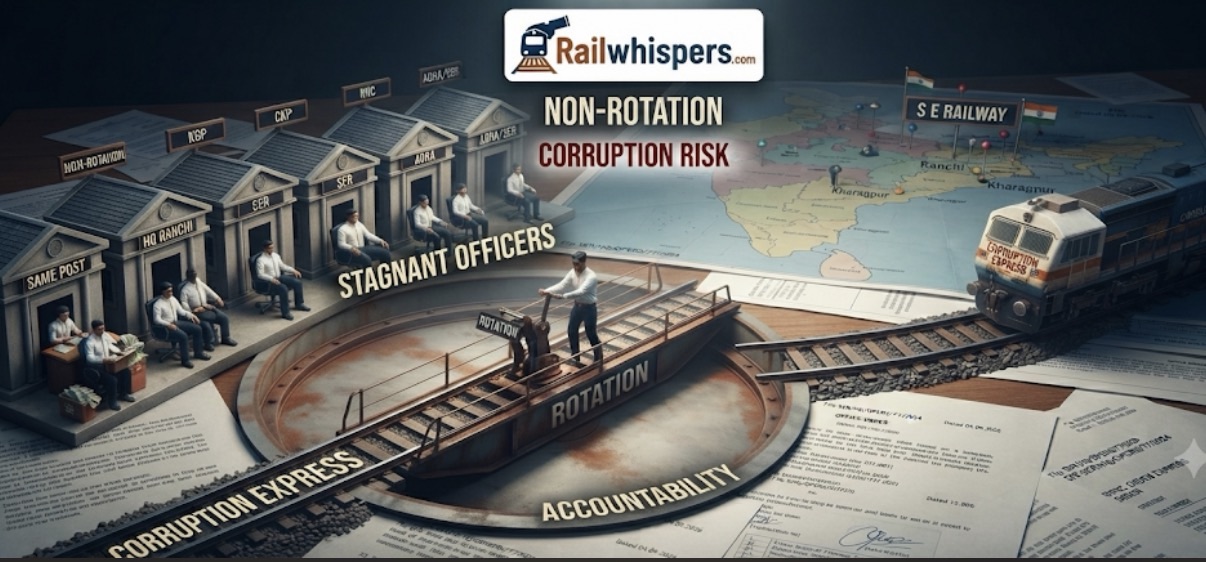
Systemic Stagnation and Non-Rotation of Officers Fueling Corruption in Government Infrastructure
Kolkata: The persistent issue of administrative stagnation and the prolonged retention of officers in sensitive executive and construction postings have emerged as primary drivers of institutional corruption within government sectors, particularly in the national rail network. Whistleblower inputs and recent administrative office orders highlight a deep-rooted pattern where key officials remain entrenched in single stations or specific drawing posts for extensive periods, bypassing standard rotation norms and undermining governance accountability.
Recent personnel movements, such as Office Order No. 215/2026 issued by the Personnel Department of South Eastern Railway’s headquarters in Garden Reach, Kolkata, reflect routine bureaucratic transfers. However, governance watchdogs and field reports indicate that administrative steps often fail to address deeper systemic rot. Critical positions across engineering, signaling, and operational divisions frequently experience minimal rotation, allowing individuals to maintain continuous control over high-value project execution, contract packaging, and financial sanctioning cycles for years or even decades.
Whistleblower disclosures point out that several key administrative slots—including general management secretariats, project execution units, and divisional coordination desks—have been occupied by the same incumbents since cycles dating back to 2018, 2020, 2021, and 2022. For instance, specific engineering and signal project wings under various zonal divisions have witnessed uninterrupted tenures, raising severe questions regarding oversight mechanisms and administrative intent.
Analysts note that prolonged stationing creates insular operational loops, fostering an environment where accountability is diluted and project oversight suffers, as observed in complex civil execution works such as heavy rock-blasting and track infrastructure development projects.
Furthermore, corruption risks are heavily magnified when officers facing severe investigative scrutiny or administrative inquiries are retained or redeployed within similar operational domains instead of facing rigorous systemic isolation.
Whistleblowers have drawn sharp contrasts between routine clerical rotations and the handling of high-profile cases involving agency probes, pointing out that administrative delays in enforcing strict rotation policies directly weaken public trust. The continuous holding of sensitive drawing and disbursing posts without mandatory tenure limits enables entrenched networks to dictate terms to contractors and agencies.
Transparency advocates and internal observers emphasize that comprehensive administrative reforms require strict, uncompromised compliance with all-India transfer policies and mandatory tenure caps across all departments, particularly in vigilance, safety, and construction wings. Effective governance mandates that no officer should be permitted to sit on critical operational posts beyond standard threshold limits. Without decisive intervention and oversight from top administrative leadership to enforce rigorous rotation schedules, administrative corruption risks remaining an intractable bottleneck for public infrastructure development.