

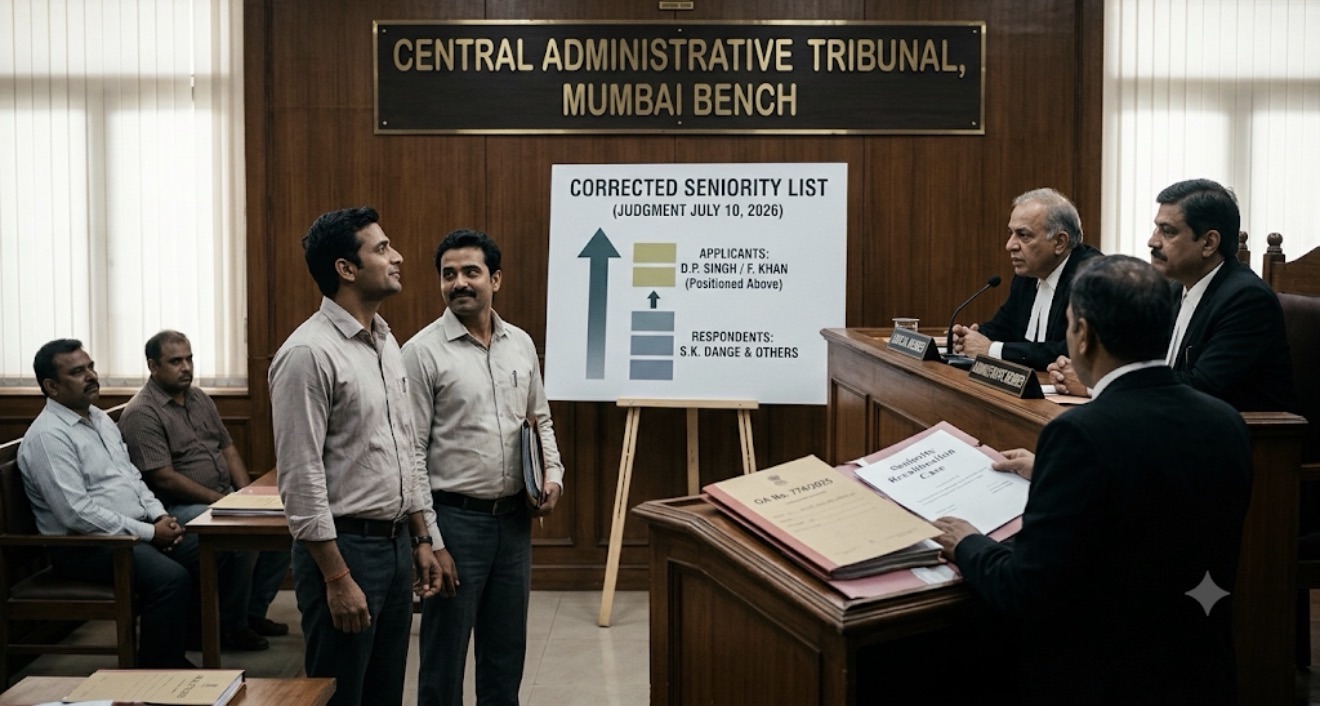
CAT Mumbai Quashes Arbitrary Central Railway Seniority List for AEE Selection
Legal Victory: CAT Mumbai Orders Recalibration of Central Railway Seniority List
CAT Sets Aside Flawed Integrated Seniority List in Central Railway Promotion Dispute
CAT Mumbai Rules Against Arbitrary Seniority Reorganization in Central Railway
Legal Assessment Report on CAT, Mumbai Bench Judgment in Original Application No. 774/2025
Central Railway completely failed—both in counter-affidavit and oral arguments—to demonstrate how that procedure was actually applied to produce the contested individual rankings!
Mumbai: This comprehensive analytical report synthesizes the judicial proceedings, legal arguments, factual matrix, and ultimate ruling of the Central Administrative Tribunal (#CAT), Mumbai Bench, in Original Application No. 774/2025, reserved on May 7, 2026, and pronounced on July 10, 2026. The primary controversy brought before the Bench—comprising Justice M.G. Sewlikar, Member (Judicial), and Justice Sangam Narain Srivastava, Member (Administrative)—pertained to the legality and rationality of the final integrated seniority lists published by the Central Railway administration on August 4, 2025, and August 12, 2025, for selection to the Group ‘B’ gazetted post of Assistant Electrical Engineer (#AEE) / Assistant Divisional Electrical Engineer (#ADEE) under the 70% departmental selection quota.
The applicants, Devendra Pratap Singh and Faheem Khan, both serving as Senior Section Engineers (#SSE/Electrical) in the Matunga Workshop of Central Railway, initiated the legal challenge under Section 19 of the Administrative Tribunals Act, 1985, seeking the quashing of the impugned seniority list and demanding a recalibration of their seniority in strict compliance with Railway Board directives, particularly #RBE No. 92/2015 dated August 18, 2015.
The factual foundation of the applicants’ case rests on their initial appointment in Central Railway on January 21, 2008, as Senior Section Engineers in Grade Pay Rs. 4600 / Pay Band Rs. 9300-34800 (Level-7) under the 6th Central Pay Commission. The Railway administration subsequently published a notification on November 13, 2024, initiating selection for filling Group ‘B’ gazetted posts of AEE/ADEE in Level-8 (Grade Pay Rs. 4800) against the 70% selection quota under Chapter II of the Indian Railway Establishment Manual (#IREM) Vol-I.
Prior to this selection, an official seniority list was published on September 5, 2024, in accordance with Railway Board letter dated August 18, 2015, wherein the applicants were placed at serial numbers 537 and 538, respectively. In that foundational 2024 list, respondent number 3, Shashikant Krishnakant Dange, working as Loco Pilot (Mail), was positioned significantly below the applicants at serial number 605.
The core grievance arose after the administration conducted the 70% Departmental Promotion Examination via Computer Based Test (#CBT) and declared the written test results on July 14, 2025. Upon the publication of the revised final integrated seniority list on August 12, 2025, the applicants observed an arbitrary inversion of relative rankings: respondent number 3 was elevated to serial number 6, while applicant numbers 1 and 2 were relegated to serial numbers 64 and 65, respectively.
Furthermore, private respondents numbered 4 to 14—comprising Chief Power/Loco Inspectors (CLIs) and Loco Pilots across various divisions—were placed above the applicants at serial positions 24, 26, 33, 35, 42, 45, 46, 47, 57, 60, and 61, despite the fact that their names did not even figure in the baseline seniority list published in September 2024. Although the applicants submitted formal representations to the Principal Chief Personnel Officer (#PCPO) of Central Railway on August 5, 2025, and August 22, 2025, pointing out these glaring inconsistencies, the administration failed to rectify the list, forcing the applicants to seek judicial intervention.
In defense of the impugned seniority list, the Central Railway administration and official respondents raised preliminary technical objections as well as substantive policy justifications. Procedurally, the respondents argued that the application suffered from non-joinder of necessary parties (a defect subsequently cured when the applicants impleaded respondents 4 to 14, who were duly served but chose not to appear).
The respondents also raised a technical plea that the joint application was single-spaced, violating an administrative circular issued by the Chairman of CAT requiring double spacing. On the merits, the railway administration contended that the selection was conducted under Railway Board guidelines dated August 20, 1991, March 19, 2019, June 28, 2022, and October 8, 2024 (RBE No. 93/2024). They explained that under earlier selection rules, candidates were called in a 1:3 ratio based on seniority, necessitating a local 2016 decision to consider Loco Pilot (Passenger) as the base grade for integrated seniority.
However, under the new RBE No. 93/2024 policy, all eligible candidates who volunteered were permitted to take the CBT without numerical restrictions. Consequently, Central Railway revised its methodology to assign integrated seniority to running staff and Chief Loco Inspectors based on their date of promotion to the base grade of Loco Pilot (Goods), equating Level-6 running staff with Level-7 stationary staff to maintain parity, a practice allegedly cleared for ongoing selections by a Railway Board clarification dated September 19, 2025.
Upon critical judicial examination, the Tribunal identified fatal evidentiary and logical deficiencies in the railway administration’s arguments. The Bench observed that while the respondents elaborately explained the abstract procedural mechanics and policy instructions governing integrated seniority, they completely failed—both in their written counter-affidavit and during oral arguments—to demonstrate how that procedure was actually applied to produce the contested individual rankings.
The administration offered no explanation as to how respondent number 3, who was at serial number 605 in the September 2024 list, jumped to serial number 6 above the applicants, nor could they explain how respondents 4 to 14, whose names were entirely absent from the 2024 list, suddenly appeared above the applicants in the August 2025 list. The Tribunal highlighted that the respondents did not even address or deny the explicit factual averments made in paragraph 4.8 of the application regarding the unexplained inclusion of respondents 4 to 14, thereby legally admitting those facts.
Addressing the procedural objection concerning single-spacing, the Tribunal firmly rejected the respondents’ plea to dismiss the application on technical grounds. Relying on landmark Supreme Court decisions in Kailash v. Nanhku (AIR 2005 SC 2441) and Sushil Kumar Sen v. State of Bihar ((1975) 1 SCC 774), the Tribunal held that procedural rules are the handmaid of justice, intended to facilitate substantial justice rather than obstruct substantive rights. Once an application is registered by the registry, minor formatting non-compliances cannot be weaponized to defeat legal remedies.
In its final verdict, the Tribunal held that the preparation of the impugned seniority list dated August 12, 2025, suffered from a total non-application of mind and gross arbitrariness, making it legally unsustainable. Consequently, the Tribunal allowed the Original Application with no order as to costs. The Bench quashed the impugned seniority list dated August 12, 2025 (Annexure-A-1), to the specific extent of applicant numbers 1 and 2 and respondent numbers 3 through 14. The Tribunal directed the Central Railway administration to recalibrate the integrated seniority list and explicitly place the applicants above respondent numbers 3 through 14, thereby restoring regulatory compliance and structural fairness to the departmental promotion process.