

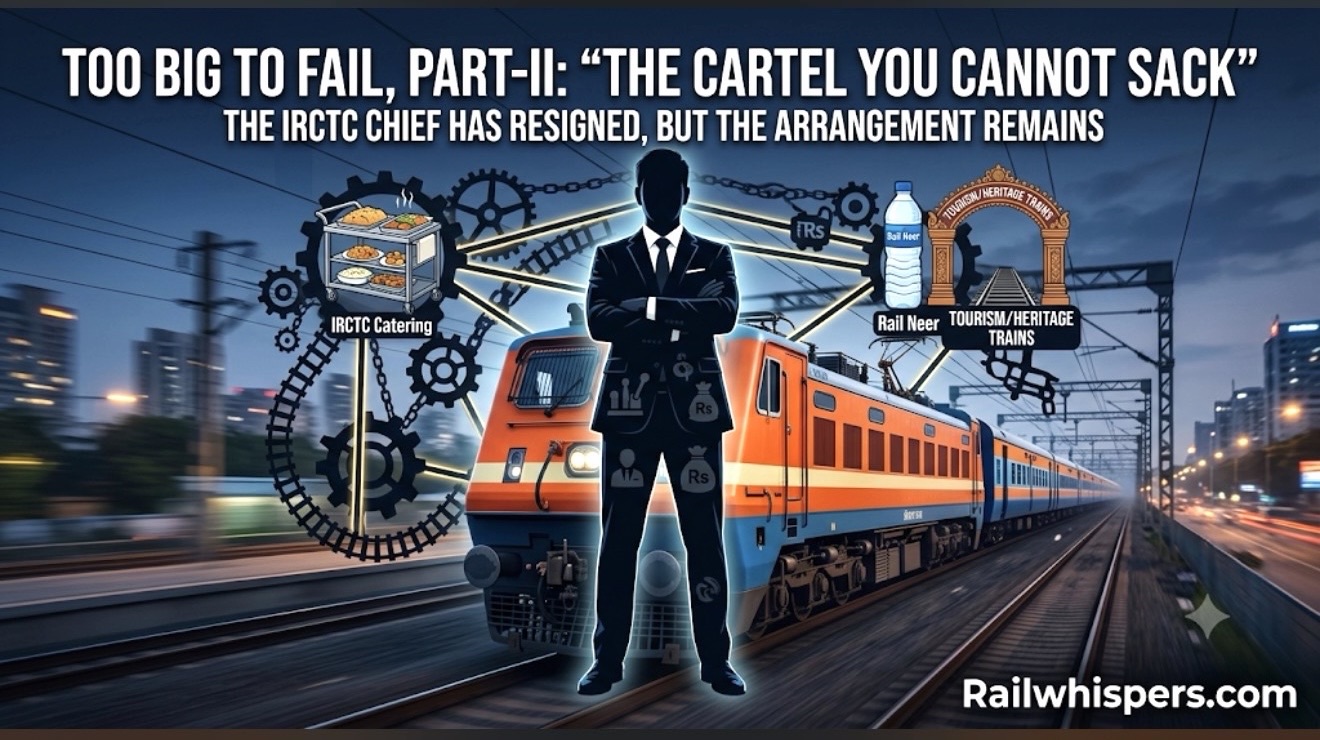
Published Too Big to Fail, Part II: “The Cartel You Cannot Sack”
This series began with Railwhispers’ “Too Big to Fail ???”, 2 April 2026
The #resignation of the chief of the Indian Railway Catering and Tourism Corporation (#IRCTC) has been accepted, with official records citing “personal reasons.” In the corridors of power, the story is told differently, but that is not the most pressing issue. The question that truly matters is the administrative one that invariably trails a departure like this: “Who holds additional charge until a regular chief is chosen, and how long will that ‘until’ turn out to be?”
Going by precedent, it will be a long time. The selection process through the Public Enterprises Selection Board (#PESB) has not even begun. Before the outgoing chief took office, the corporation was run by part-time heads for more than three years. An interim arrangement is meant to be a short bridge; at this corporation, it has a habit of becoming the road itself.
The officer who has now departed arrived with a reputation for handling tough postings, and the few honest hands remaining inside allowed themselves to hope he would clean up the organization. Instead, according to those who watched it happen, he was drawn into the very system he was meant to dismantle. Insiders use a blunt word: “he was sucked into it. And the system, in their telling, is not some vague corporate culture. It is a highly functional alliance between a dominant contractor and a small group of officers who hold the levers that control careers.”
Look at where the powers went. The Schedule of Powers (#SOP)—the document outlining who inside the corporation decides what—was reportedly rewritten to concentrate personnel and administrative authority into a single directorate. The head of that directorate, responsible on paper for tourism marketing, was also handed charge of human resources. This effectively granted them control over promotions, postings, and transfers across every cadre, along with oversight of the massive infrastructure spending yet to come. What this arrangement left for the chief executive to actually manage is a question that answers itself. A tight coterie is said to have run the chief’s own office. One of its members, insiders say, rose from the humblest railway grades almost to the doorstep of a directorship, bypassing senior officers, and was halted only when the selection board declined to confirm him.
How does a contractor keep a rotating cast of officers in line? They use a method the staff describe without needing to spell it out. There is the carrot, which needs no explanation, and the stick—the threat of a vigilance case or a bogus complaint to investigating agencies for any officer who refuses to fall into step. An honest official quickly learns that honesty is the riskier posture.
Having dominated catering, less noticed is how far it has moved into tourism. The corporation’s flagship heritage-train service, according to officers who will say so only privately, is routed and timed less by where passengers wish to travel than by where the contractor’s margins lie. Sources reveal that the business taken on loss is to be eligible to bid for the profitable ones, tenders of which fall due shortly. Even the new business in conferences and exhibitions is said to be shaped so the firm qualifies for work it has never done. This is not a vendor held at arm’s length but a partner, one that turns up at meetings with state governments to negotiate terms that route higher payments back to itself. There is a word for that—Institutionalised overcharging.
Step back from the palace politics, and the record reads even worse, because the corporation’s high standing has little to do with how well it serves the traveller. Its value on the stock market rests entirely on one thing: its monopoly. Take that away, and it is worth asking what it actually does well. The ticketing system still buckles in the opening minutes of the tatkal window, just as it has for years. The catering and tourism supplier base has not been broadened.
Even bottled water tells the story. The corporation owns the packaged-water brand outright and controls it from plant to platform, yet it still cannot reliably supply bottles to the trains that request them. A monopoly that cannot get water to a captive market has no shortage of opportunity; what it lacks is the will to perform.
Which is why the small administrative question is actually the vital one. To hand additional charge to an interim head who will merely keep the seat warm is to keep the existing arrangement warm along with it. A caretaker does not break a cartel; he manages it, and that management is exactly what brought the corporation to this point. Having accepted one resignation, the ministry must not simply reach for a safe pair of hands, but examine the next pair closely. What are this officer’s dealings with the dominant vendors? Has he ever taken a decision that cost an entrenched contractor money? Can he blacklist non-performers, open up the supplier base, and withstand the inevitable vigilance complaints that will follow? These are uncomfortable questions to ask of senior officials, but they are the only ones worth asking, because the hardest fact about this vendor is that its reach extends into the postings themselves. The officer sent to discipline it may very well owe his chair to it.
What is needed is a clean break, not continuity dressed up as stability. The test is simple and can be applied this month:
- Start the regular selection process immediately, on a fixed and tight timeline, so that interim stewardship does not harden into permanent rule.
- Give charge only to someone whose record proves they have taken a decision that cost a powerful vendor money.
- Restore the Schedule of Powers to the chief executive, and wrench personnel and postings out of the directorate that does business with the contractor.
- Freeze fresh, single-firm awards in tourism until the eligibility rules that were bent are rewritten transparently in the open.
- Publish the numbers: reveal exactly what the corporation pays its dominant contractor, and what its water monopoly actually supplies against what the trains demand.
None of this is radical. It is the ordinary work of running a public enterprise for the public—which is exactly the work that has been left undone.
The alternative is another prolonged interim arrangement, another chief drawn into the same system, and another few years in which the corporation’s monopoly expands while its service deteriorates. And this pattern does not stop at the pantry car. The next part of this series follows the exact same logic onto the factory floor, where the vendors are larger, the sums are heavier, and the flaws are sealed inside the machines long before anyone is ever allowed to look.
The Reboot, Concretely
Six actions the Ministry can take right now, each verifiable later:
- Launch the PESB selection for a regular CMD immediately, under a strict deadline, ensuring the interim charge does not quietly become the norm as it did for three years previously.
- Screen every interim and permanent candidate on a single metric: Has the officer ever taken a decision that cost an entrenched vendor money, and will they blacklist non-performers and widen the supplier base under pressure?
- Restore the Schedule of Powers to the CMD, and separate personnel and postings authority from the directorate that manages the dominant contractor’s business.
- Freeze fresh single-firm tourism awards (such as luxury trains and MICE) until the eligibility criteria are rewritten transparently, and order an independent review of how heritage-train itineraries and pricing are set.
- Protect and reinstate officers who were transferred after raising vendor complaints, and bar retaliatory transfers tied to contractor decisions.
- Publish IRCTC’s financial metrics on a fixed cadence, specifically detailing payments made to its dominant catering-and-tourism contractor, alongside Rail Neer supply-versus-demand data, so performance can be judged by hard numbers rather than narratives. Contd.