

Severe Corrosion in LHB Coaches and the Mechanical Deptt’s Functionality: An Examination of Claims vs. Ground Reality
Overview and Analysis of Coach Condition and Corrosion
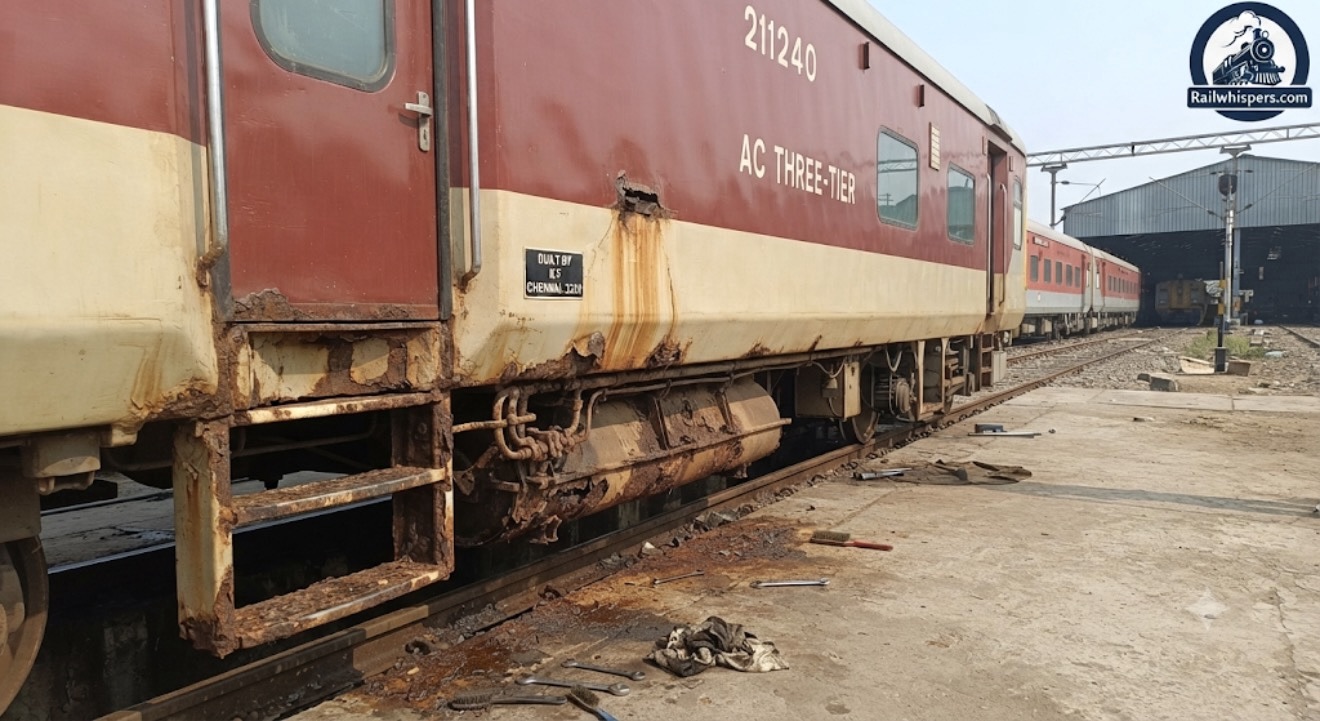
According to the manufacturing plate of the LHB coach (Number 211240, AC Three-Tier) shown in the video, it was manufactured by ICF Chennai in the year 2020, meaning this coach is not even six years old yet—this video was sent to the #Railwhispers by a senior Stores officer on 26 May 2024. Despite this, severe corrosion (rust) and peeling paint are clearly visible on the lower parts of the coach (the under-frame, lower edges of the side walls, and around the steps).
LHB coaches are considered to have a superior design and higher corrosion-resistant capacity compared to traditional ICF coaches, ensuring they remain rust-free for a longer duration. However, the current condition of this coach indicates that metal degradation to this extent within its initial years raises serious questions not only about manufacturing quality and anti-corrosion treatment but also exposes the shortcomings of timely maintenance.
Railway Board’s Concerns and Key Findings of the Report:
- Growing Concern: The Railway Board has expressed deep concern over heavy corrosion occurring in LHB passenger coaches, despite the use of corrosion-resistant materials and improved cleaning practices. At a recent PCME conference, officials instructed ICF Chennai, RCF Kapurthala, and MCF Raebareli to investigate the problem and suggest corrective measures. The Railway Board’s minutes state: “Heavy corrosion in LHB bogies is a cause of worry.”
- Affected Areas: Both AC and non-AC LHB coaches are being examined, with particular attention given to underframes, bogies, and lavatory-related areas. An Eastern Railway report prepared in March analyzed corrosion by coach age and component, identifying several vulnerable areas.
- Lavatory Leakage: A major issue is toilet/lavatory leakage. Water can seep through flooring or defective pipe fittings and reach the underframe. Bio-toilet overflow or effluent leakage is especially concerning because the liquid is acidic and chloride-rich, accelerating the corrosion of components such as trough floors, sole bars, and headstocks.
Other Identified Contributing Factors:
- Improper or harsh cleaning practices.
- Dents or damage to steel surfaces.
- Water entering through edges, joints, or tears in vinyl advertisement wrappers.
- Blocked drainage passages causing water stagnation.
- Saline coastal air, where salt acts as an electrolyte and accelerates corrosion.
Recommended Precautions:
- Avoid aggressive cleaning chemicals.
- Avoid high-salinity or untreated water for coach washing.
- Properly rinse and dry coaches after washing.
- Keep drain holes, slots, and underframe/bogie passages clear.
- Strengthen corrosion-protection systems.
- Inspect corrosion-prone components during scheduled maintenance.
- Give special attention to critical safety areas.
The Railway Ministry has instructed all Zonal Railways to examine the identified components and adhere to these precautionary measures.
Expertise of Mechanical Engineers
This coach is not even six years old yet. This is an #LHB coach, which has been considered superior to the ICF coach—and in terms of structure and design, it is better too. But ever since these coaches have been manufactured in the country, the jerks experienced in them have not stopped for the last twenty-five years. Their coupling could not be improved, and the moment the driver applies the brakes, passengers feel a massive jerk. This is a prime example of the expertise of Indian Railways’ mechanical engineers. Along with this, it was also claimed that the shells of these coaches would not rust, but this video has blown all those claims to pieces. We have already written in detail about the mess surrounding loco shells, while the scam going on in coach shells is said to be much bigger than that.
The mechanical department’s entire focus is on expanding its empire. Fires inside trains, fires in brakes, train parting, failure of bio-toilets, a scam named OBHS, the EnHM fraud, and irregularities in mechanized laundries, etc., have completely exposed the true face of the entire mechanical department.
Another narrative being floated is that there is no longer any need to manufacture LHB coaches because the future belongs to Vande Bharat trains. This is also completely wrong. If the railways are to provide Antyodaya-level service to the public, premium Vande Bharat trains will never be able to deliver that. Mind you, the upgradation of 2×25 kV in TRD was considered more essential not for freight hauling, but for trains like Vande Bharat. Fencing worth 4–5 thousand crores, and Vande Bharat maintenance sheds worth tens of thousands of crores—where the capital investment is from the Government of India, but they are being operated by private vendors—these are all secondary and massive expenses of Vande Bharat.
Thousands of MSME units are connected to coach manufacturing activities. This is not the case with Vande Bharat. The government needs to think about where the votes will come from.
Now the time has come to take concrete action. A system running on contracts can never ensure railway safety. Even to run operations on a contract basis, railway officials and supervisors must know how to work—they must have the practical experience of working and getting work done in sheds and fields, as we have written before. Railway #vigilance does not see any of this, because they and their favorites (#Madams) want glamour and flashiness, and for that path, the rusting of the shell is very necessary. Whether trains run on tracks, in fields, or on platforms, what difference does it make if a hundred or two hundred people die?
When the French Revolution took place, the Queen could not understand why people did not eat cake if they had no bread to eat. The situation of the Indian Railways has become quite similar today. In the game of transfers and postings, ministers, babus, MPs, MLAs, petty leaders, and party workers are all neck-deep. Every official and supervisor considers their personal facilities paramount, and they bend the entire system to achieve it. How will discipline remain? The government will have to think about how many votes they will actually get by posting such dishonest and incompetent people to specific locations!
Conclusion:
LHB coaches were introduced as a major upgrade over conventional ICF coaches, offering improvements in speed, safety, passenger capacity, and corrosion resistance. However, finding this level of severe corrosion in coaches less than six years old—and the growing concern expressed by the Railway Board—proves that this is not merely a technical failure, but a serious consequence of manufacturing quality control lapses and maintenance laxity.
The key question now is not just where the corrosion is occurring, but how quickly the root causes can be addressed before deterioration compromises critical components. Passenger safety ultimately depends on what happens inside the coach, not just what passengers see inside it. The railway administration urgently needs to implement strict improvements in its inspection systems, maintenance standards, and priorities.