

Administrative Restructuring and Policy Shift in Power Car Operations
“Ensuring the timely disbursement of proper wages to contract laborers is the primary responsibility of the principal employer—Indian Railways.”
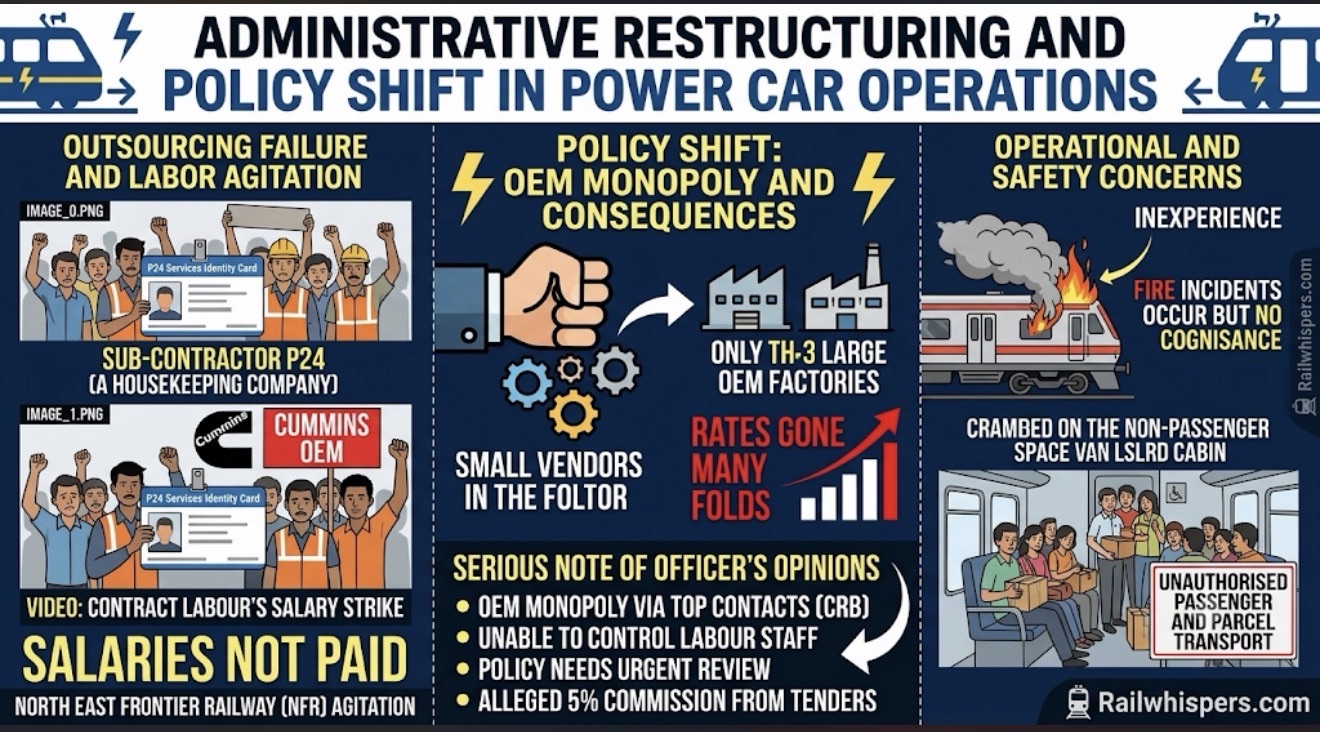
The Ministry of Railways, through a directive issued under the guidance of the Chairperson and Chief Executive Officer of the Railway Board (#CRB), has implemented a comprehensive restructuring of the guidelines governing the maintenance and escorting of #LHB Power Cars and #LSLRDs. The freshly enacted policy completely replaces previous frameworks and mandates that all maintenance schedules ranging from routine checks to extensive overhauls—along with onboard train escorting duties—must be executed exclusively by the respective Original Equipment Manufacturers (#OEMs). Under the new operational terms, only authorized OEMs are permitted to participate in Railway Board tenders, establishing a direct administrative arrangement and placing total contractual responsibility under their domain.
The policy transition has completely altered the administrative landscape for local technical vendors and small-scale contractors who previously managed these vital operations. Former contractors have expressed deep concerns regarding the strategic shift, noting that while smaller entities operated on comparatively lower profit margins, they maintained highly responsive, localized workforce management systems that effectively minimized labor friction and prevented any operational disruptions or service agitations.
Critics of the centralized policy argue that the selected diesel engine manufacturers lack specialized experience in managing large-scale contractual labor pools on the ground. It is further alleged that these corporations (OEMs) have heavily sublet core operational responsibilities to secondary housekeeping agencies and inexperienced subcontractors who possess minimal technical eligibility, familiarity, or training regarding complex railway electrical frameworks.
Labor Disruption and Operational Agitations in Northeast Frontier Railway
Serious operational challenges and labor agitations have emerged at Kamakhya Junction under the Northeast Frontier Railway (#NFR) in Guwahati following the implementation of the centralized power car policy. On-site investigations and broadcast footage reveal widespread strikes and public agitations staged by contractual train operators and technical laborers. The affected workforce was deployed under a secondary subcontracting agreement by M/s. #P24 Services Property Solution Private Limited—a housekeeping and property management firm operating on behalf of a primary diesel engine #OEM.
Contractual staff on the ground have raised serious grievances regarding severe non-payment of wages, systemic absence of mandatory duty attendance logging, and sudden arbitrary terminations. Protesting workers highlighted that despite continuous technical duty tours spanning major inter-city transit routes, multiple months of statutory wages have been entirely withheld by the subcontractor, causing severe financial distress to local families and violating basic statutory labor codes.
Furthermore, labor representatives stated that when the workforce formally demanded standard salary increments and approached regional labor authorities for intervention, the subcontracting management retaliated by filing contested police complaints at the Guwahati Government Railway Police (#GRP) station, alleging defamation and professional misconduct. The escalating labor friction has resulted in the mass displacement of experienced local technical staff, who are reportedly being replaced by external, untrained personnel with no certified competencies in high-voltage railway systems.
Escalating Technical Risks, Uncertified Staffing, and Unauthorized Activity
Senior divisional railway officials and technical experts have raised urgent safety red flags regarding the operational risks unfolding under the unmonitored subcontracting framework. Field reports indicate a worrying surge in critical rolling stock vulnerabilities, including recurring fire incidents and electrical short-circuits within power car cabins that are routinely being downplayed or left unaddressed by the outsourced technical management. Under Section 3 of the official 2025 Railway Board guidelines, all onboard #escorting and #maintenance personnel must mandatorily undergo specialized high-voltage training on 750V systems administered directly by the OEM, alongside mandatory fire safety and Fire Detection and Suppression System (#FDSS) certifications issued by the Zonal Railway’s depot-in-charge.
Evidence from recent terminal inspections reveals a systemic failure in enforcing these rigorous safety protocols. The subcontractors stand accused of deploying completely uncertified, raw labor lacking requisite Industrial Training Institute (#ITI) technical qualifications or valid safety competency certificates. To mitigate their financial overheads and cover lost margins, underpaid contract workers are reportedly engaging in highly hazardous and unauthorized practices, including using the restricted space of government power cars and LSLRD cabins to transport commercial parcels and carry unauthorized passengers for personal livelihood collection. These activities directly violate standard operating procedures and compromise the critical emergency response capabilities of train crews during transit crises.
Divisional Technical Opinions and Calls for Strategic Policy Review
Internal communications and technical feedback received from Senior Divisional Electrical Engineers (Sr. DEEs/Coaching) across multiple railway divisions indicate widespread administrative dissatisfaction with the current framework and a strong consensus in favor of a thorough policy review. Senior operational officers have explicitly stated that while field divisions are legally bound to enforce current Railway Board circulars, the direct intervention of highest-level administrative contacts has established an unsustainable corporate monopoly. This administrative insulation allows major OEMs to distance themselves from ground-level engineering realities, leaving them entirely incapable of managing localized labor dynamics or maintaining stringent quality control over complex rolling stock.
In continuation, read these three articles recently published by the Railwhispers—
- July 1, 2026: “One Asset, One Manager? The रायता Reaches the Field”
- July 2, 2026: “Part-II: The Order That Bled, and the Letter That Was Pulled Back”
- July 3, 2026: “Part III: Who Pays, and What the Board Should Actually Do”
- Also see the video report: “#Ep225: एक परिसंपत्ति—एक प्रबंधक? ‘रायता’ फील्ड तक पहुंचा!”
Divisional mechanical and electrical heads have formally initiated high-level correspondence, urging Principal Chief Mechanical Engineers (#PCMEs) to aggressively pursue a comprehensive policy reassessment at the Board level. Prominent technical officers have warned that the current centralized model is fundamentally unsustainable and will ultimately compel the Ministry of Railways to roll back its guidelines to safeguard passenger safety and operational reliability.
Furthermore, internal administrative reports contain highly damaging disclosures from field officers, who allege that the current restrictive procurement framework is heavily influenced by systemic financial distortions at the highest administrative echelons. Reports indicate that an estimated 5% commission on total tender valuations is being funneled to specific administrative managers (via a Director level officer in transformation cell) to protect the current OEM monopoly, highlighting a critical governance vulnerability that demands immediate oversight investigation.
Conclusion
The structural transition of the Indian Railways’ power car maintenance framework from a competitive, multi-tiered local vendor system to a strictly centralized OEM-monopoly model has introduced severe operational, financial, and safety vulnerabilities across the national transit network. The administrative consolidation, intended to standardize maintenance profiles, has instead resulted in an unregulated subcontracting hierarchy.
Major diesel engine corporations have completely sublet critical technical responsibilities to secondary housekeeping agencies that lack core engineering expertise or institutional labor management capabilities. This systemic outsourcing has triggered widespread labor agitations over unpaid wages, severely disrupting workforce stability and displacing experienced technical personnel.
“The timely disbursement of prescribed wages to contract labor remains the primary statutory responsibility of the principal employer, Indian Railways.” More critically, the enforcement of core safety parameters has faced severe degradation. The widespread deployment of uncertified, untrained contract staff—coupled with the reported failure to address recurring fire incidents and the hazardous practice of carrying unauthorized commercial passengers and parcels inside restricted power car cabins—presents an immediate, high-risk threat to passenger safety and railway asset protection.
Given the widespread technical dissent from Senior Divisional Electrical Engineers and the serious administrative allegations regarding high-level financial commissions, an independent, comprehensive evaluation of the 2025 Power Car Maintenance Policy is urgently required to restore procurement integrity, ensure strict statutory labor compliance, and re-establish the rigorous safety standards governing Indian Railways’ rolling stock operations. Contd.