

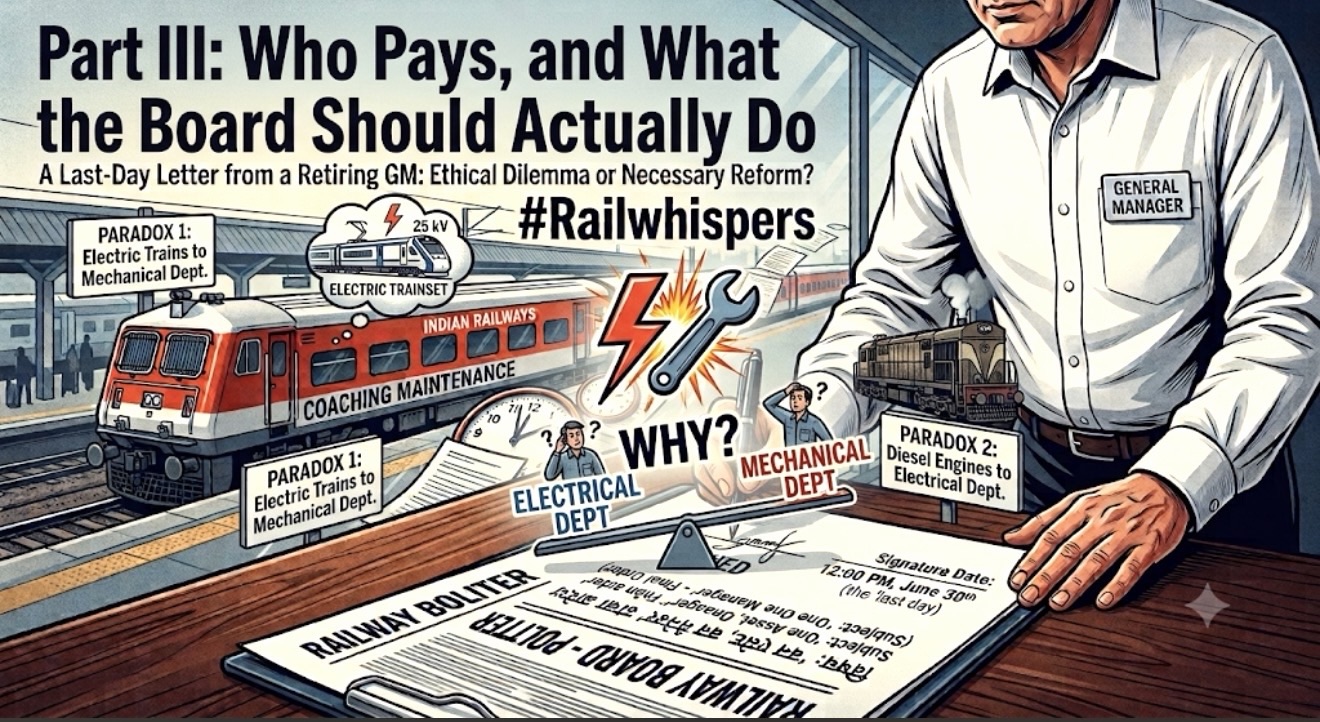
Part III: Who Pays, and What the Board Should Actually Do
Strip away the cadre politics, follow the money, and then follow the risk. Both lead to the exact same place: “the citizen waiting on the platform.”
Also Read: “One Asset, One Manager? The रायता Reaches the Field”
Also Read: “Part-II: The Order That Bled, and the Letter That Was Pulled Back”
While departments squabbled over who owns a coach’s air conditioner, capital walked right out the door. High-tech passenger platforms—expensive to procure and brutally expensive to maintain—have drained funds that should have been spent building the rolling stock the country actually rides. The backbone of the government’s passenger base, the ordinary commuter, waits endlessly for MEMUs while glamorous trainsets stand stabled or run on thin frequencies outside a few showcase routes without adequate occupancy. The Hon’ble Minister has himself been heard stating that public representatives constantly ask him for more MEMUs. Yet, the railway has neither the money nor, after a decade of this administrative muddle, the bandwidth to build and induct them. That is what a ‘confused’ organization chart does: “it doesn’t just misplace officers; it misallocates the nation’s capital.”
#Ep225: एक परिसंपत्ति, एक प्रबंधक? रायता फील्ड तक पहुंचा! #gmnwr
Then there is the growing dependence on the Annual Maintenance Contract (#AMC), which has quietly become the railway’s crutch. Indian Railways did not drift into outsourced maintenance by accident. It was pushed there by this exact style of management, where no single department owns an asset cleanly enough to maintain it in-house—so the contract goes out and the private vendor walks in. New rolling stock now arrives bundled with maintenance deals running for as long as three and a half decades. Some call it a backdoor layout, where control of the railway’s crown jewels is ceded without the honesty of calling it privatization. Mega-contracts that hand entire maintenance lifecycles over to private hands will eventually cost the government dearly—both politically and financially. We have said this before, and we say it again, louder.
Look next at what the mechanical department has been reduced to. With diesel locomotives largely gone from its core responsibilities, the cadre needed a new empire, and new portfolios were conjured just to keep it busy. Today, cleanliness—the Prime Minister’s own flagship agenda point—is smeared thin across multiple, fragmented administrative layers, leaving no one able to tell you who actually owns the mandate. It is laughable—and we mean truly laughable—that a massive bureaucratic apparatus sits at the apex of housekeeping while platforms still stink and toilets still spill onto the tracks. An entire engineering domain has been reduced to the washing of coaches, with a flag officer planted on top to call it “rationalisation.” So, when a retiring mechanical General Manager writes that his department has delivered focused, coach-oriented maintenance, forgive us for asking which department he actually means: “the one drowning in housekeeping paperwork, or the one that still cannot answer cleanly for a power car at the cutting edge?”
Now for the part that is absolutely non-negotiable: “#Safety.” When you wash domain expertise down the drain, you are left with engineering branches that look like a deer frozen in headlights. Every single one of them turns to external consultants and vendors because no one inside the organization owns the technical knowledge anymore. The railway’s own conduct gives the game away. After a recent run of coach fires, the administration moved to overhaul coach wiring across the entire fleet. Set aside the convenient talk of sabotage in some of those cases; the very decision to rip out and replace wiring across a fleet tells you the house was not in order. You do not re-wire rolling stock that was being maintained with focused, singular accountability. You re-wire stock that was not.
And, remember the statutory law the federation keeps pointing to: “high-voltage electrical work is meant, by law, for qualified electrical hands.” An administrative structure that subordinates those hands to managers from an entirely different discipline is not just an HR preference; it is a question a court of law may one day ask in the wake of the next tragedy. A confused system like this rewards a handful of well-placed vendors who book windfall profits from the chaos. But the government must remember the grim arithmetic that no covering letter will ever spell out: “every systemic failure washes the nation’s doorstep in blood, and structures that blur who answers for an electrical asset make the next accident likelier, not rarer.”
So, what should the Railway Board do with this last-day letter? Certainly not bless it. It should ask why a temporary order is being smuggled into permanence by its own author on his way out the door. It should ask where the Sr.DEE(Coaching) post promised in 2024 went, and why an unfilled promise is now being recast as an operational danger. It should remember that its own July 25, 2025 letter—the operational heart of this philosophy—could not survive contact with the unions and its own traction member. And it should remember that the root of this entire “#रायता” is still bleeding the very railway it was meant to reform.
Let the electrical department own electrical reliability, electric locomotives, and traction. Let the mechanical department fix what is mechanical—starting with the toilets, the uncoupling issues, the jerking, and the train parting it has been instructed to mind. Keep the diesel skill set alive exactly where it belongs. And finally, give back to the citizen the one thing nine years of transformation took away—a clear, unambiguous answer to the simplest question of all: “when the asset fails, who is responsible?”
The asset belongs to the citizen. Not to a cadre. Not to a vendor. And certainly not to a retiring officer’s parting legacy.
References
Prior railwhispers.com articles drawn upon—
27 July 2025, “The रायता !“
15 August 2025, “The रायता ! Part-II“
Primary documents
- 29 June 2026, GM/NWR letter, “Integration of Passenger Rolling Stock Maintenance,” No. NWR/HQ/MECH/C&W/CHG/3
- 15 July 2024, NWR Memorandum (JPO) No. 52/2024, “Improvement in reliability of Electrical Assets,” especially clauses 20 and 22
- 25 July 2025, Railway Board letter No. 2025/O&M/8/2, “Manpower Management of Mechanical & Electrical officers/staff involved in Maintenance of Train sets, LHB/ICF coaches, EMU/MEMU/DEMUs & Diesel Locos,” signed by Joint Secretary/Railway Board (uploaded)
Corroborating sources - 2 August 2025, AIRF letter to Member (Traction & Rolling Stock), “Request for Revision & held in abeyance of Instructions issued on Manpower Management…“
- 13 May 2019, AIRF DO letter to CRB on cadre control of Mechanical & Electrical staff (Electricity Act / EIG / electrical-engineering history argument)