

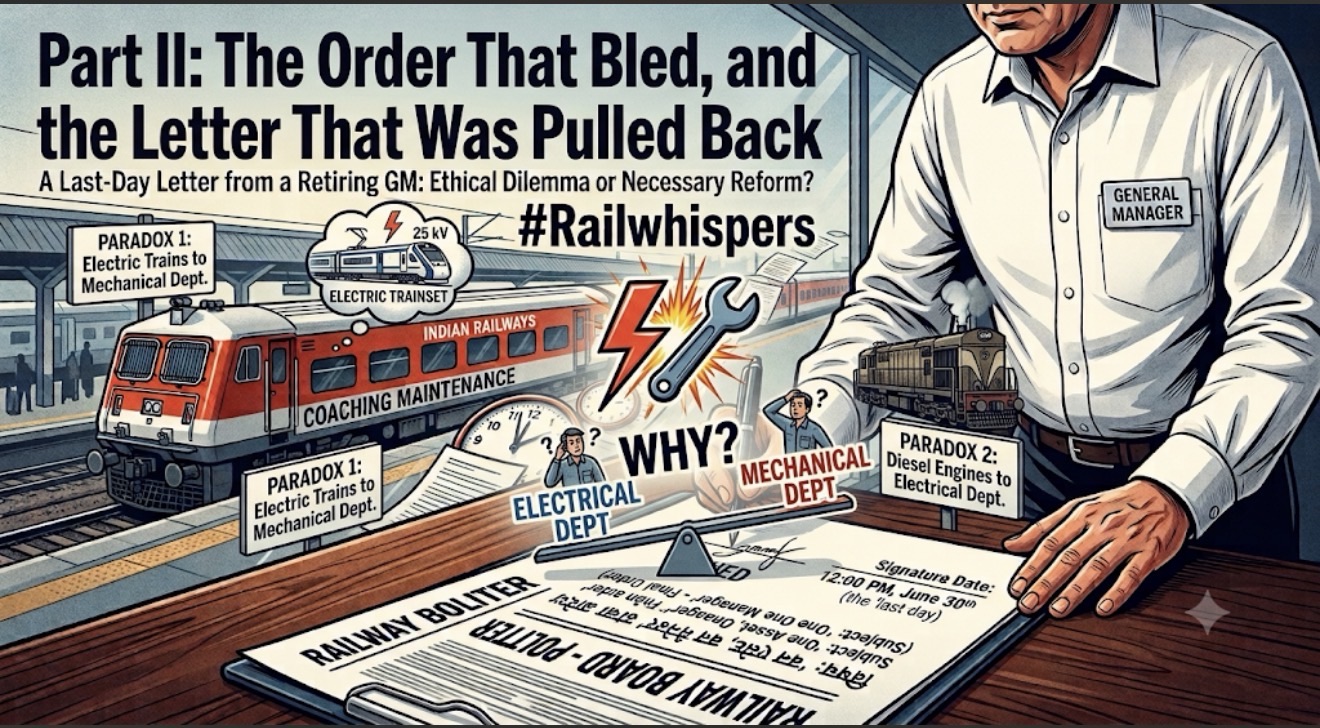
Part II: The Order That Bled, and the Letter That Was Pulled Back
A General Manager signs away the electrical department’s last toehold in coaching maintenance and asks the Railway Board to sanction it across all of Indian Railways—doing so with just one working day left in service. As we have maintained before, an officer in the twilight of their tenure has no business altering policy, transfers, or postings. This letter is not a routine administrative decision; it is a revelation.
#Ep225: एक परिसंपत्ति-एक प्रबंधक? ‘रायता’ फील्ड तक पहुंचा! #gmnwr
Office Order 58 of 2016 sounded perfectly clean on paper: locomotives to the electrical department, coaches and wagons to the mechanical department. The trouble is that rolling stock does not sort itself so neatly, and the order produced two glaring paradoxes that the railway is still paying for today.
Also Read-Part-I-: “One Asset, One Manager? The रायता Reaches the Field”
Apply the principle and watch it break immediately. A diesel locomotive is a locomotive, so under this rule, it goes to the electrical department—even though a diesel engine is about as mechanical a machine as the railway owns. Meanwhile, a trainset is a passenger vehicle, so it is filed as a coach and handed to the mechanical department—even though it is electrically propelled, runs on 25 kilovolts, and has been built, maintained, and indigenized by electrical engineers for the better part of a century. The order took two distinct assets where vehicle category and propulsion technology point in opposite directions, and in both cases, it chose the wrong master. Diesel engines went to the electricals; electric trains went to the mechanicals. If a schoolchild drew it this way in an exam, we would mark it wrong.
The railwaymen’s federation has been saying exactly this, on the record, for years. They reminded the Board long ago that electric lighting came to Indian carriages in 1902 and air conditioning in 1934, and that the electrical department has owned these systems ever since. They even took the argument further into the realm of law: under statutory regulations, high-voltage installations and the inspections that govern them must be handled by qualified electrical engineers. Put bluntly, the federation’s argument is that handing 25-kilovolt electric traction and high-voltage coach systems to mechanical control is not merely unwise—it actively violates the statutes designed to keep people from being electrocuted. That is not a turf war; that is a safety-and-legality complaint, and it deserves an answer the Board has never properly given.
For nine years, the confusion simply festered. Then, on July 25, 2025, the Board issued a long, winding letter, signed by a Joint Secretary, to operationalize Office Order 58 in granular, manpower terms. Read it, and the paradoxes are no longer abstract—they become convoluted reporting lines. Trainsets, electrically propelled to the very last axle, are to be maintained by mechanical officers under a Coaching wing that reports entirely to the mechanical hierarchy. #EMU and #MEMU stock is left with electrical officers, yet those same electrical officers are made to report upward to the mechanical #PCME.
Meanwhile, diesel locomotives—with all those purely mechanical engines—sit under a Diesel wing reporting to the electrical side. The same letter then orders that inter-departmental postings be settled by consultation between the two departments.
The whole edifice is crisscross: “electrical officers saluting mechanical chiefs for electrical machines, mechanical officers saluting electrical chiefs for diesel engines, and a standing requirement to coordinate across the divide at every single turn.”
This is the exact document the NWR General Manager now cites as settled law, the precedent he claims his zone is merely following. However, there is an inconvenient fact about that precedent: it never actually settled. Within days of its issuance, the federation wrote formally to the Member in charge, demanding the July 25 letter be held in abeyance and warning of unrest, safety risks, and collapsing morale across the system. The senior-most traction officer of the Board is also reported to have raised serious objections of his own. Consequently, the Board, true to its habit, is reported to have quietly pulled the letter back. We use the word “reported” with care, because no one issues a official press note when Rail Bhawan reverses itself. But the contestation is beyond dispute, preserved on the federation’s own letterhead, dated and public.
Hold that sequence in your mind: a Board letter codifies the ‘One Asset, One Manager’ philosophy in July 2025. The unions revolt, the traction member objects, and the letter is rolled back within a weeks. Then, eleven months later, a retiring General Manager writes to the very same Board asking it to take that exact philosophy—the one its own operational letter could not survive—and impose it permanently on the entirety of Indian Railways. He calls it ‘reform’. We call it reviving a corpse and asking the Board to pretend it never died.
Policies that cannot survive three weeks are not policies; they are experiments that failed in public. And an experiment that failed in 2025 does not suddenly become wisdom just because a mechanical officer signs his name to it again in 2026 on his last day in office. What this bureaucratic tug-of-war costs the railway, and the passenger, is the focus of Part III.
References
Prior railwhispers.com articles drawn upon—
27 July 2025, “The रायता !“
15 August 2025, “The रायता ! Part-II“
Primary documents
- 29 June 2026, GM/NWR letter, “Integration of Passenger Rolling Stock Maintenance,” No. NWR/HQ/MECH/C&W/CHG/3
- 15 July 2024, NWR Memorandum (JPO) No. 52/2024, “Improvement in reliability of Electrical Assets,” especially clauses 20 and 22
- 25 July 2025, Railway Board letter No. 2025/O&M/8/2, “Manpower Management of Mechanical & Electrical officers/staff involved in Maintenance of Train sets, LHB/ICF coaches, EMU/MEMU/DEMUs & Diesel Locos,” signed by Joint Secretary/Railway Board (uploaded)
Corroborating sources - 2 August 2025, AIRF letter to Member (Traction & Rolling Stock), “Request for Revision & held in abeyance of Instructions issued on Manpower Management…“
- 13 May 2019, AIRF DO letter to CRB on cadre control of Mechanical & Electrical staff (Electricity Act / EIG / electrical-engineering history argument)