

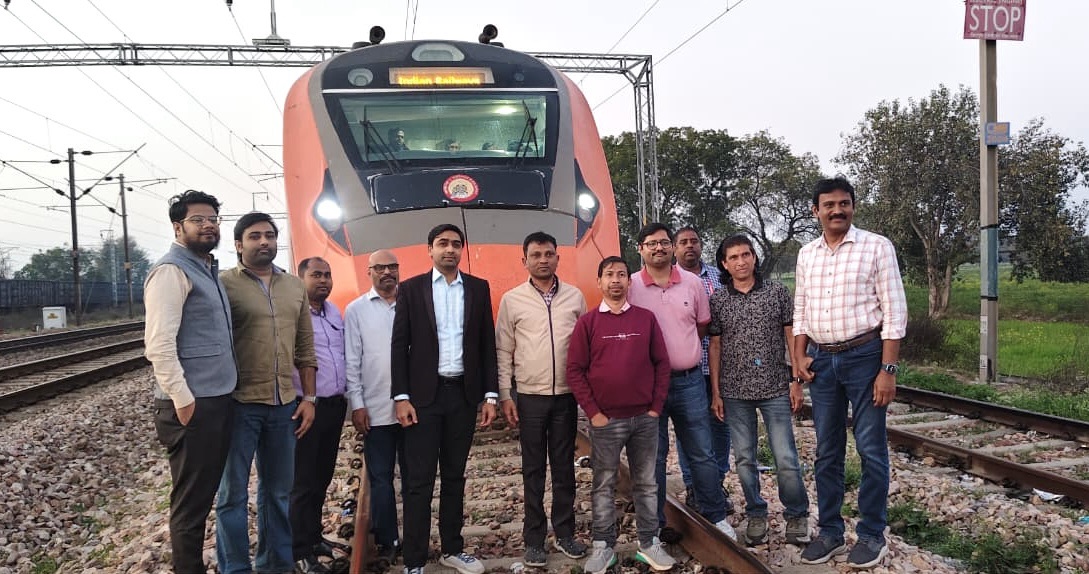
NCR: Successful Trial of ‘KAVACH’ System at 160 kmph on Dadri–Tundla Section
Prayagraj Bureau: Under the guidance of General Manager Naresh Pal Singh, North Central Railway has achieved a historic milestone in the field of rail safety. Successful trials of the indigenous Automatic Train Protection (#ATP) system, ‘#KAVACH’, are being conducted at a high speed of 160 kmph on the Dadri–Tundla section of the Prayagraj Division.
A significant phase of this trial series was completed today, February 14, 2026, involving a 20-coach Vande Bharat Express rake. The performance of the system was evaluated under high-speed operating conditions, yielding precise results in speed supervision and automatic braking intervention at 160 kmph.
Following the successful trials with the Vande Bharat rake, the system will now be tested with conventional coach compositions. Detailed trials are scheduled for February 16, 17, and 18 using WAP-5 and WAP-7 electric locomotives.
These trials are being conducted under an Independent Safety Audit (ISA) in the presence of the Italian safety assessment agency, ITALCERTIFER.
The testing focused on several critical operational and safety parameters:
- Kulwa Loop Line Speed Control Test: Automatically controlling the train’s speed within safe limits while entering the station’s loop line.
- SPAD Prevention: Verifying the system’s effectiveness in preventing ‘Signal Passing At Danger’ (SPAD) incidents.
- Failure Scenarios: Testing the system’s response under challenging conditions such as station-to-station and loco communication failures, and the absence of RFID tags.
- Auto-Whistling: Evaluating the automatic whistling feature at level crossing gates.
The objective of these comprehensive trials is to ensure the highest global safety standards before the full-scale implementation of the system. Upon the successful completion of all necessary tests and approvals, regular operations of KAVACH-equipped trains on this section are planned to commence at the earliest.
This technology will not only prevent accidents caused by human error but will also prove to be a milestone in ensuring the safe and punctual operation of trains during dense fog and adverse weather conditions.