

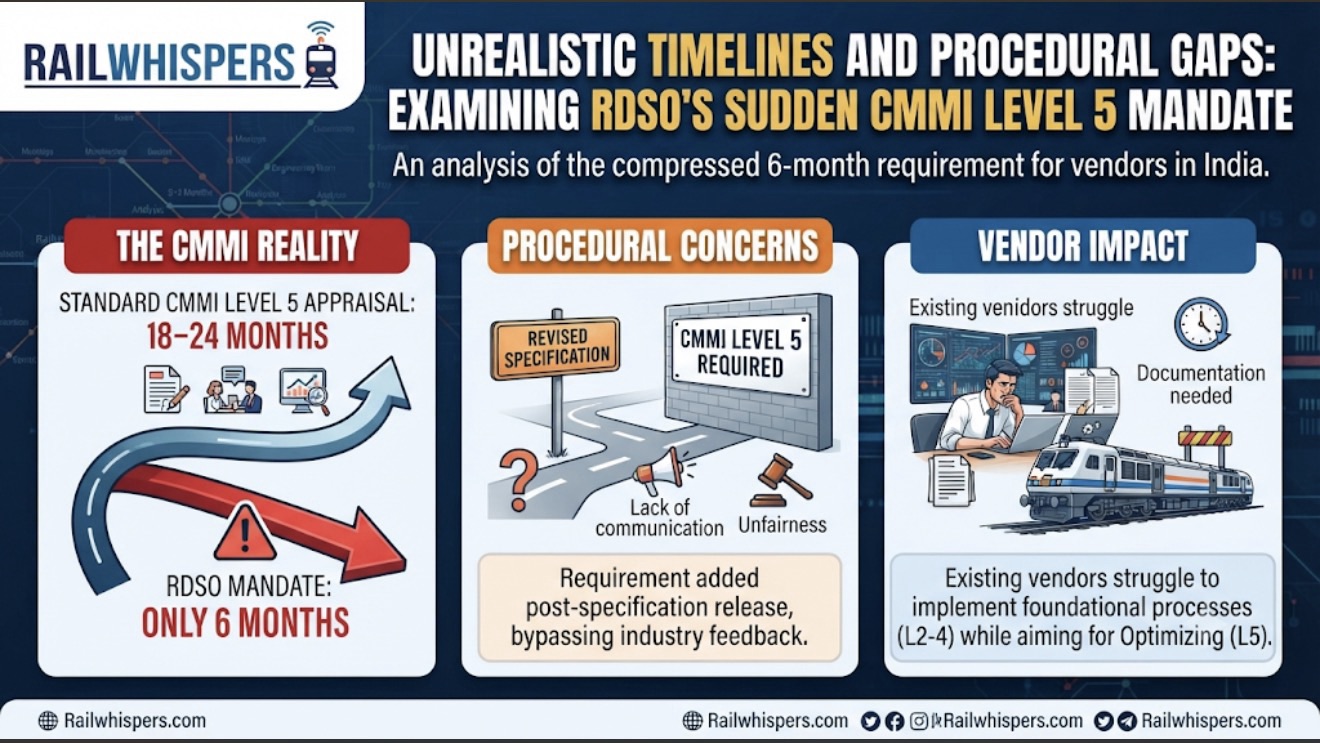
Unrealistic Timelines and Procedural Gaps: Examining RDSO’s Sudden CMMI Level 5 Mandate
How Can RDSO Expect CMMI Level 5 Compliance in Just Six Months?
RDSO’s CMMI Level 5 Requirement: Timeline Realities and Transparency Concerns
RDSO’s Six-Month CMMI Level 5 Mandate Raises Fairness Concerns
In India, organizations are officially appraised (not certified) for Capability Maturity Model Integration (#CMMI) Level 5 (Optimizing) under the Information Systems Audit and Control Association (#ISACA) & CMMI Institute framework (currently CMMI V3.0).
You do not apply to a government body; instead, you engage an ISACA-authorized CMMI Partner and Certified Lead Appraiser who conducts a formal Benchmark Appraisal and submits you’re rating to ISACA’s Published Appraisal Results Site (PARS).
Step-by-Step Appraisal
Process-1. Define Scope and Model Domain: Months 1–2. Choose the CMMI V3.0 domain that matches your business—typically Development (DEV) for software/hardware engineering, Services (SVC) for IT/managed services, or Supplier Management. Decide which specific business units, delivery centres, and live projects will be included in the appraisal boundary.
Process-2. Engage a Consultant and Certified Lead Appraiser: Keep consulting and appraisal independent. Hire an implementation consultant (optional but standard) to build your processes, and separately contract an ISACA-certified Lead Appraiser. Under ISACA rules, the person who conducts your formal appraisal cannot be the same consultant who wrote your processes.
Process-3. Conduct a Gap Analysis: Baseline against Level 3, 4, and 5 practices. Map your current workflows against CMMI requirements. Because Level 5 builds directly on Levels 2, 3, and 4, you must satisfy all foundational practices (standard defined processes) as well as high-maturity practices.
Process-4. Build Process Assets and Quantitative Models: Months 3–6. Establish your Organization’s Set of Standard Processes (OSSP), templates, and quality manuals. For Level 5 specifically, deploy Statistical Process Control (SPC), Process Performance Baselines (PPBs), Process Performance Models (PPMs), and Causal Analysis and Resolution (CAR) workflows.
Process-5. Institutionalize Across Live Projects: Months 6–12. Run your active projects using the defined processes. Gather historical quantitative data, run defect-prevention and root-cause sessions, and compile objective evidence (artifacts, metrics, review logs) showing consistent execution.
Process-6. Complete a Readiness Review and Mock Appraisal: 4–8 weeks before the final audit. Train internal Appraisal Team Members (ATMs) and run a full mock audit. Fix any missing artifacts or process non-conformances uncovered during mock interviews with engineers and project managers.
Process-7. Undergo the Formal Benchmark Appraisal: Valid for 3 years upon listing. The Certified Lead Appraiser and ATM team conduct a rigorous on-site/hybrid inspection of project artifacts and interview practitioners, QA leads, and executives. Upon passing, the Lead Appraiser submits the results to ISACA, and your organization is officially listed on PARS for 3 years. Key Requirements, Timelines & Cost Structure in India Factor What to Expect for CMMI Level 5 in India Prerequisite Maturity You do not strictly need a separate prior certificate, though many firms achieve Level 3 first. Jumping straight to Level 5 requires proving Level 2–5 practices simultaneously.
Typical Timeline 18 to 24 months from scratch (or 6 to 9 months if you already operate at a mature Level 3 with historical metrics).
How does RDSO expect vendors to obtain CMMI Level 5 certification within six months of the release of the revised specification?
Furthermore, the CMMI Level 5 certification requirement has been included in the Acceptance Test Format and Type Test Format, whereas this requirement was not mentioned in the officially released specification.
Introducing such a significant eligibility requirement through the Acceptance Test and Type Test formats, without including it in the original released specification, raises serious concerns regarding procedural transparency and fairness to existing vendors.
Any major changes or additional qualification requirements introduced in the specification should have been communicated to all concerned vendors, and their comments and feedback should have been invited before finalising the revised requirements.
Vendors need adequate time to understand, evaluate and comply with new requirements, particularly when they involve a lengthy certification process such as CMMI Level 5. To be continued..